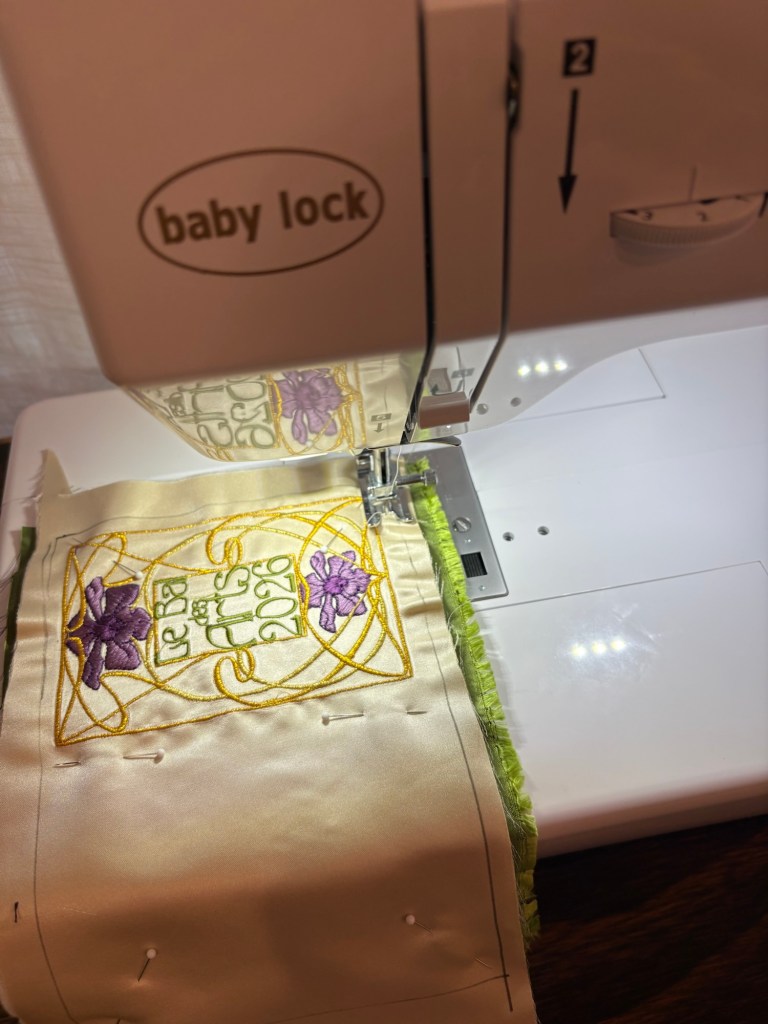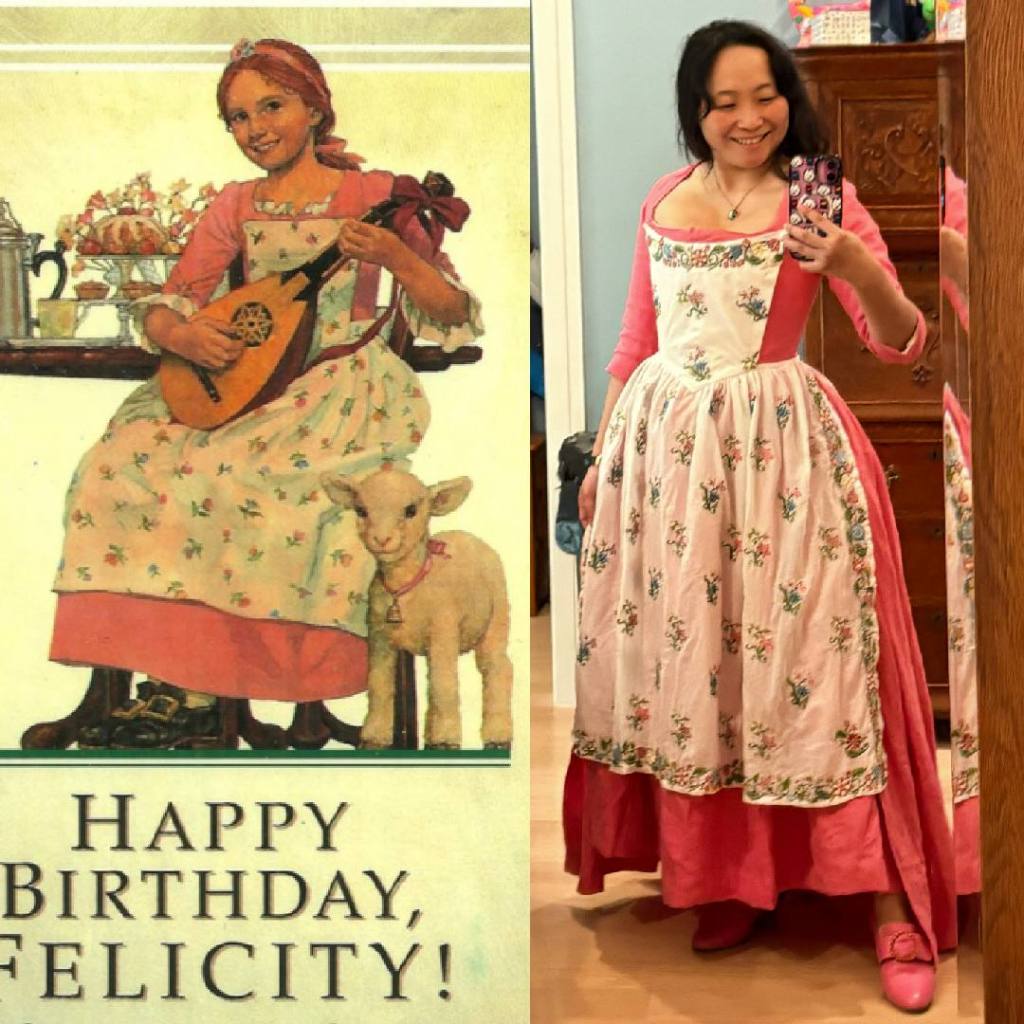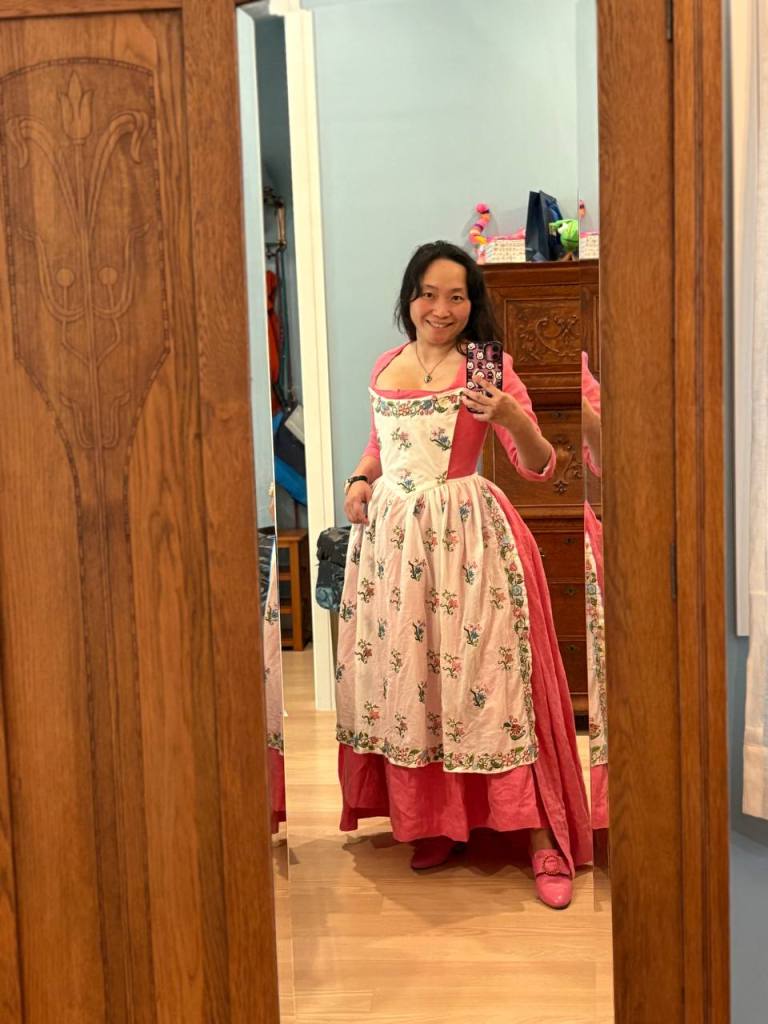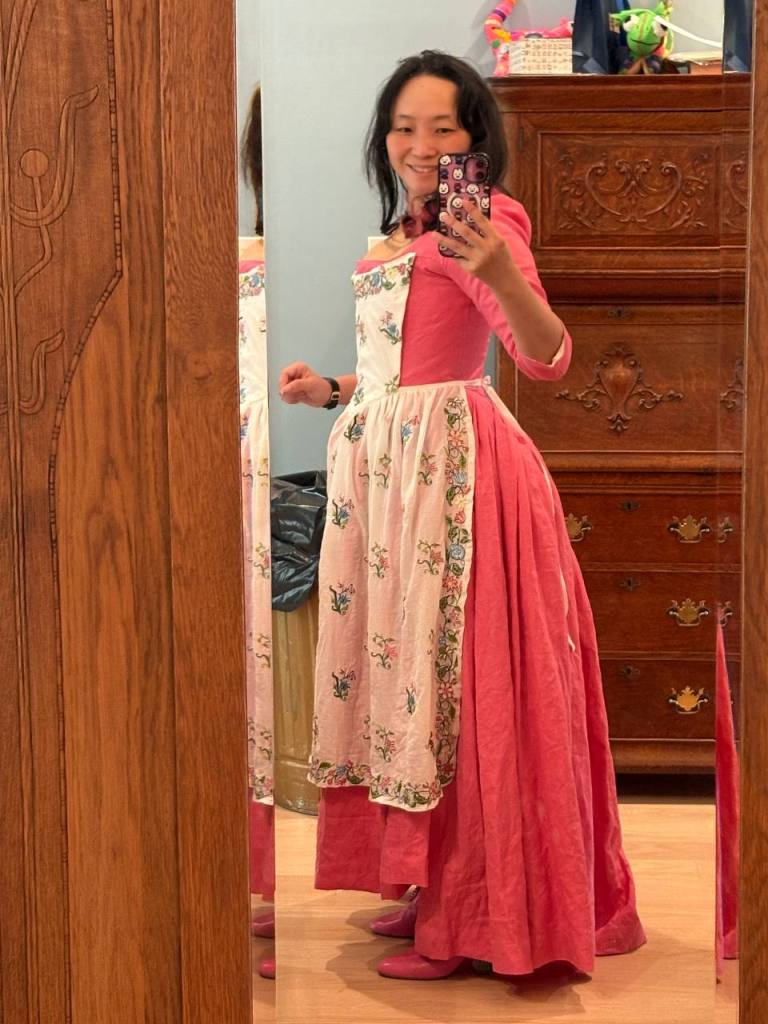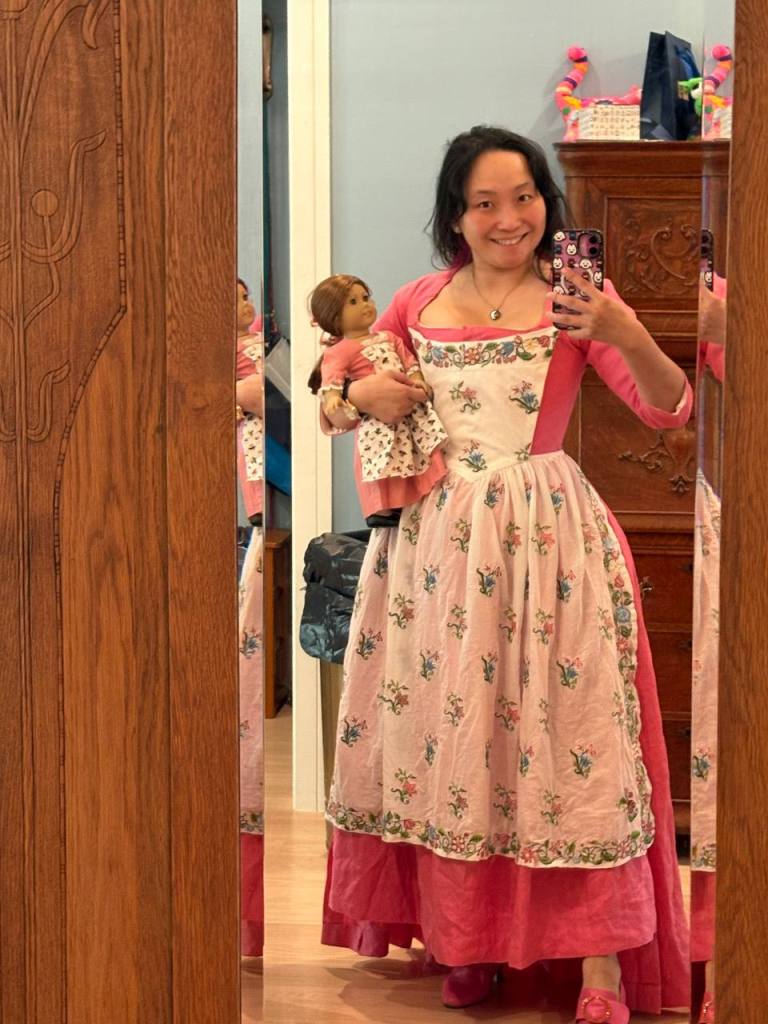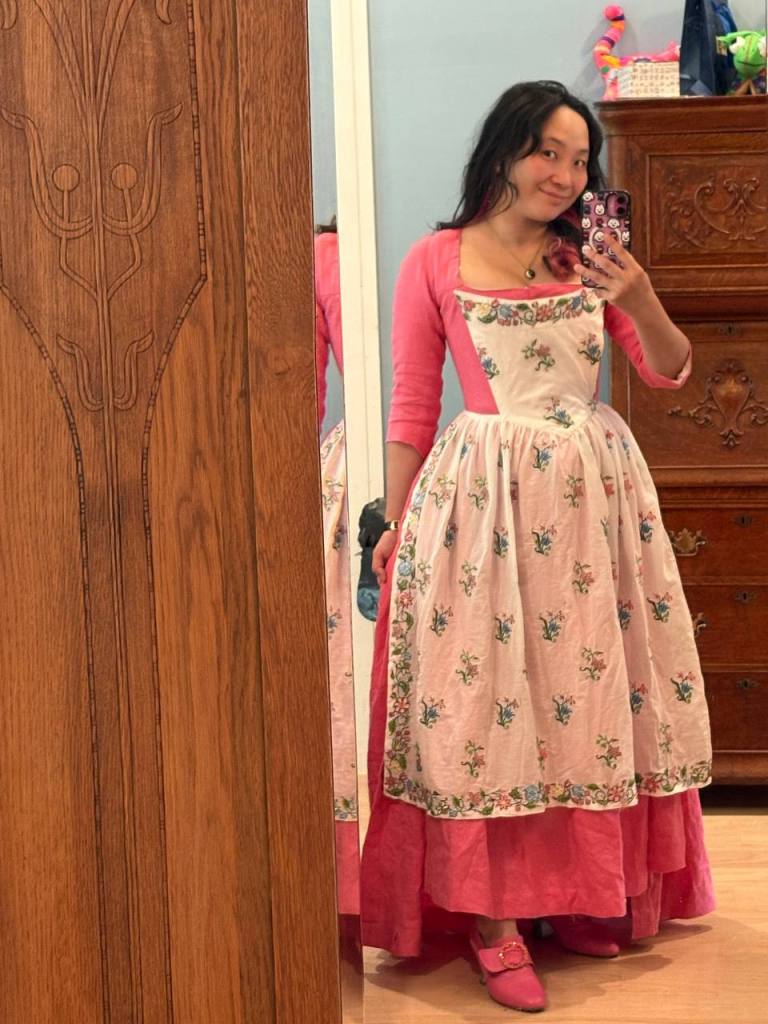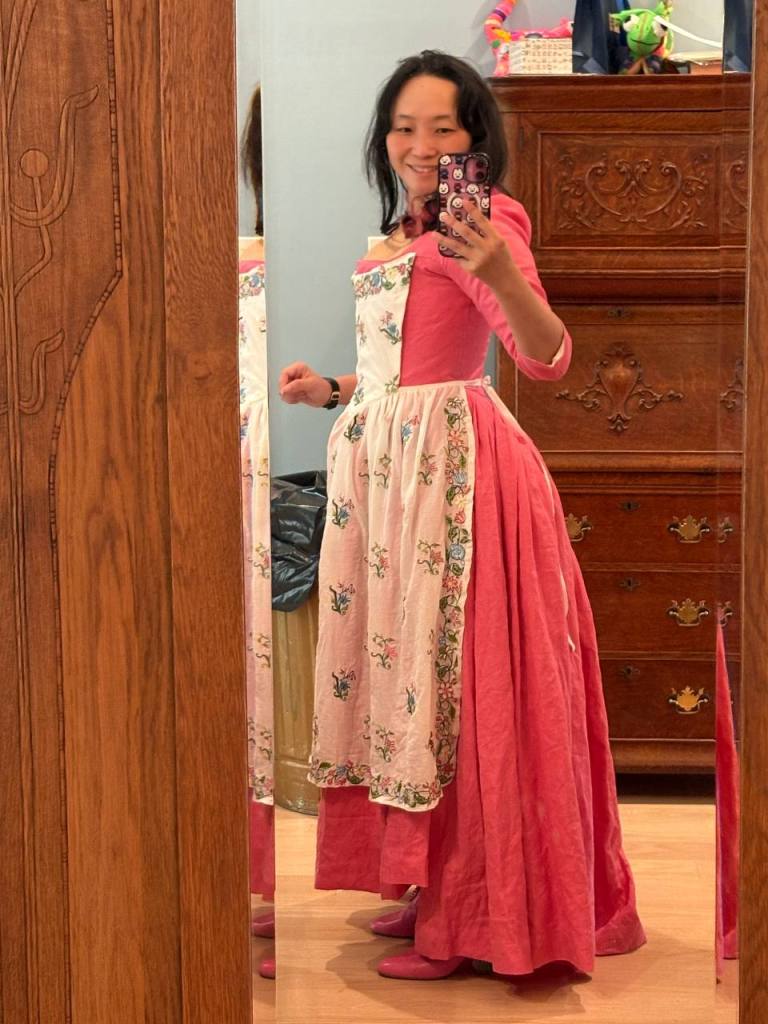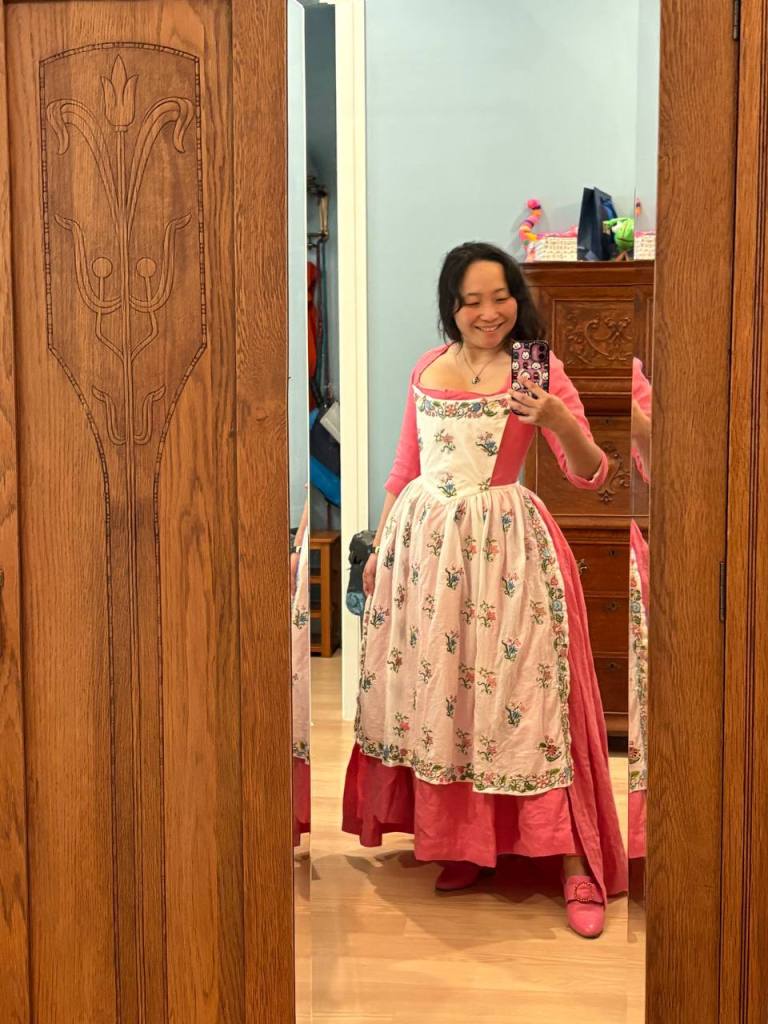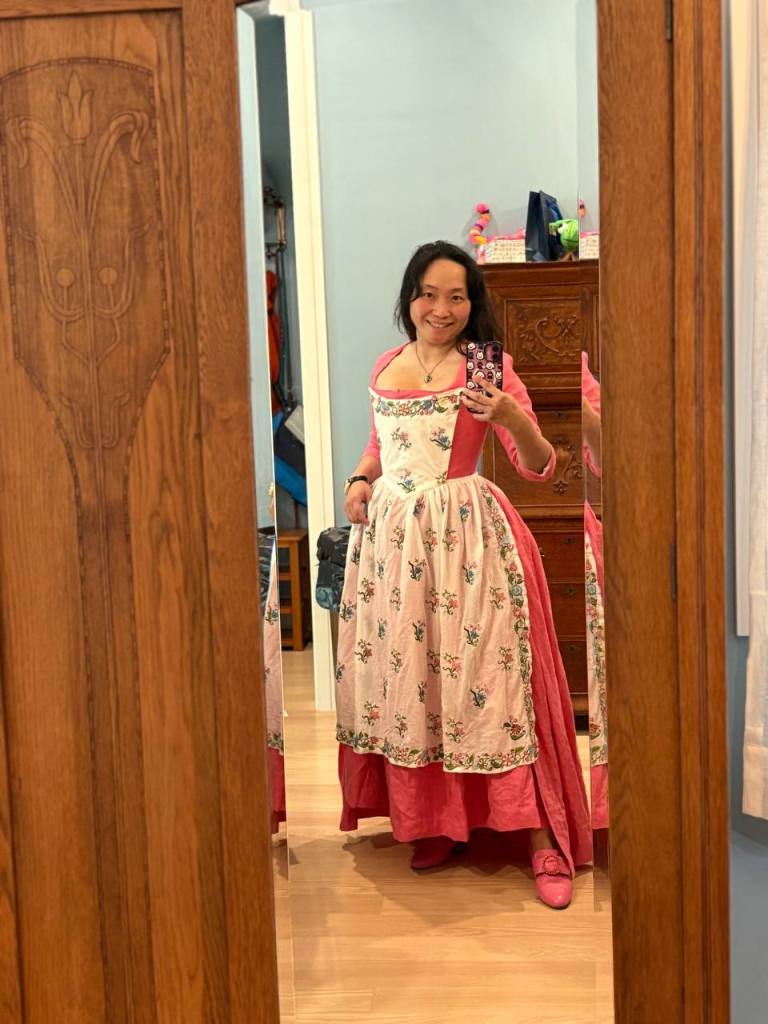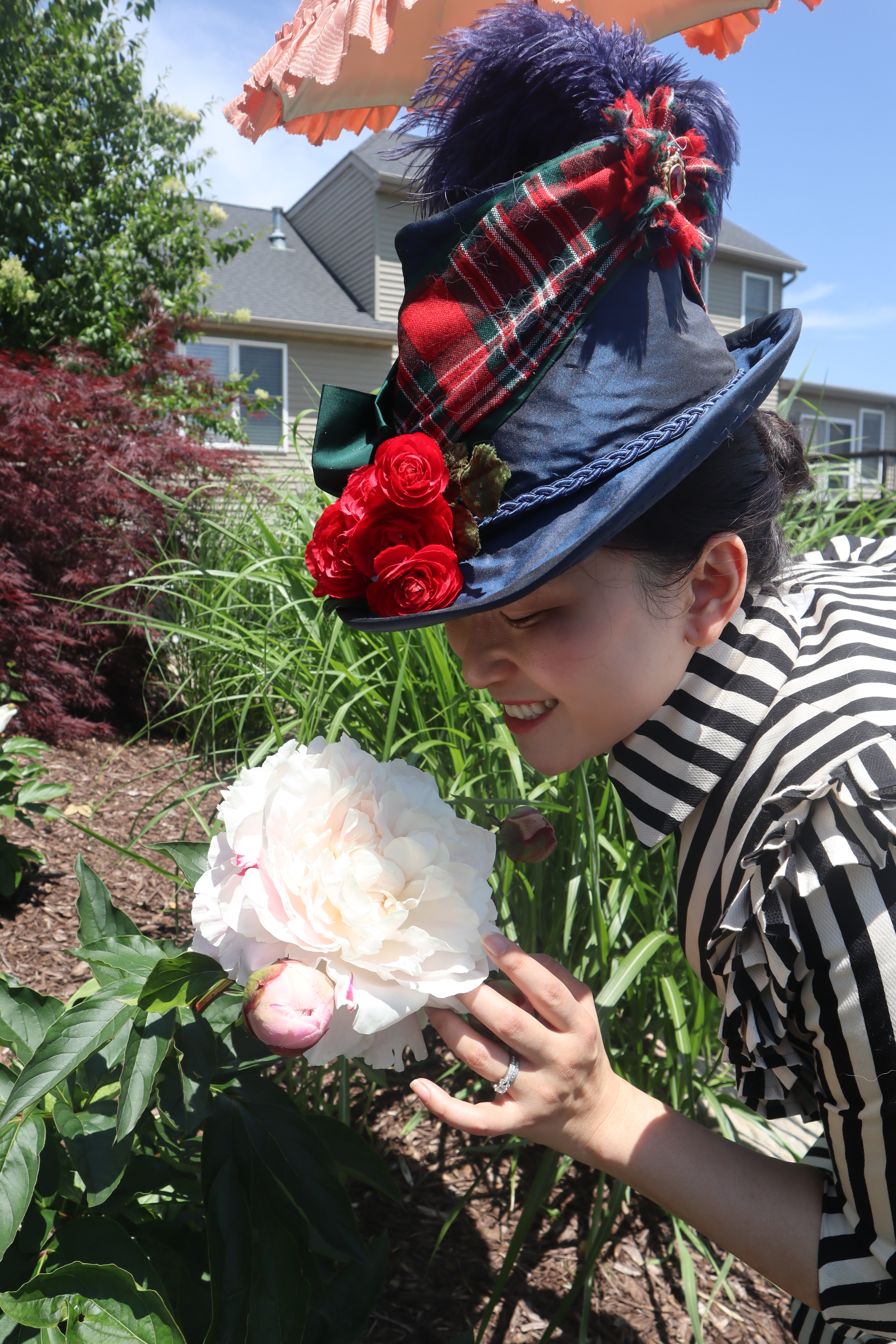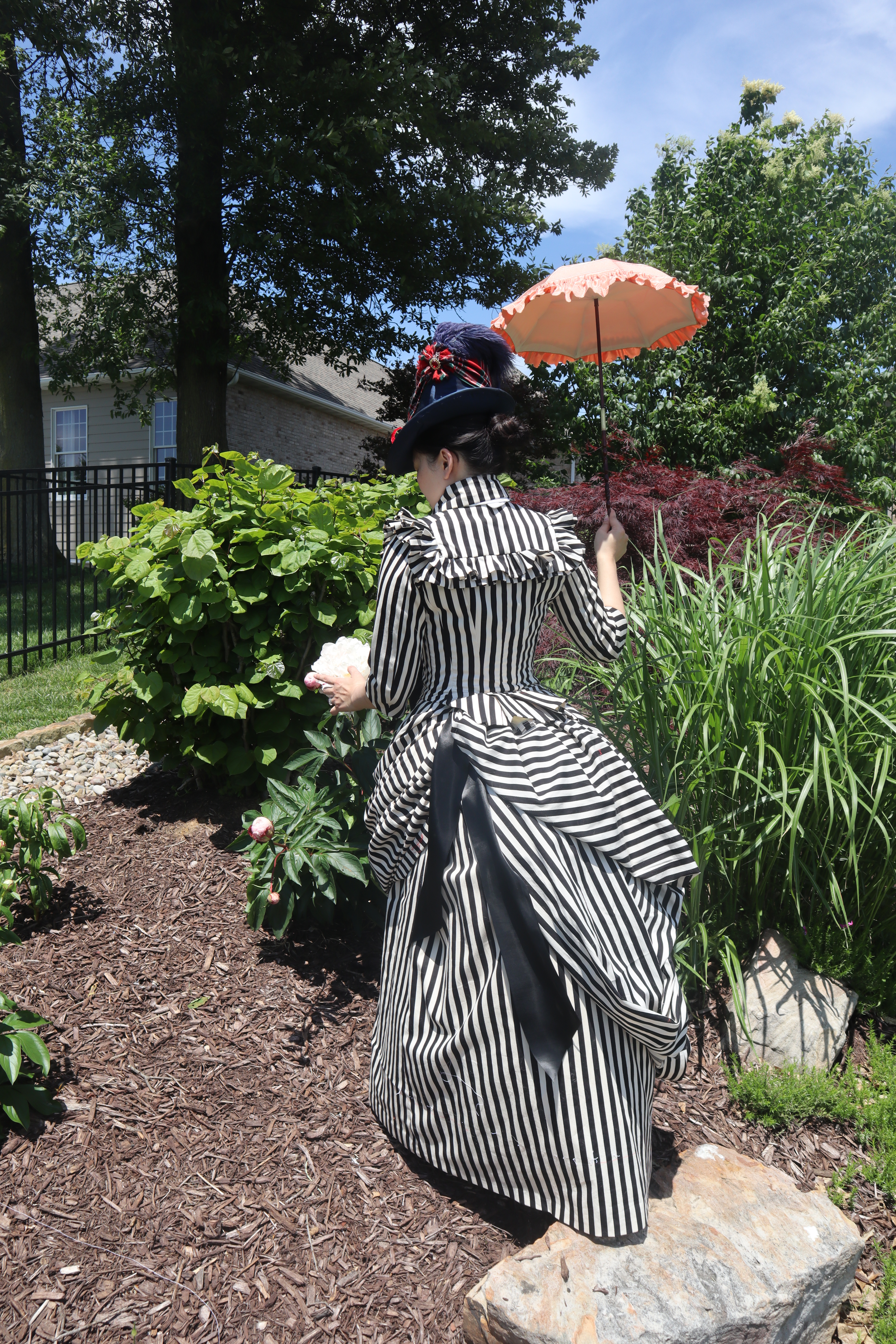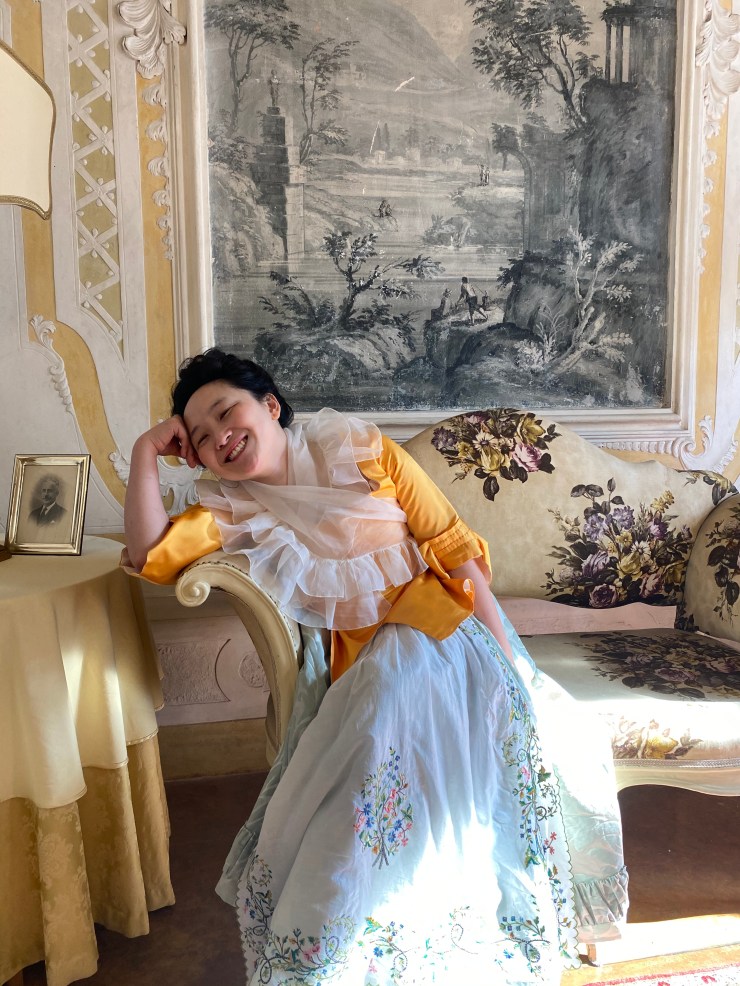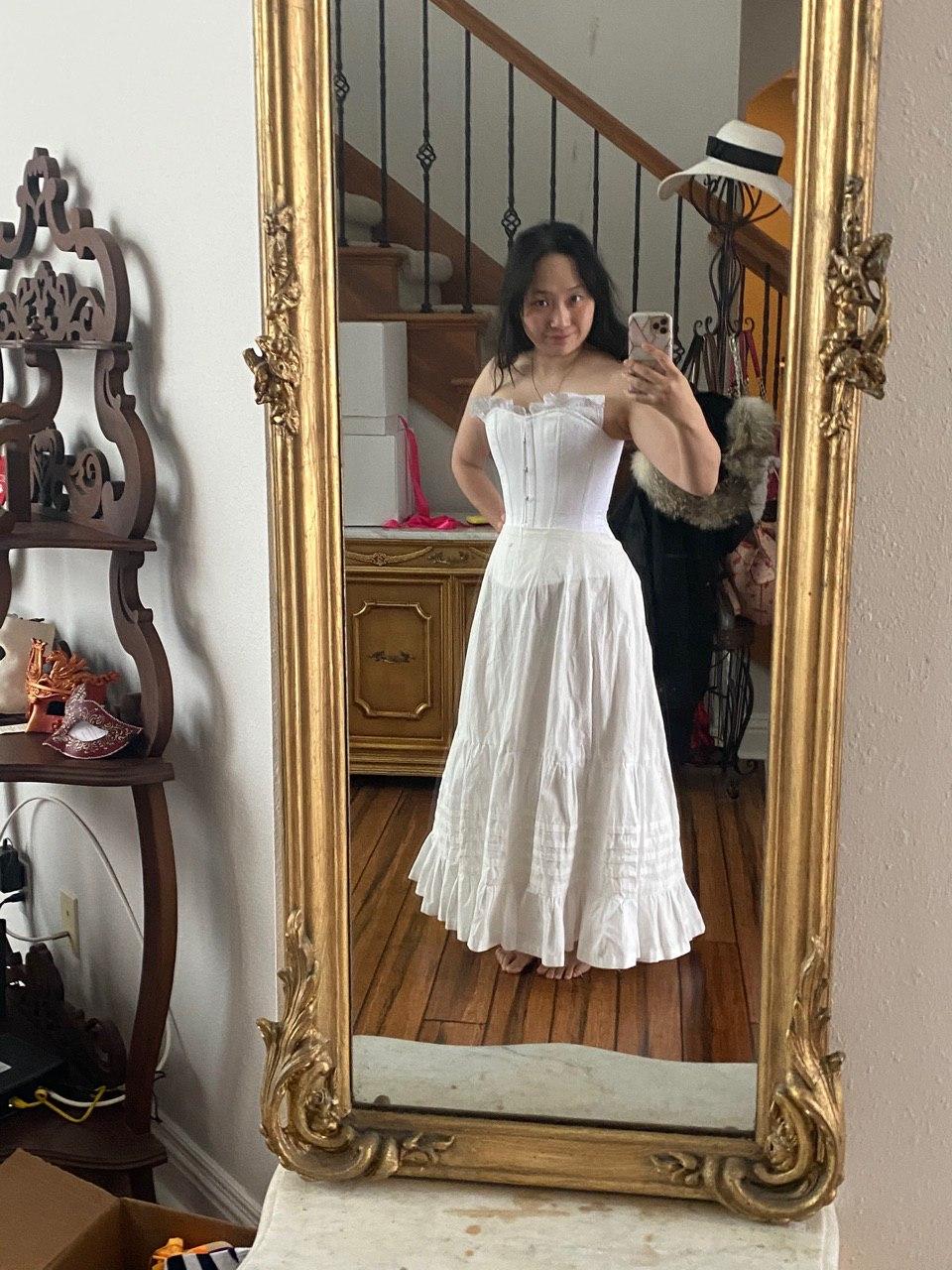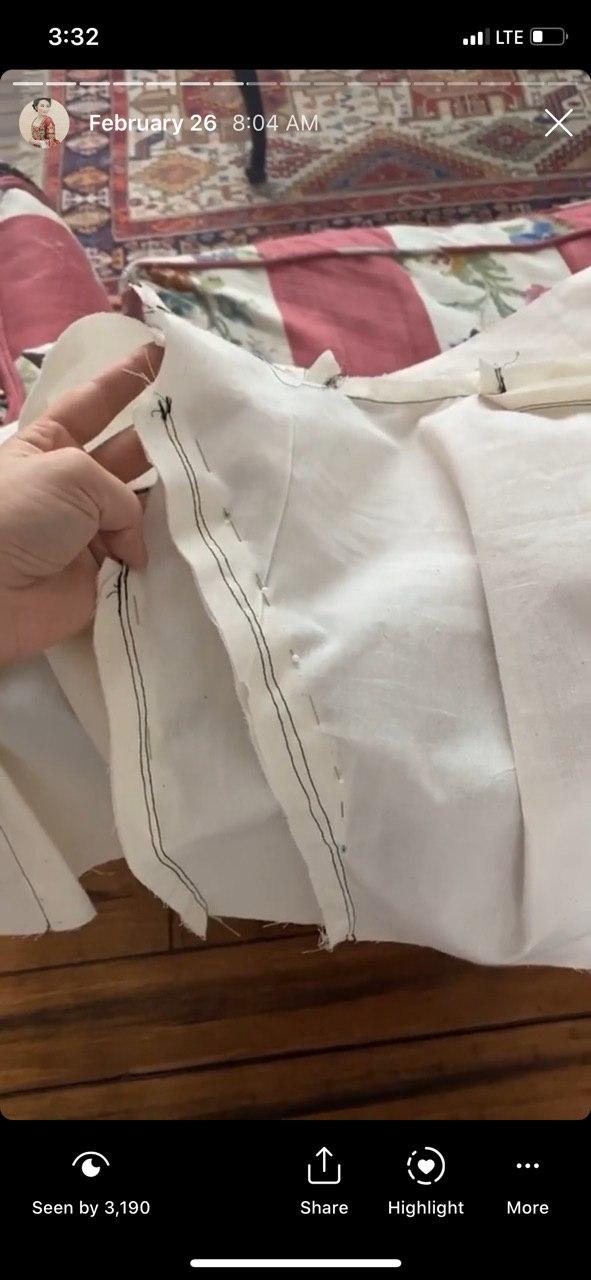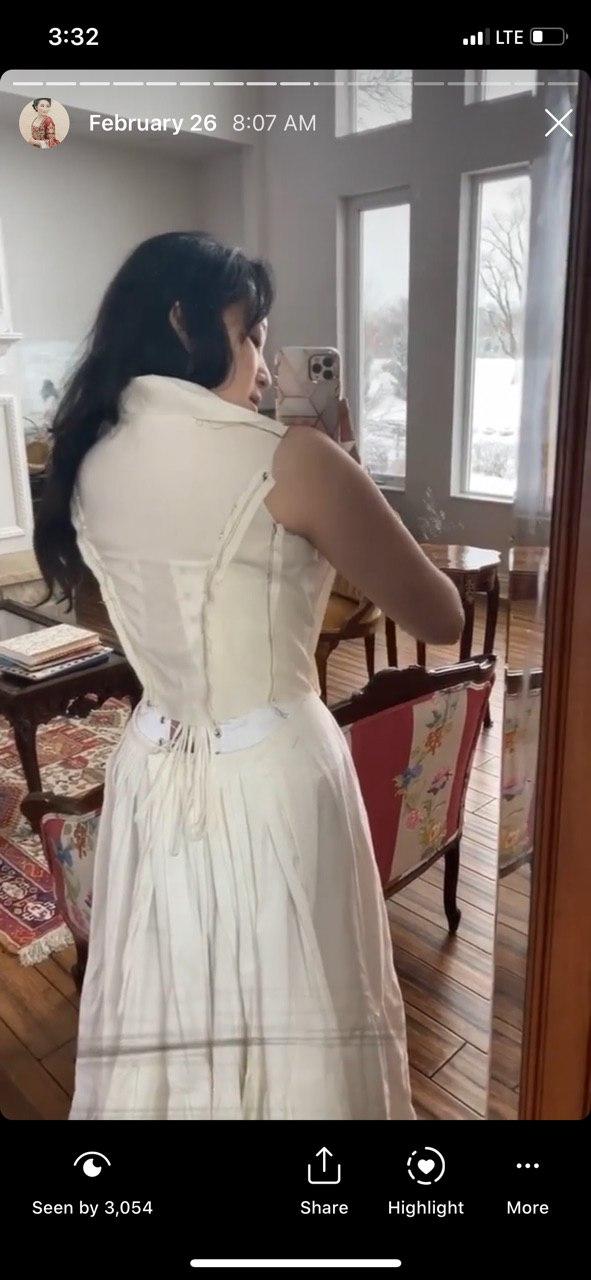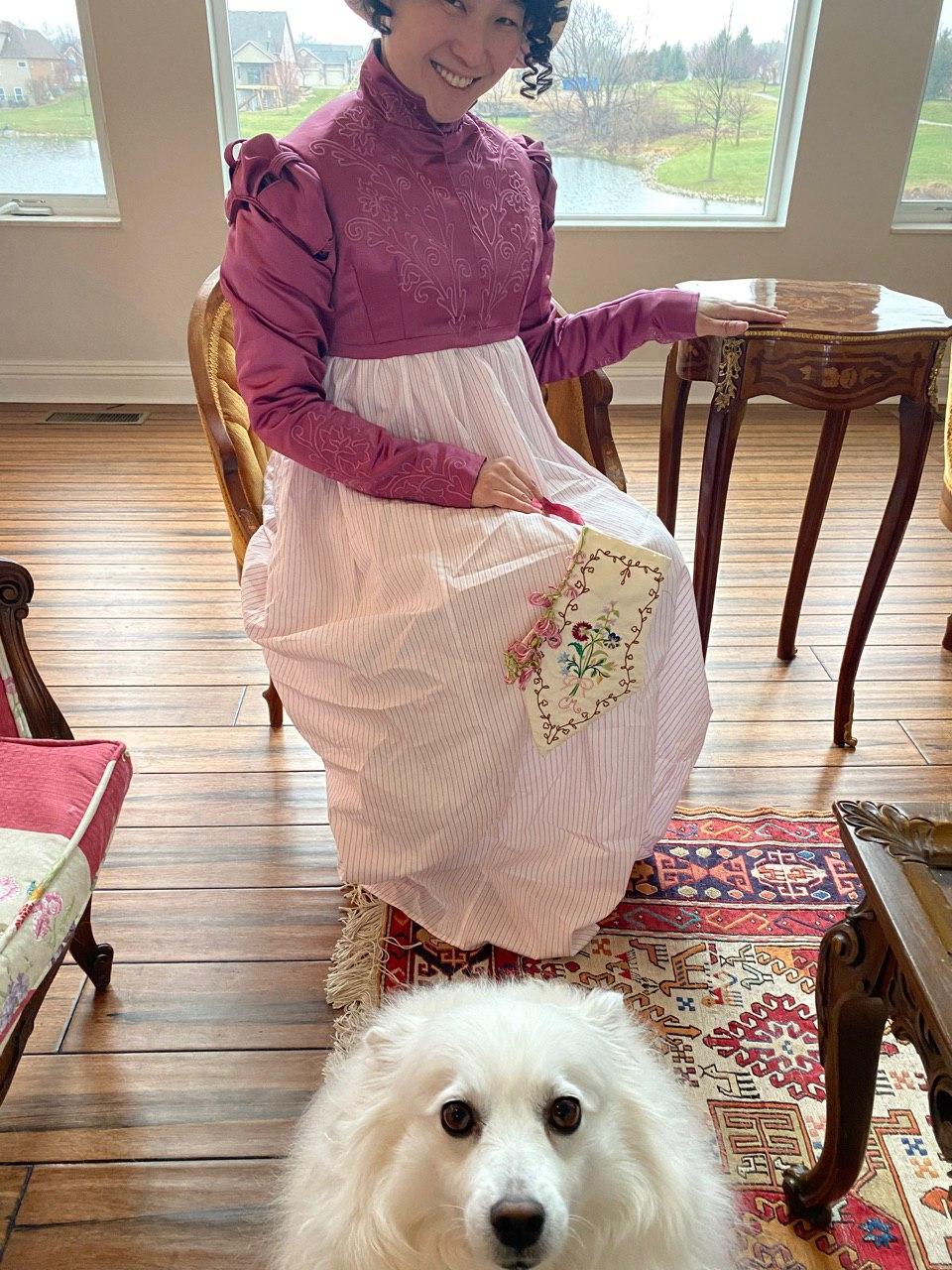
Making Felicity Merriman’s Apron (But let’s make it embroidered!)

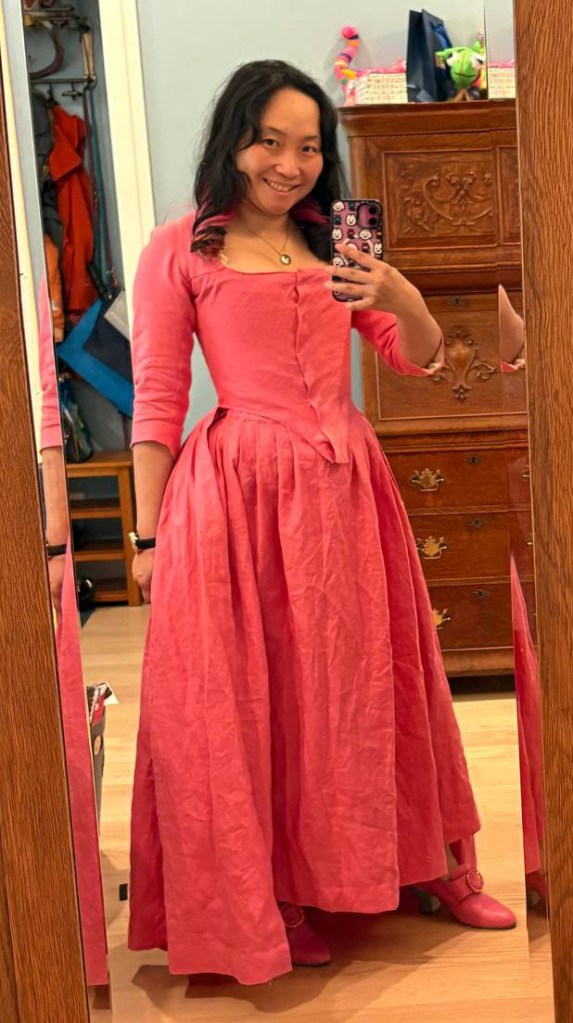
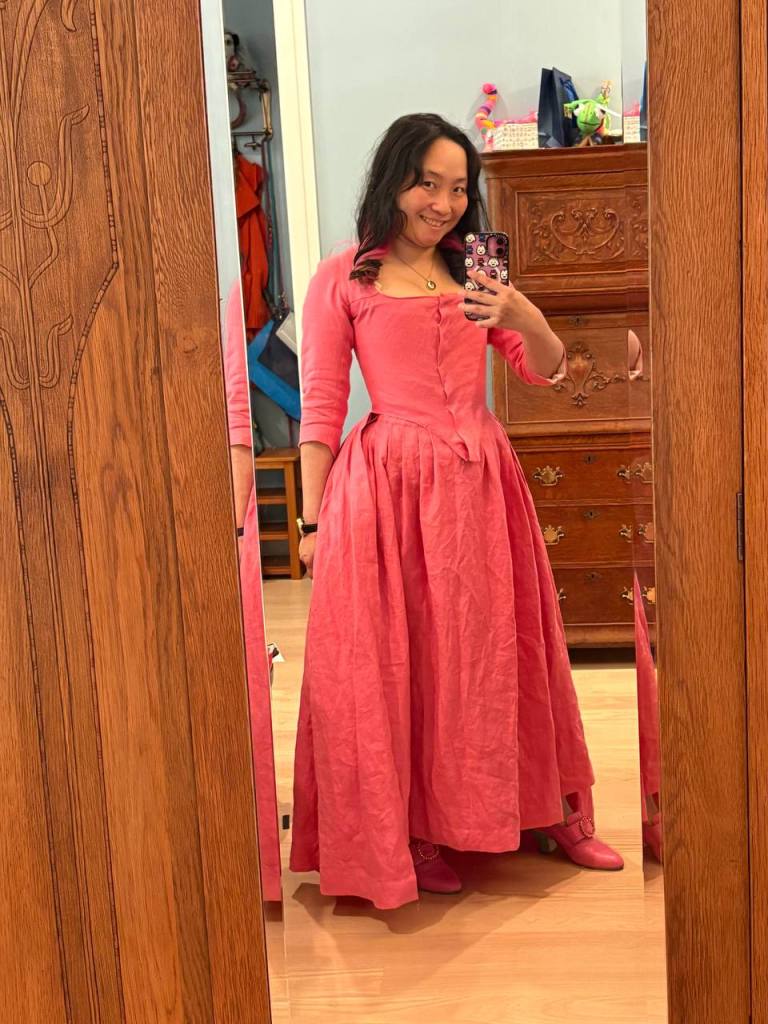
Last month, I put up a post about making Felicity Merriman’s pink dress. The original dress that Felicity wore would probably have been a back lacing gown called a faux gown that was made for children.
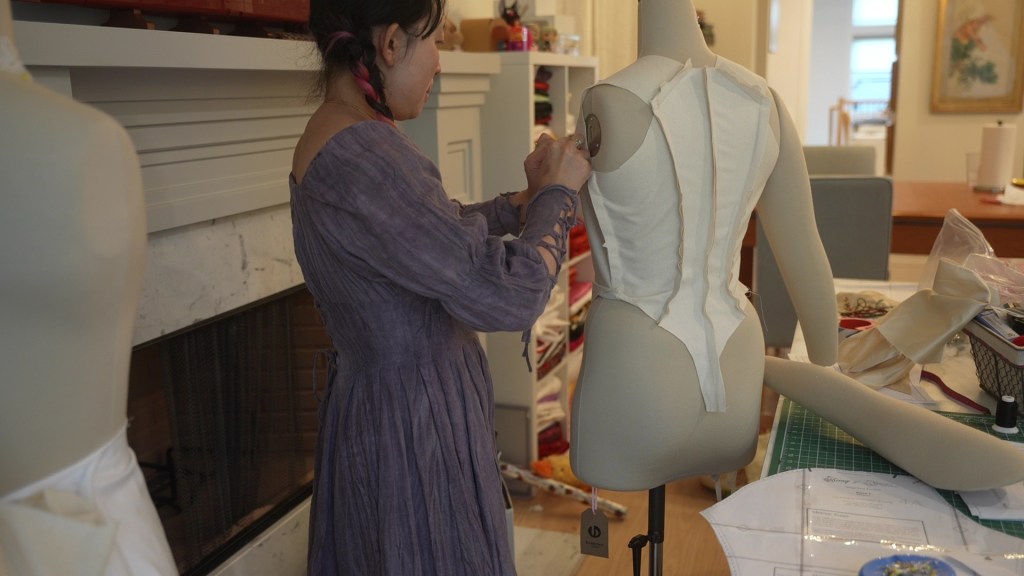
However, since I’m a grown woman, I thought it would be far more appropriate to make an 18th century gown for a grown up. In my case, I chose an Italian gown, (or a 18th century gown that has a single front closure and a split top and skirt sewn together, worn atop a petticoat) as my base. Just keep scrolling down if you’d like to read my blog on making it. Today, we’re going to talk about the apron!

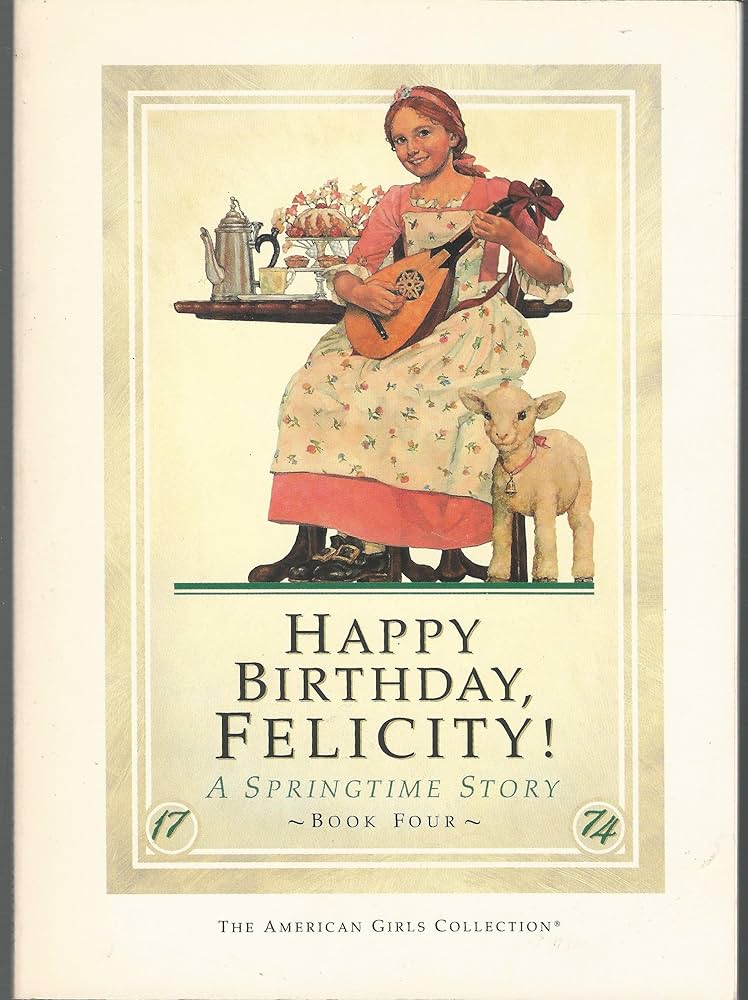
Felicty Merriman, the doll, wears a beautiful printed cotton apron on top of her pink dress. This apron type, in the doll description is described as a “pinner apron”, since the top of the apron is pinned to her dress. This is quite accurate as far as anyone can tell, (though the term pinner apron really is an 1800s term – I’m not quite sure if they called it anything other than an apron) and the doll version even came with little pins to pin it with. Now while pinning aprons to dresses sounds quite unsafe (as we’re talking straight needle pins as safety pins hadn’t been invented yet), this would have been totally ok because the boning of the stays would have prevented the pins from sticking you while you wore it.

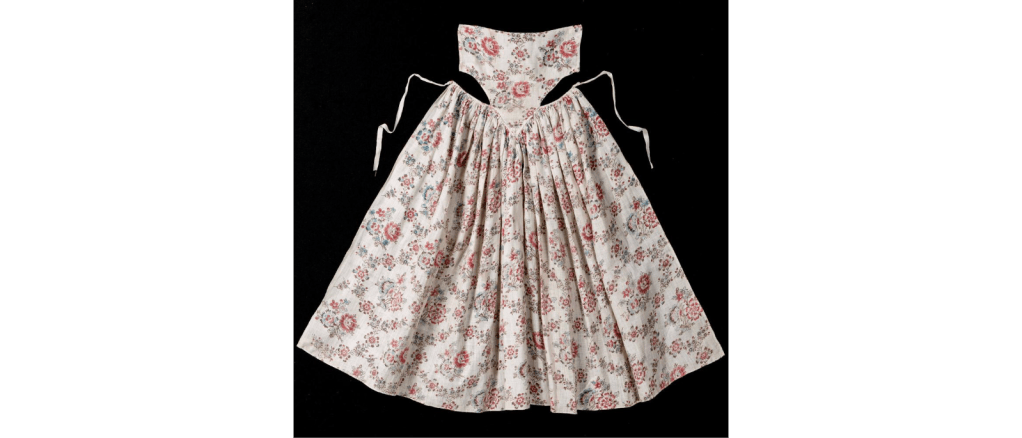
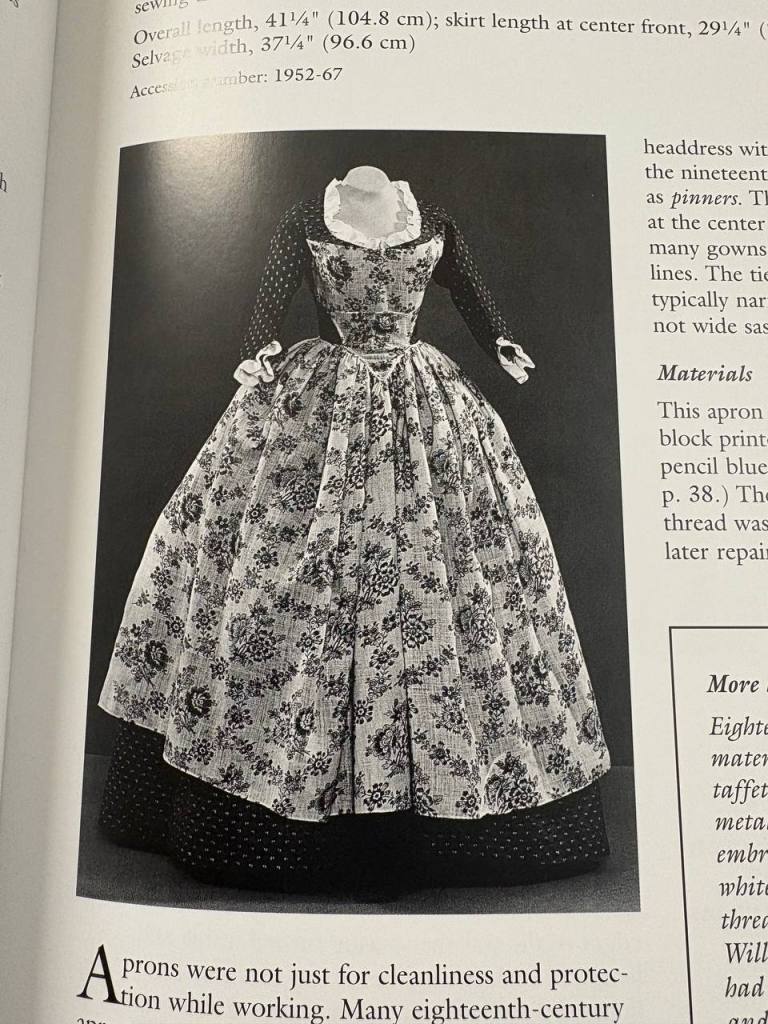
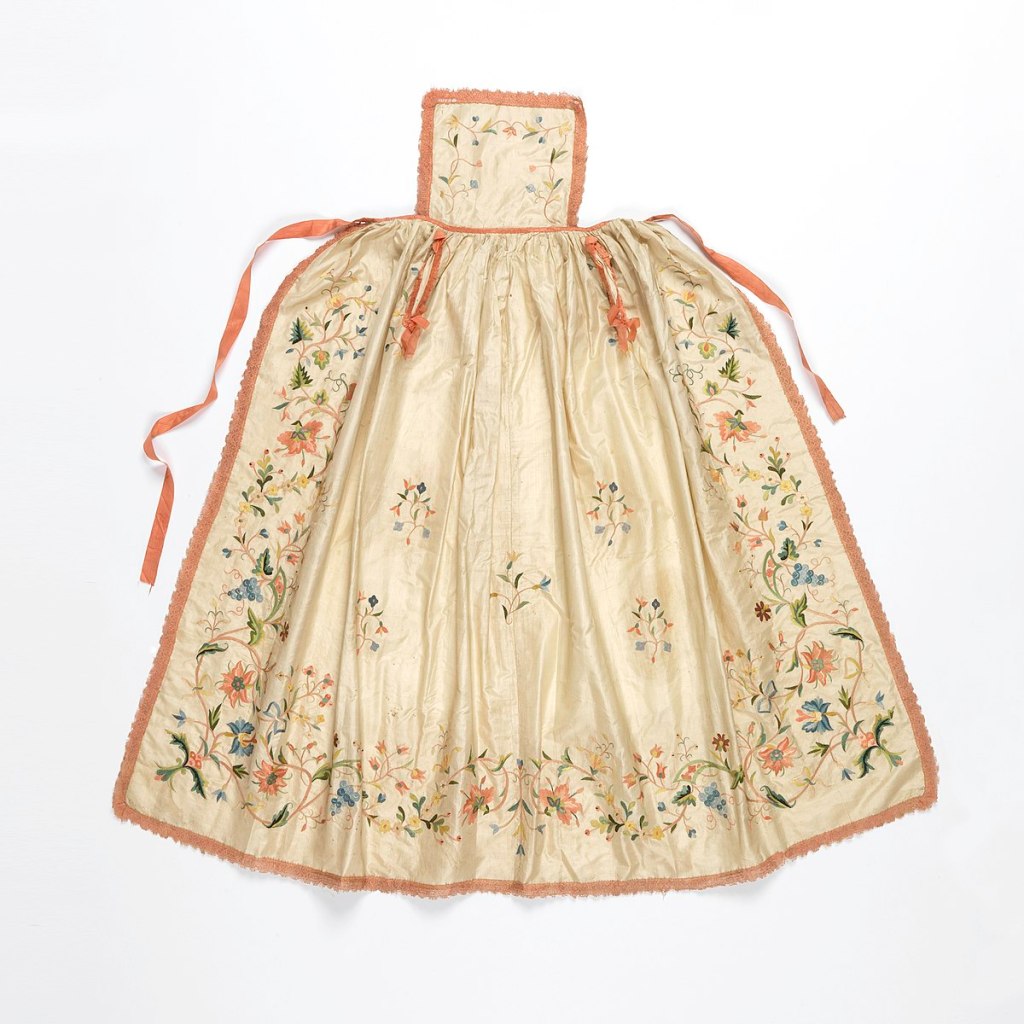
In my opinion, Felicity’s apron was probably a remake of this particular apron in the collection of Williamsburg, since most of her wardrobe was researched from that collection. (Also she lived in Williamsburg and one thing that Pleasant Company did right was research.):

Object number1952-67 Colonial Williamsburg


It’s a printed cotton, it’s a pinner type and the shape is quite full and pretty!

Now aprons weren’t just things that you wore to protect you – though they did that too. They were also often made of silks, decorated with lace, embroidery and other fine things – if they were a decorative apron. This particular apron – and thus, also Felicity’s – was probably a mix of both decorative and useful.

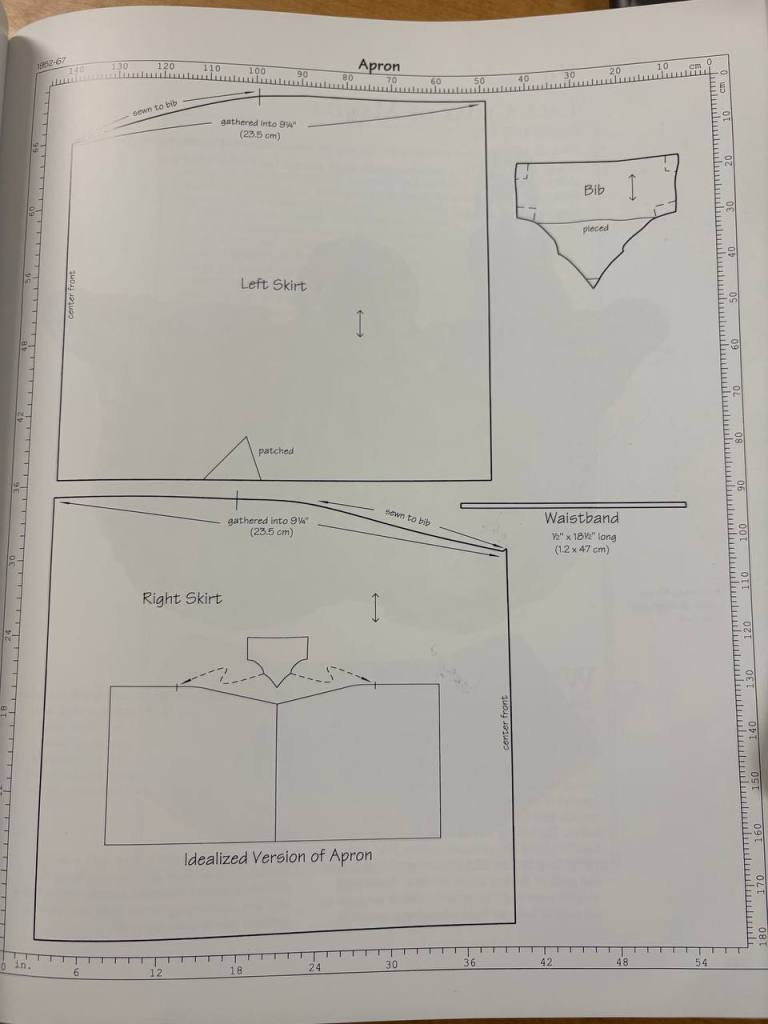
So… fun fact! The pattern for this apron is actually available IN the book “Costume Close-Up: Clothing Construction and pattern 1750-1790” by Linda Baumgarten and John Watson with Florine Carr.

This book is still available for sale, and more information about the apron can be found on page 46 (along with what I think is probably the jacket that inspired the Felicity Learns a Lesson Jacket on page 39. yes. I am also making that next.).

In any case, the pattern for the apron was REALLY cool. What was interesting to me is that the apron had a ton of piecing on the bodice. It’s when you don’t have a single piece large enough, so you sew two smaller pieces together to make it. Secondly, the apron skirt was VERY full. Like 74″ wide! Which explained why it looked so nice and full on the mannequin.

In any case, I recommend picking up the book but here is their pattern:

And it makes a lot of sense.

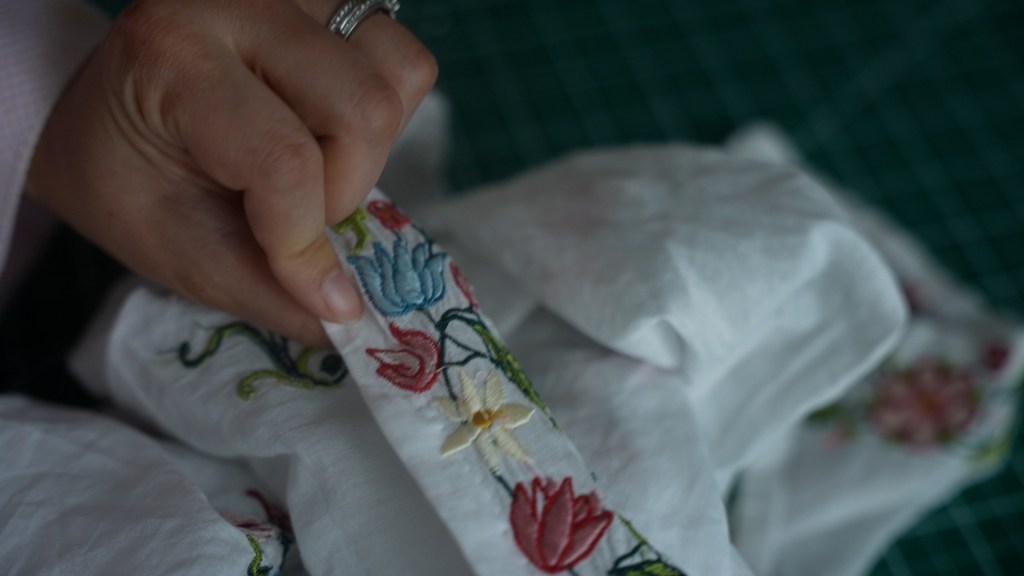
For my apron, I didn’t want a printed cotton. I wanted an EMBROIDERED cotton. Because it’s me.

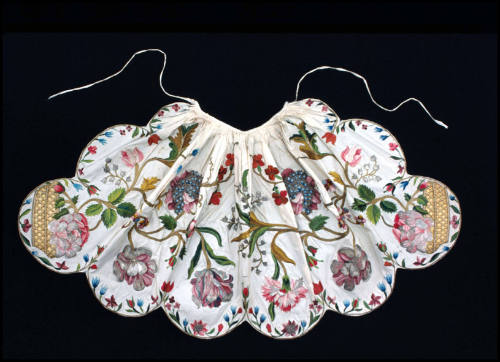
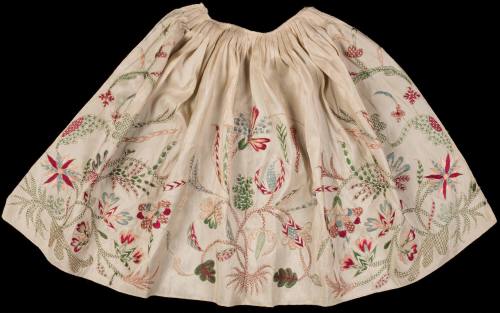
To be fair, there are a lot of examples of embroidered aprons! Here are just a few.

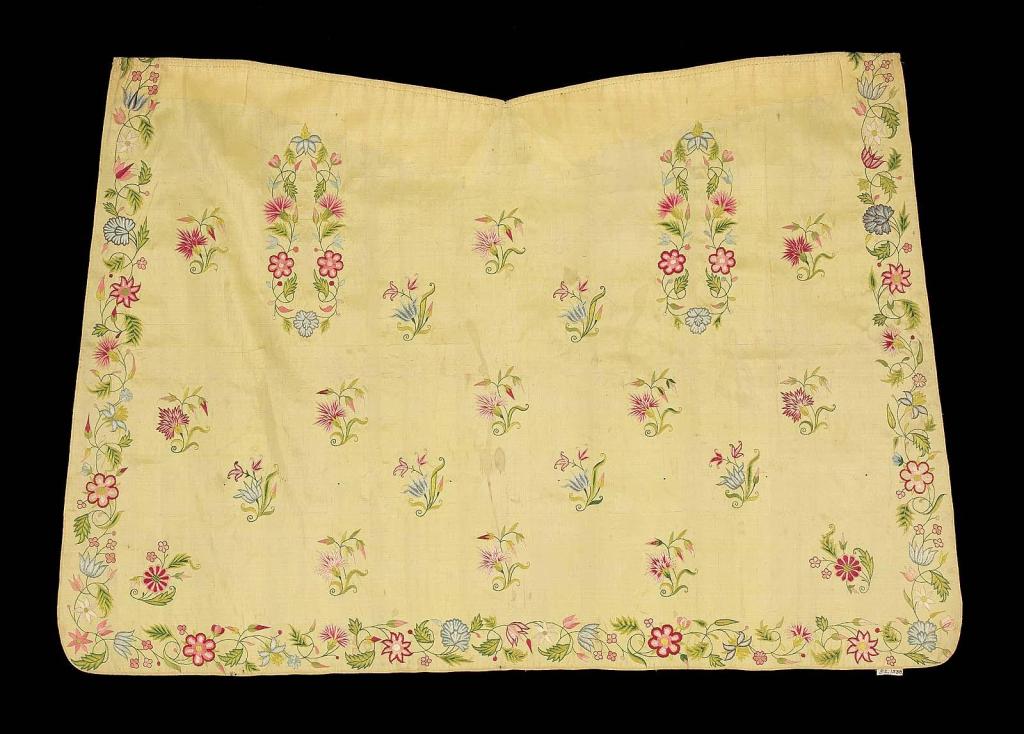
But in particular, there was one apron that I thought was perfect for Felicity’s apron the moment I saw it.

Apron of Yellow Taffeta from MFA Boston 52.1338

This one! This is an embroiddered apron with room to add pockets in the front, (hence those designs that look like ti could handle a slit), and I just thought that the embroidery was just wonderfully whimsical.

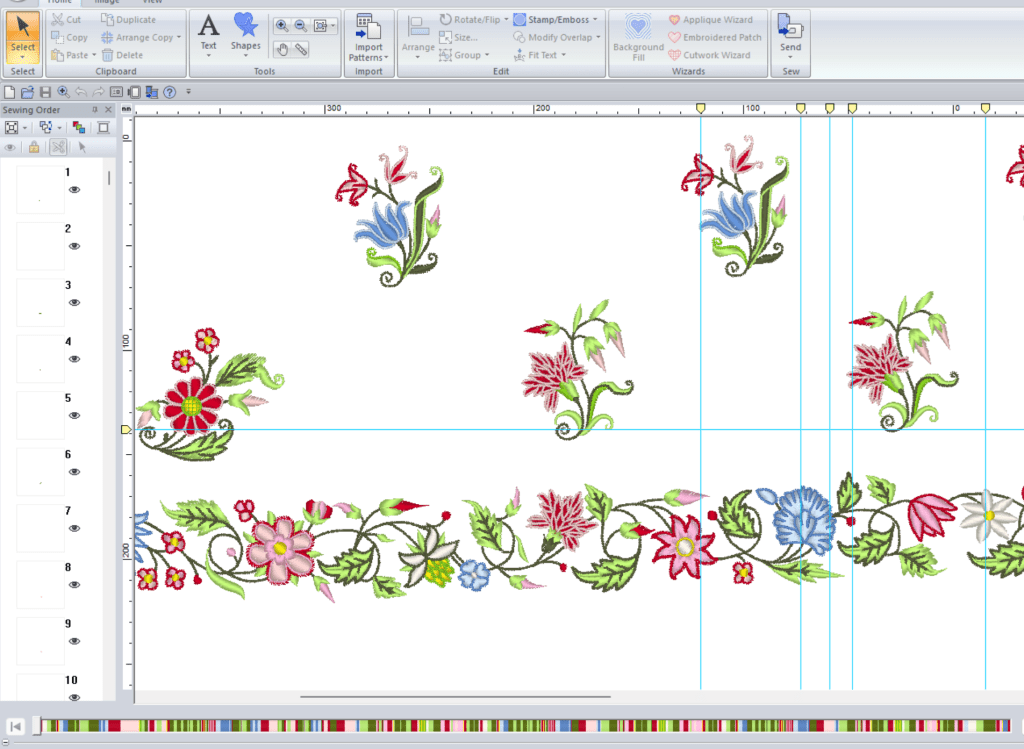
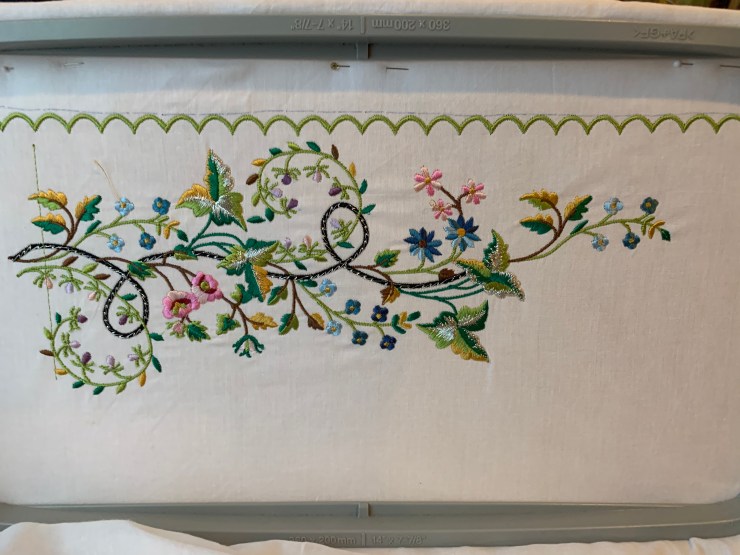
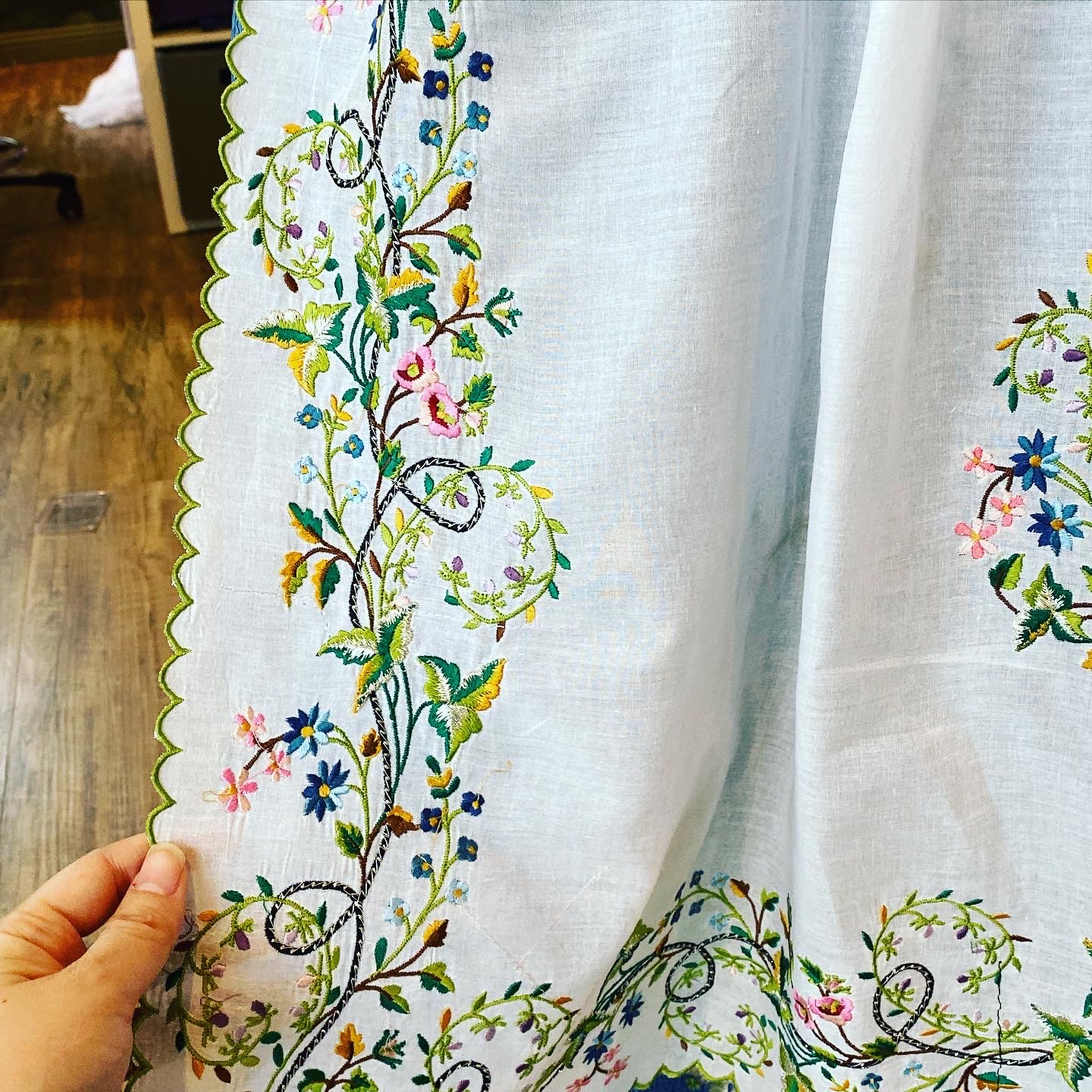
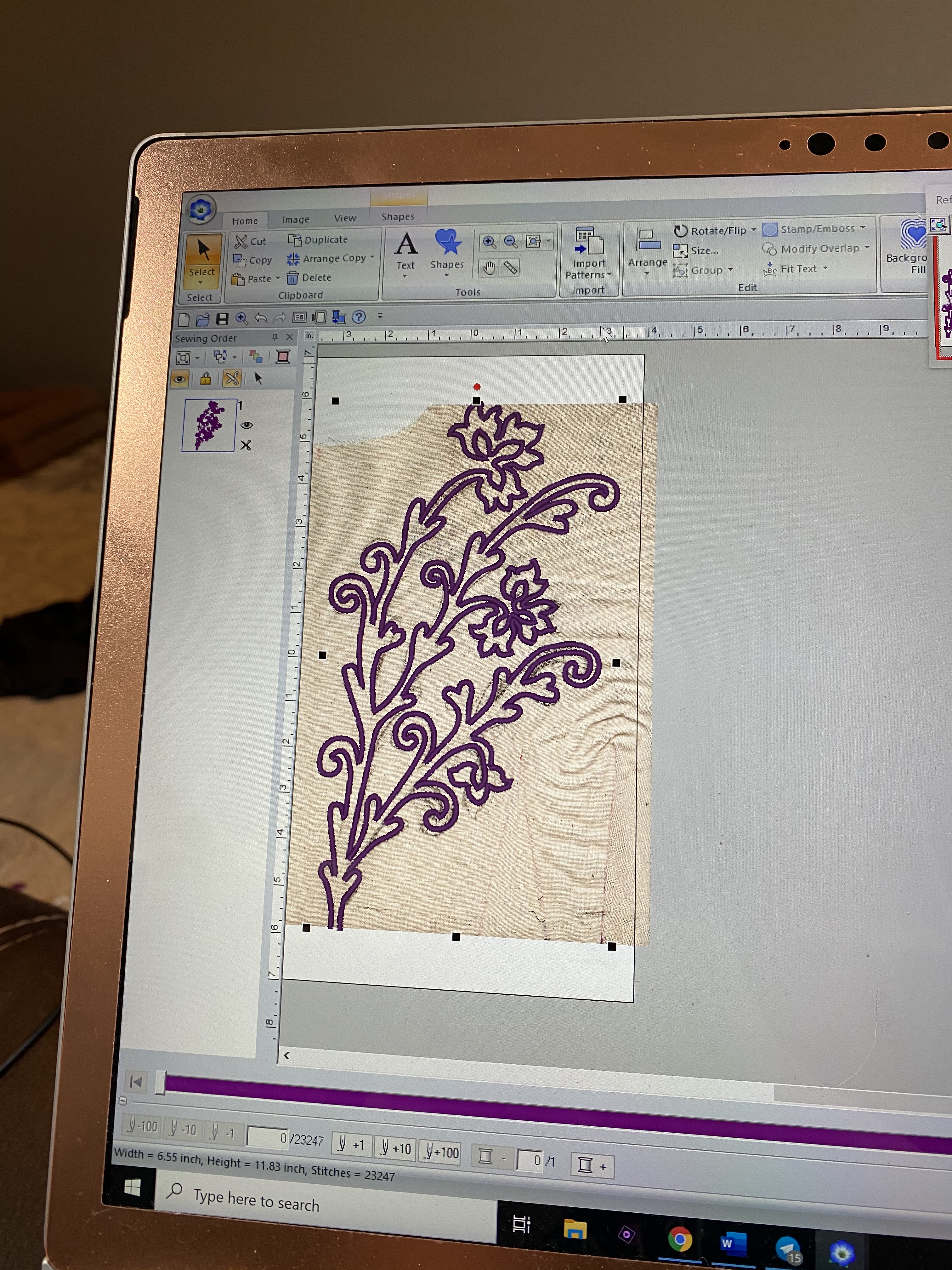
So I went ahead and digitized it all on Palette 11. Honestly, digitizing is a ton of fun – it always feels like just drawing except with thread, and the software makes it easy that if I have a touchscreen (which I do), I can literally just draw what I want.

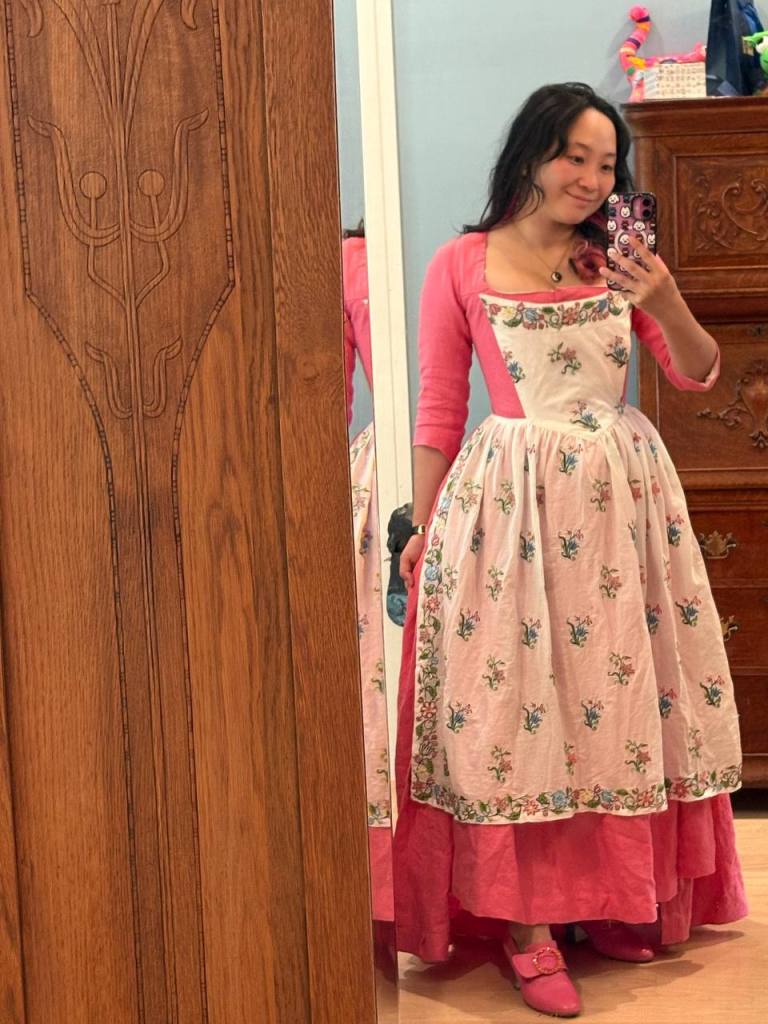
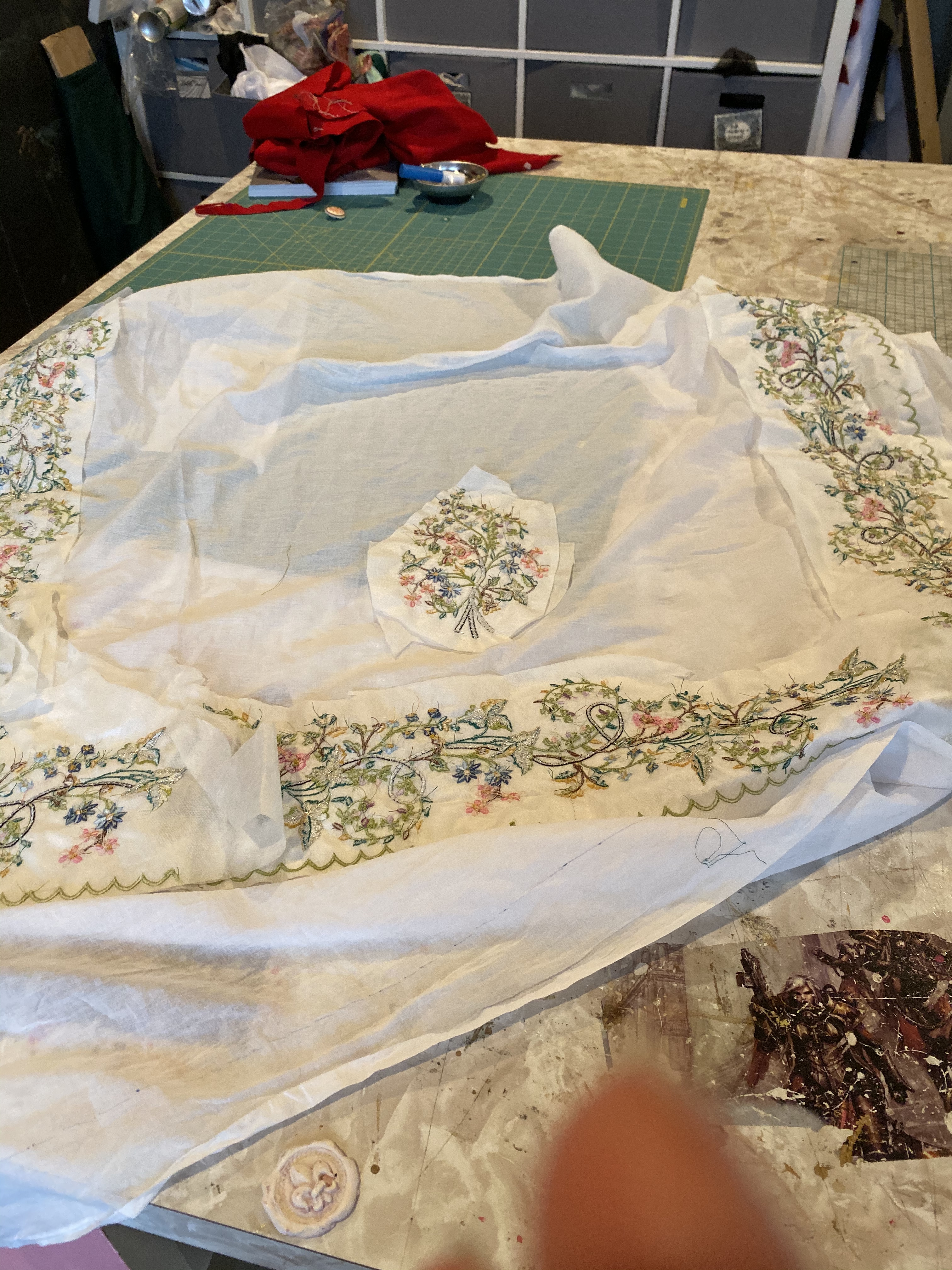
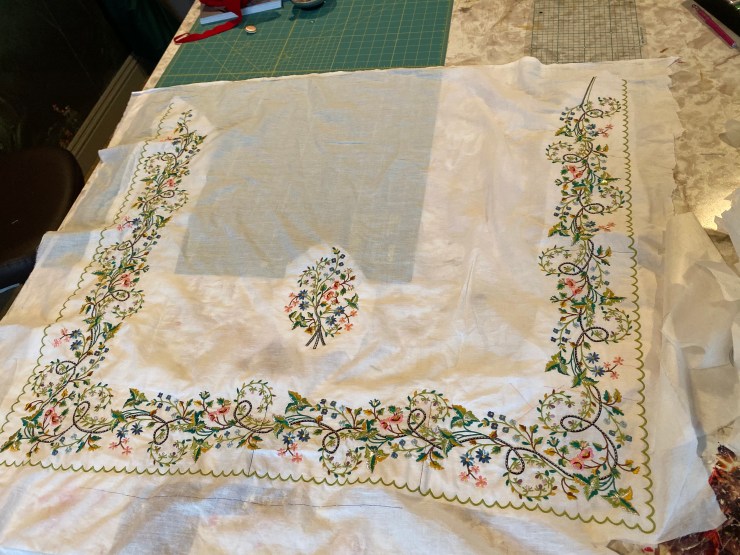
I digitized the entire apron, and really loved how colorful and whimsical the embroidery is.

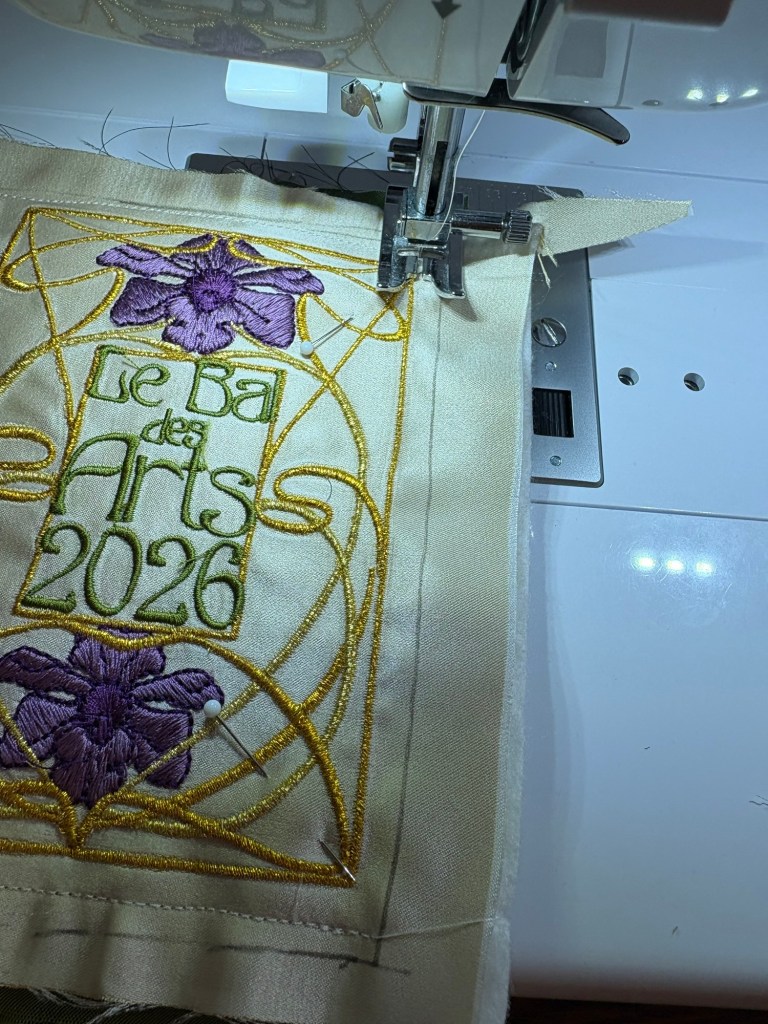
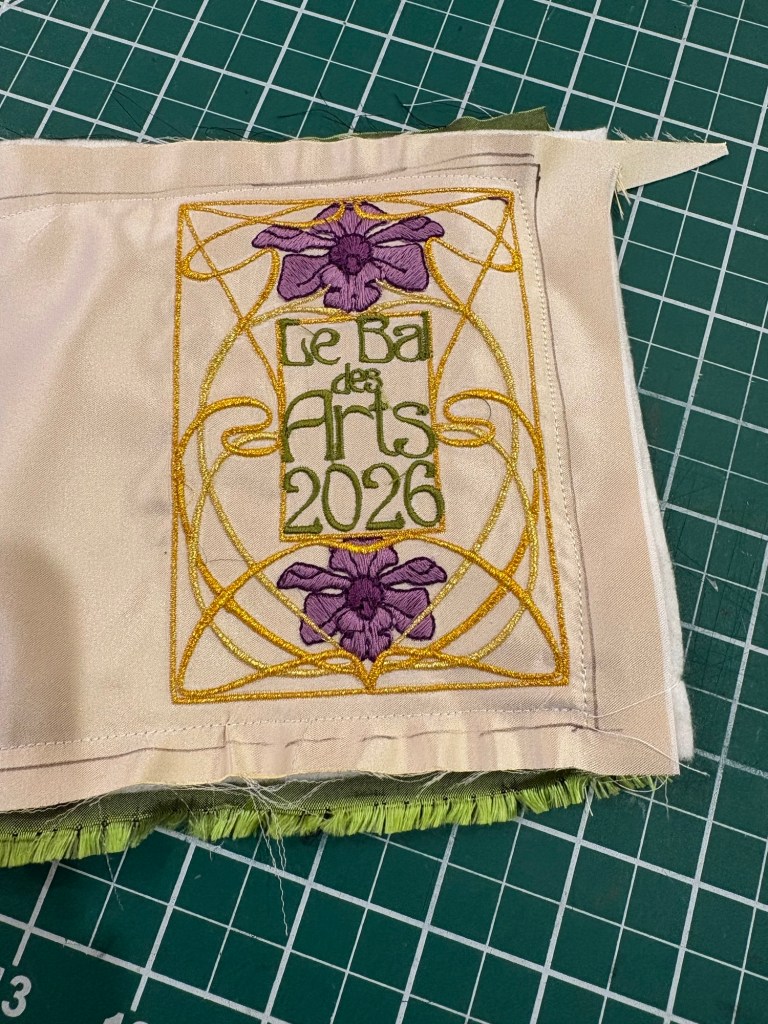
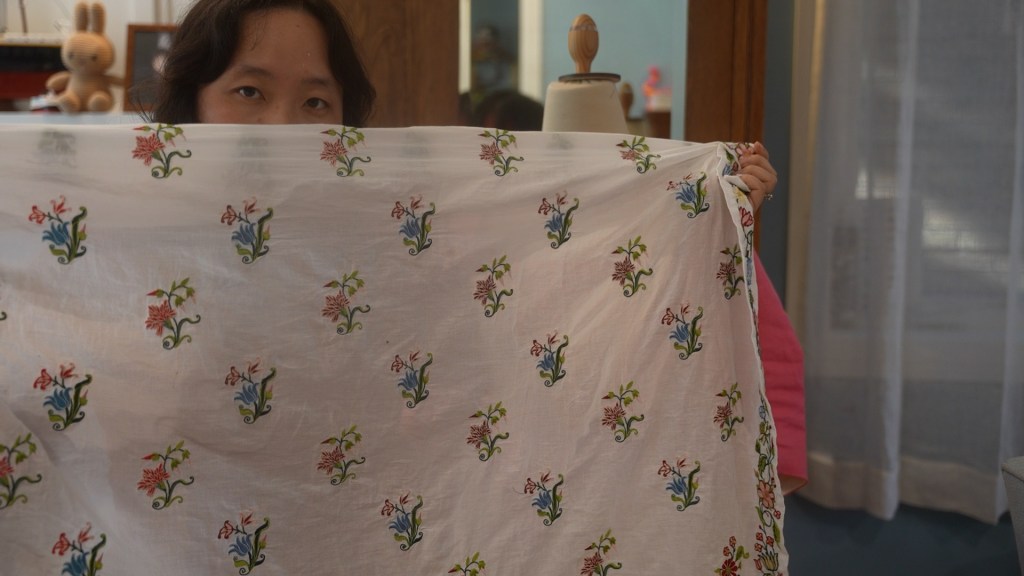
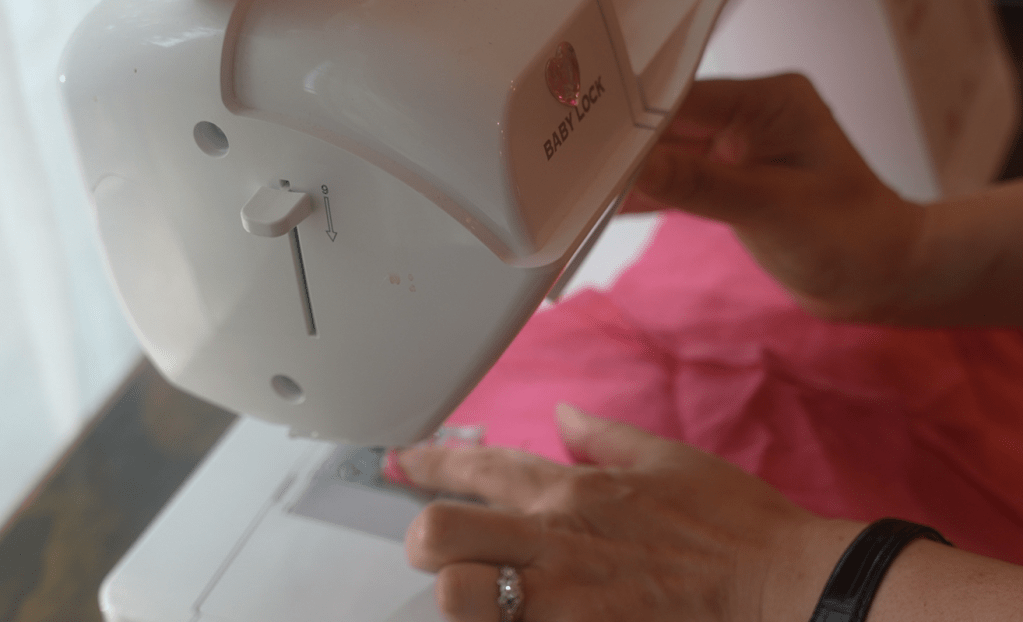
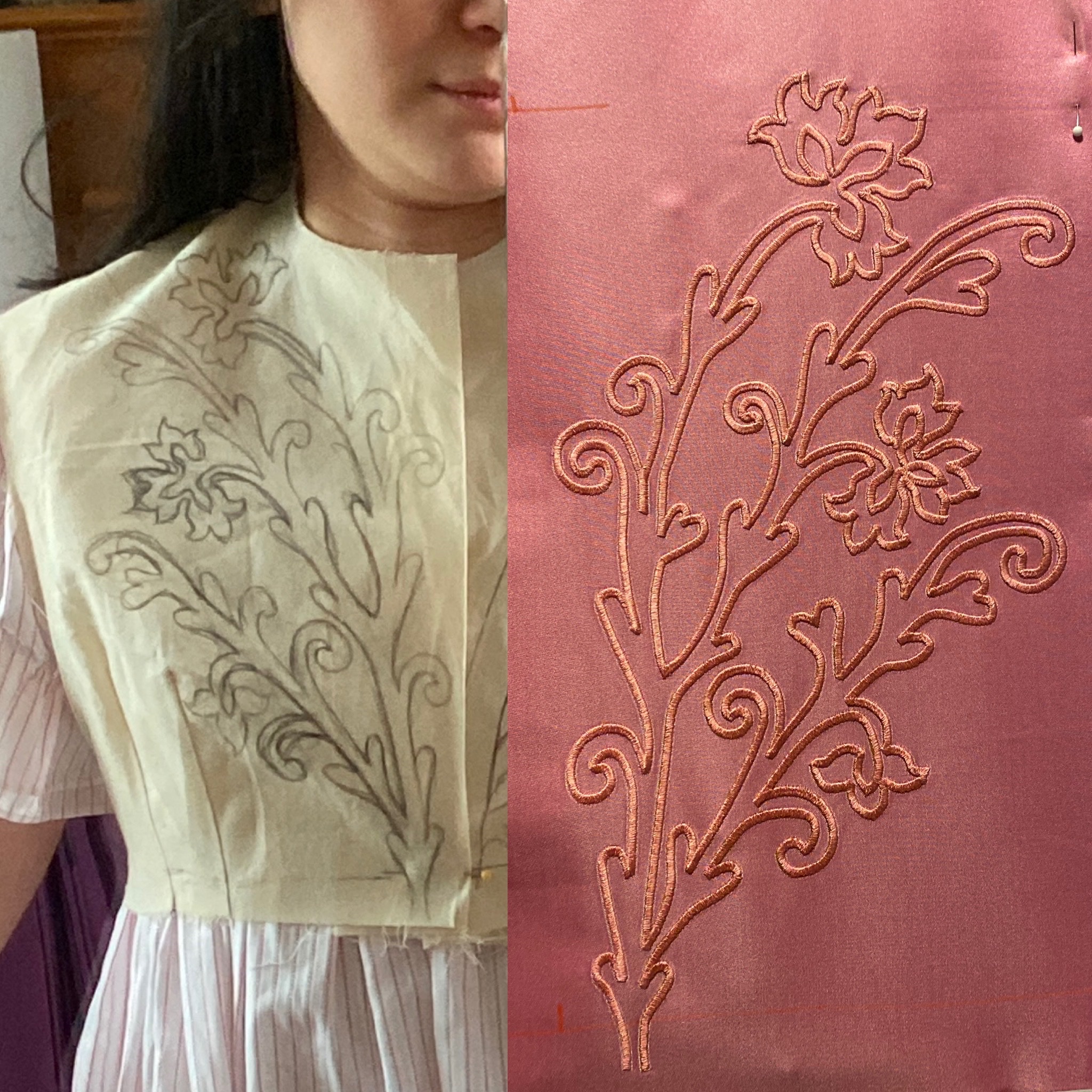
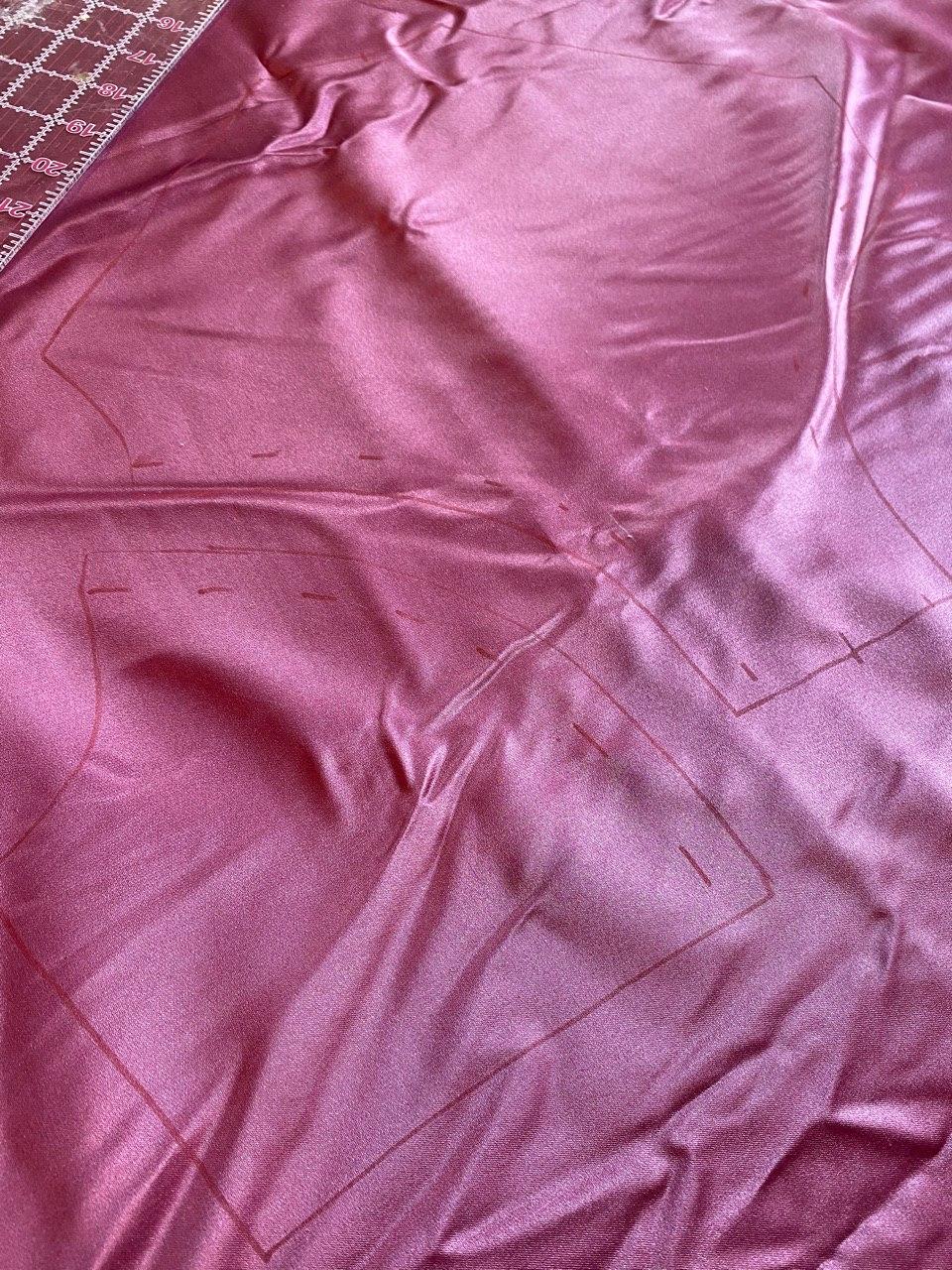
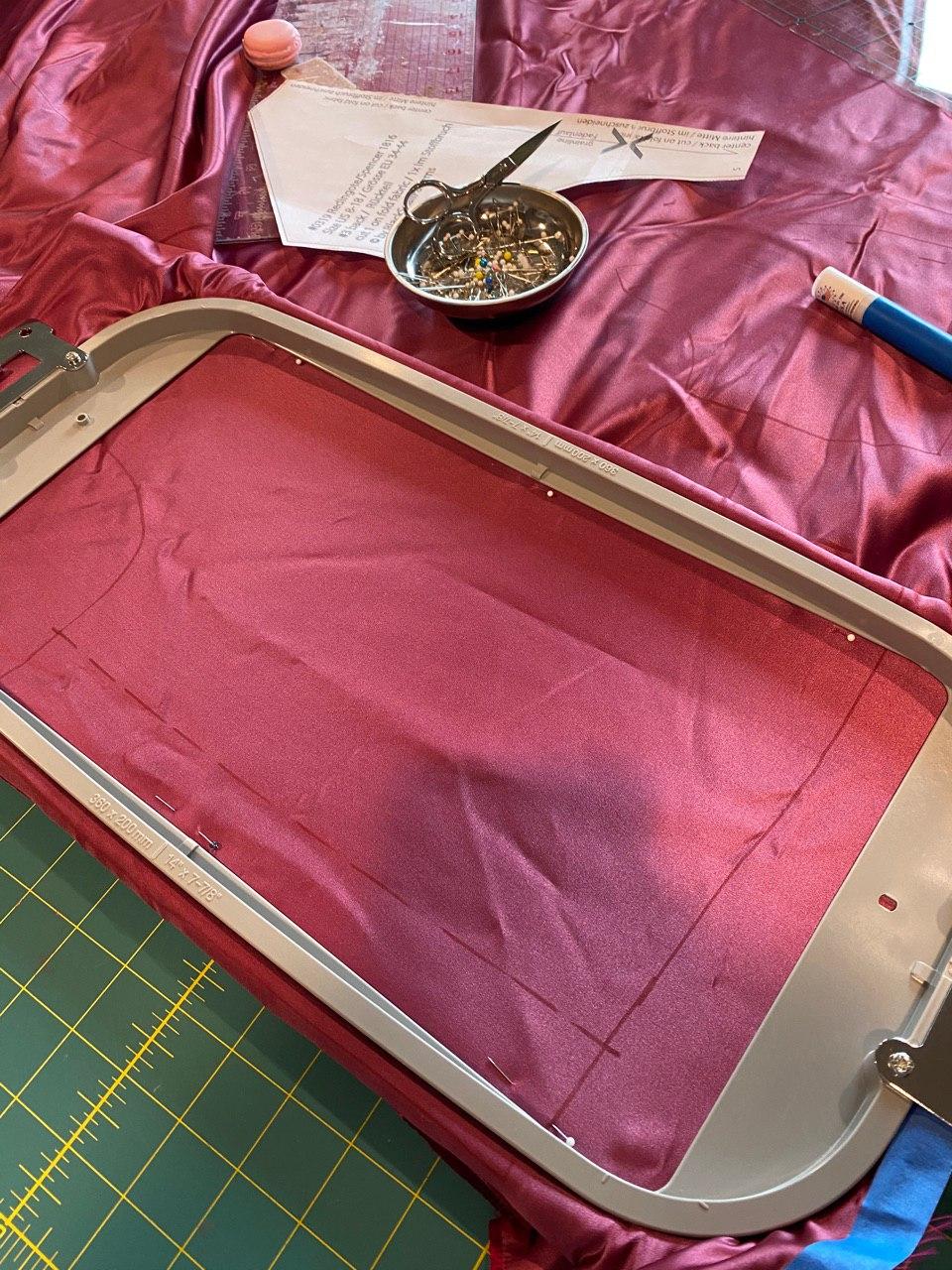
I then started stitching this out on my Baby Lock Venture – a ten needle machine with incredible durability. I think each of my machines are close to 10 mill stitches? Each flower was about 45 min of embroidery, and all in all, it took me around 40 hours of embroidery. All done with Tire Silk 50wt embroidery thread. I did use cotton as a base – in particular, I find the cotton mull from Burnley and Trowbridge to be without equal when it comes to embroidery. It was around 8 repeats for the border and then 12 to do the fill. But with 2 layers of Baby Lock dissolvable interfacing, it was all done!

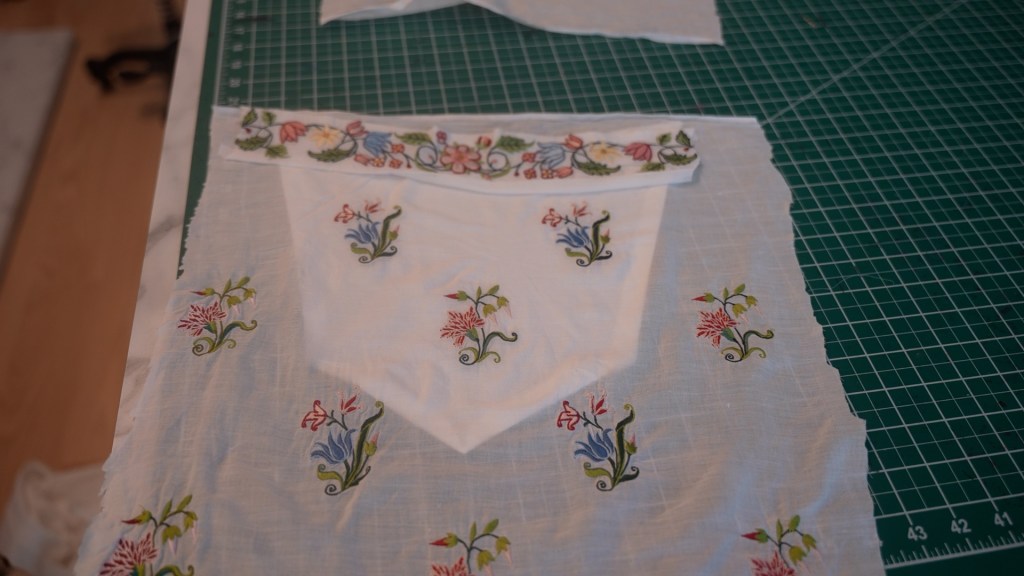
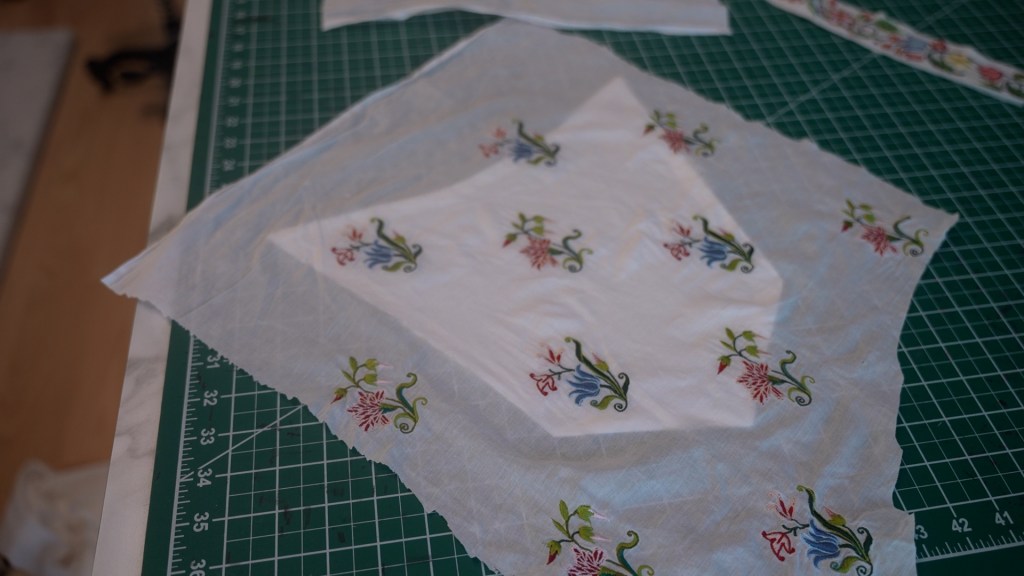
Now confession, I made a mistake with the placement on the apron halfway through, so I started again. But this was fine since this meant that I had some pieces that I could use for the top of the apron.

I then threw it in the machine to wash out with an extra rinse cycle.

Then after air drying, I steam ironed it which made it nice and flexible.

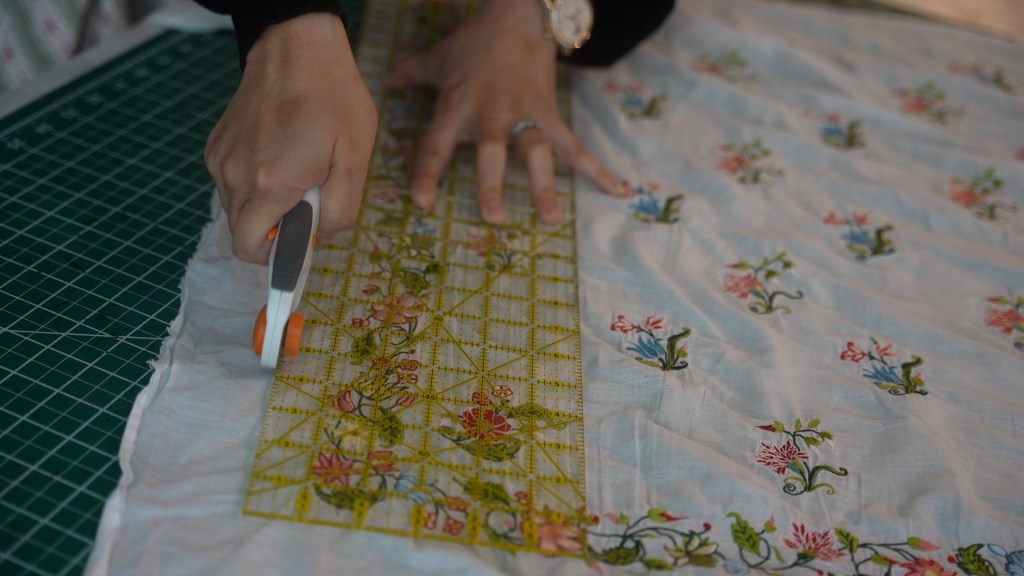
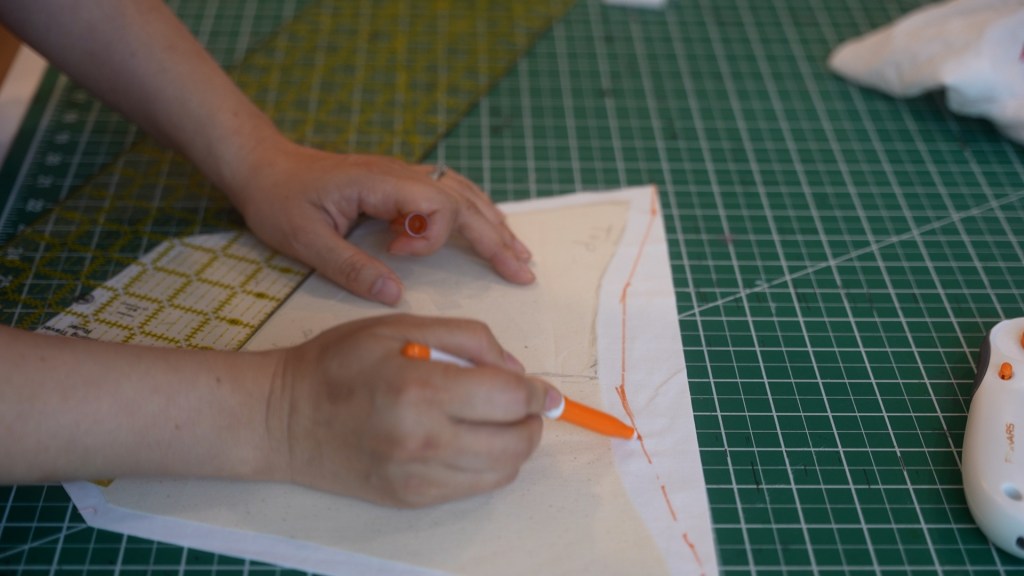
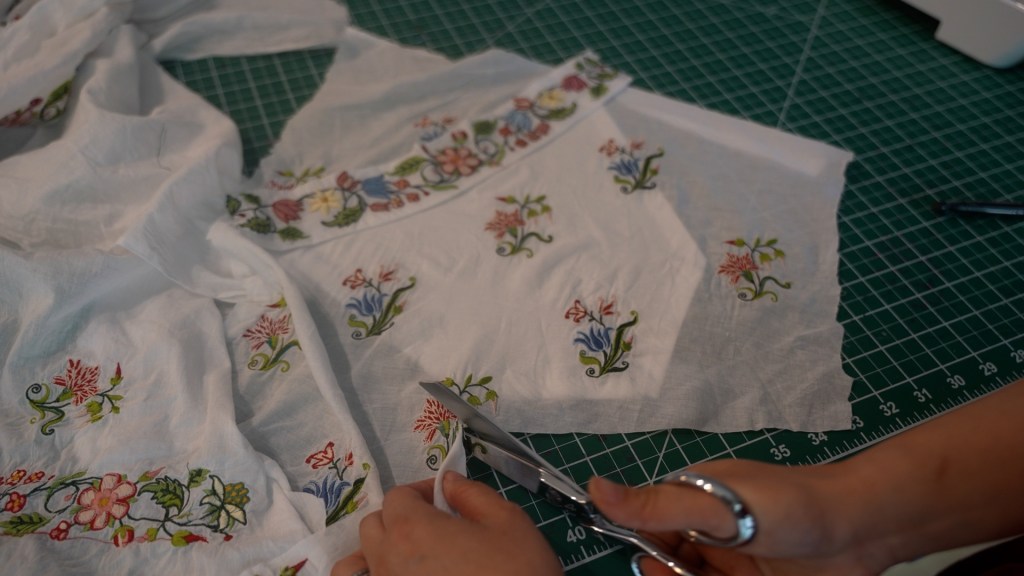
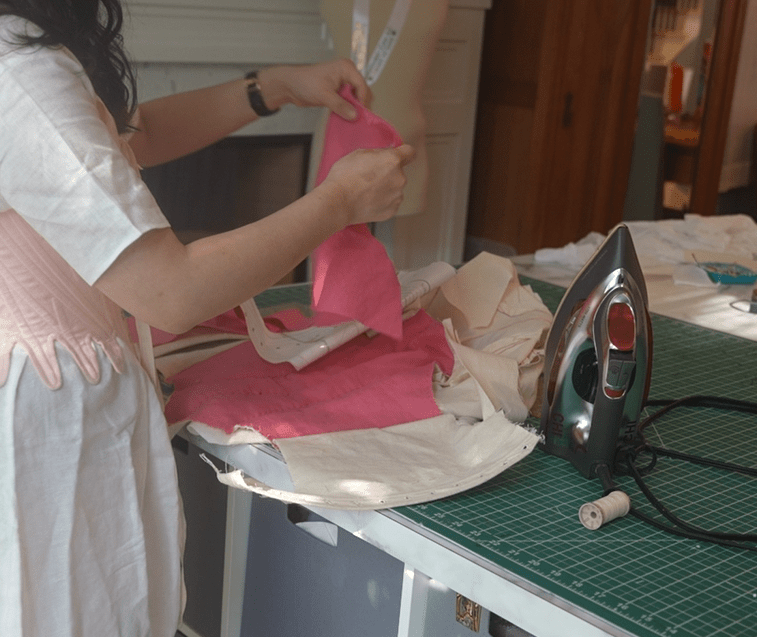
I then cut the apron out and started stitching it. For the apron skirt, all I had to do was just hem the three sides.

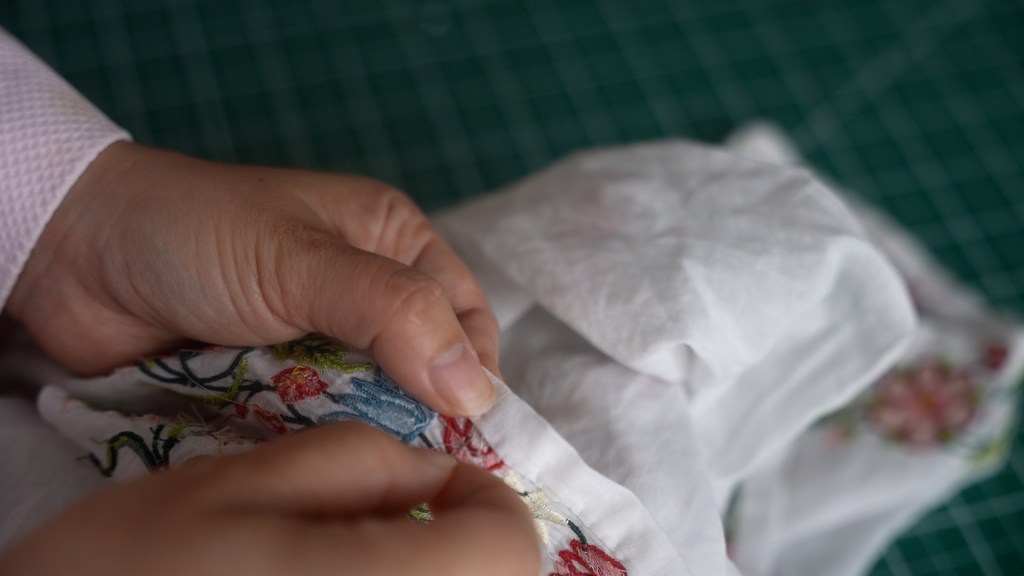
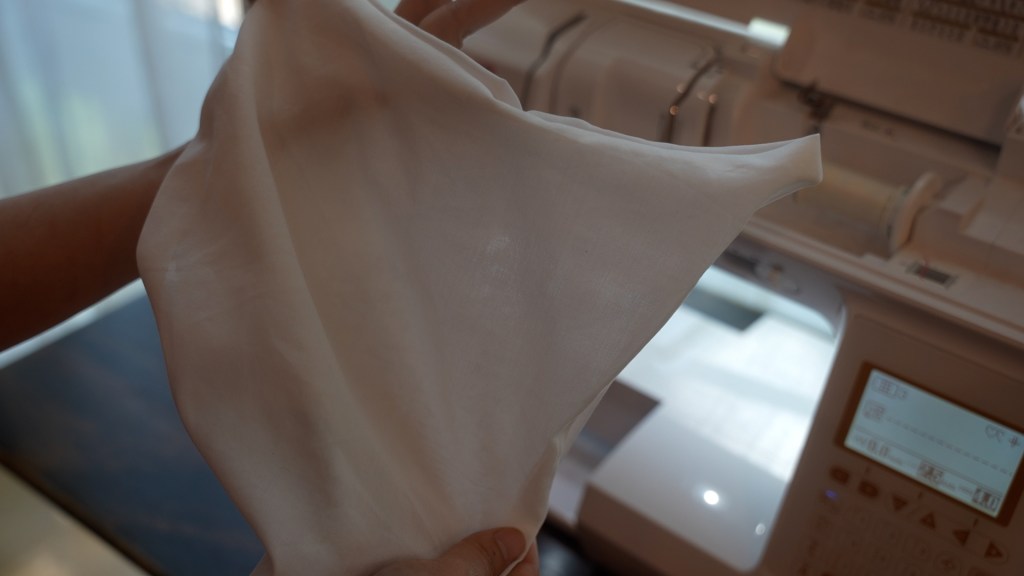
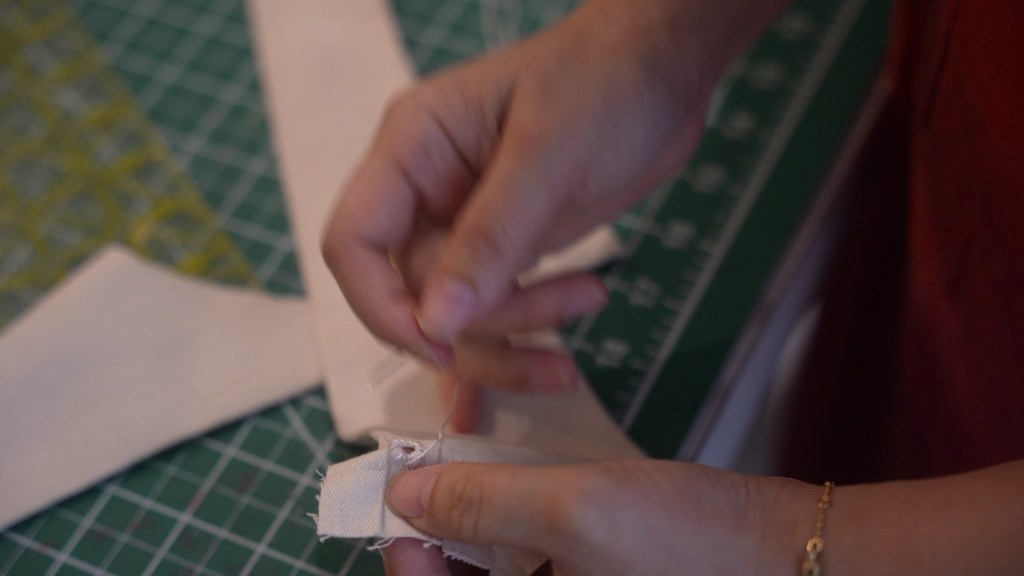
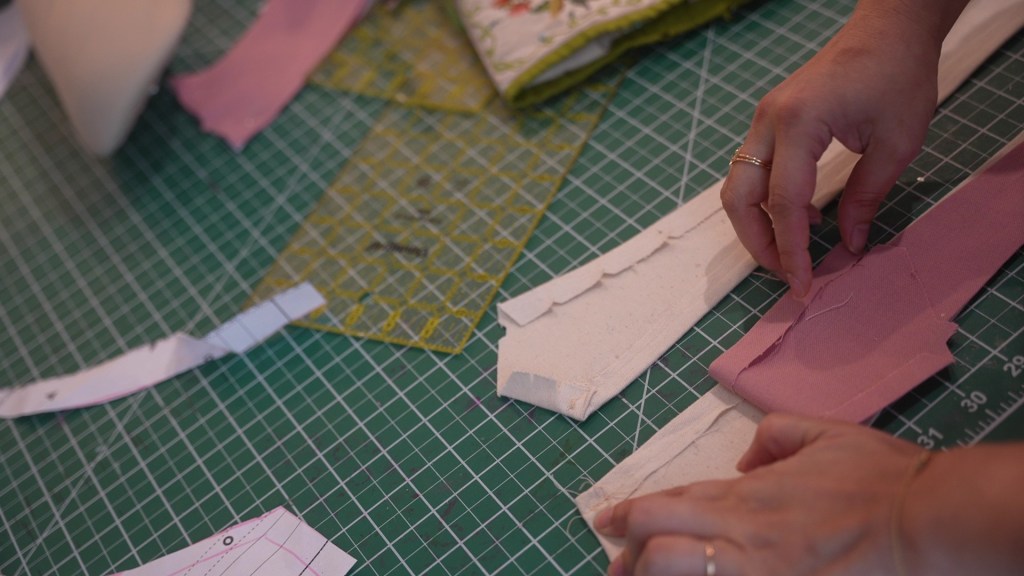
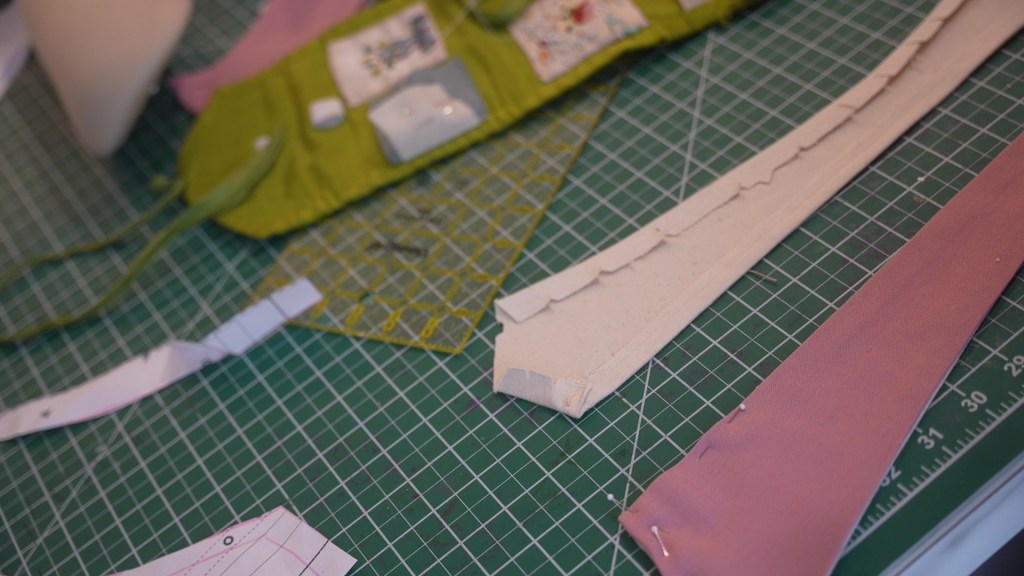
I then gathered up the top using a whip stitch. I then covered it with some white cotton mull (1″ x 20″) that I turned into a bias tape by ironing up the sides by a quarter of an inch. I gathered up the top to 18″ and then used a prick stitch to cover it with the bias tape.

I then used some tape to add apron strings on each side.

However, for this apron top, I wanted it to have a top portion as well.

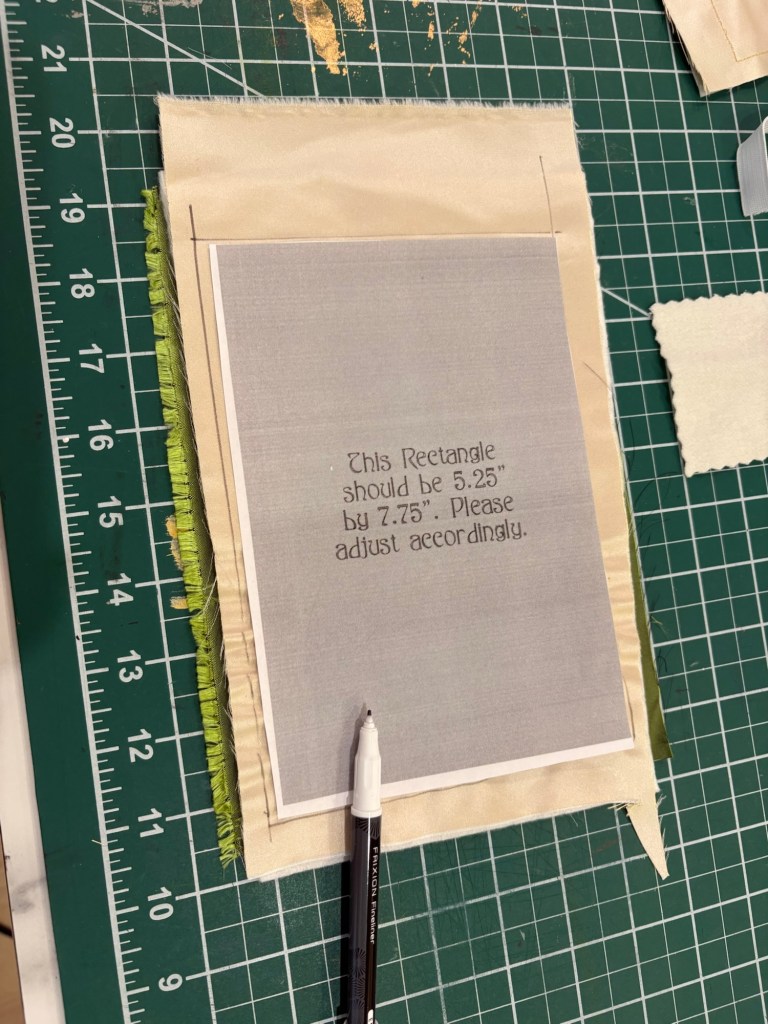
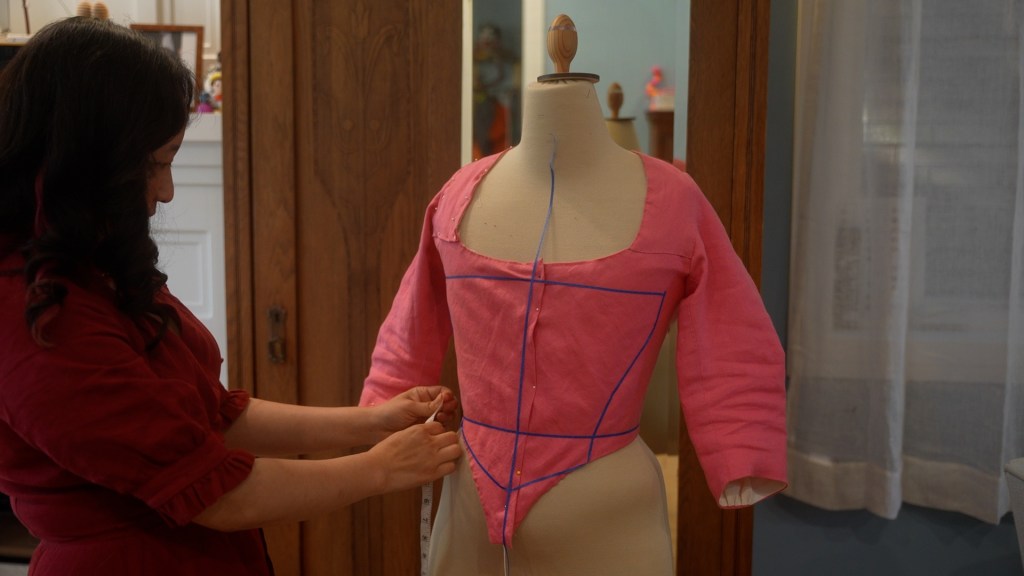
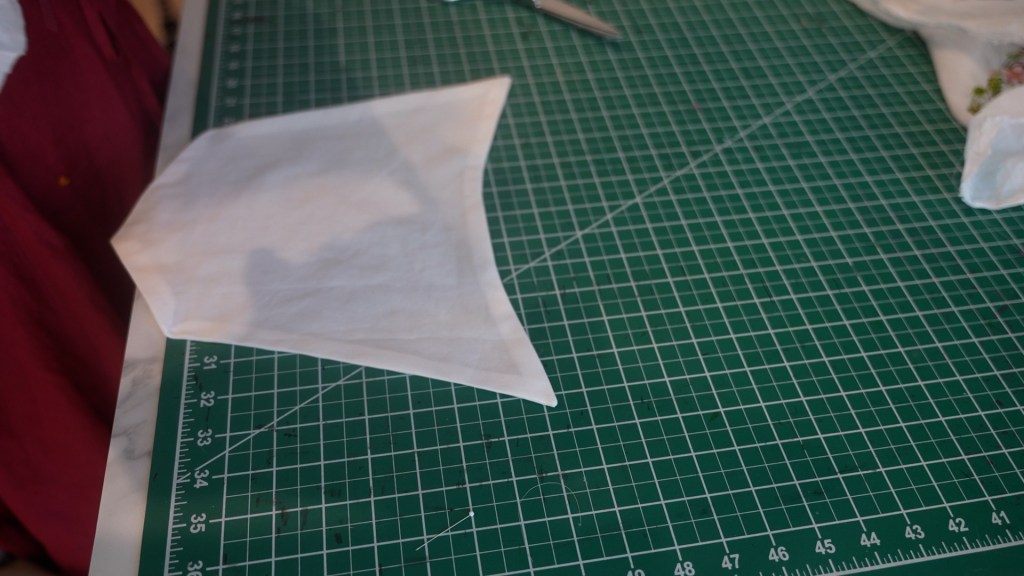
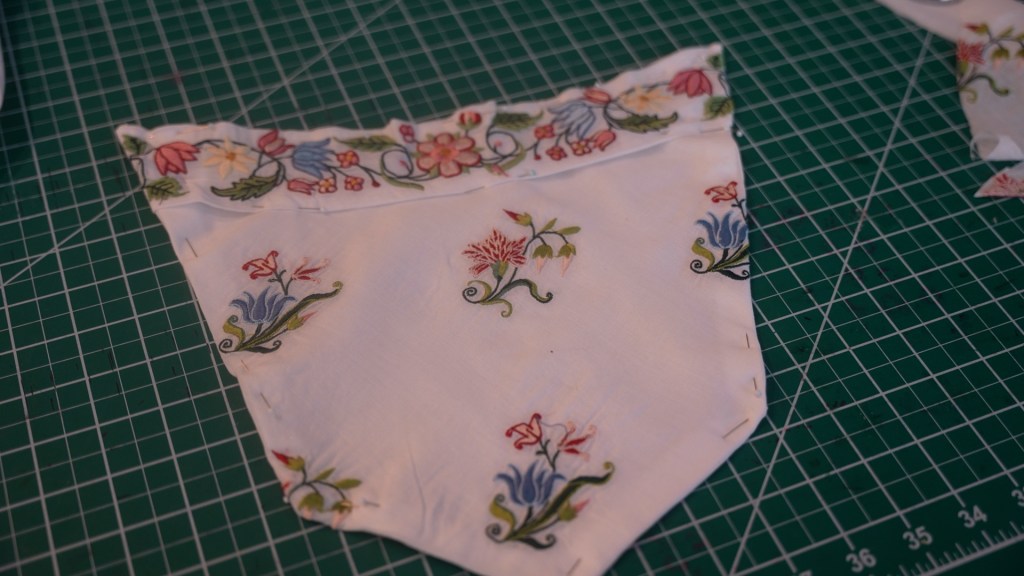
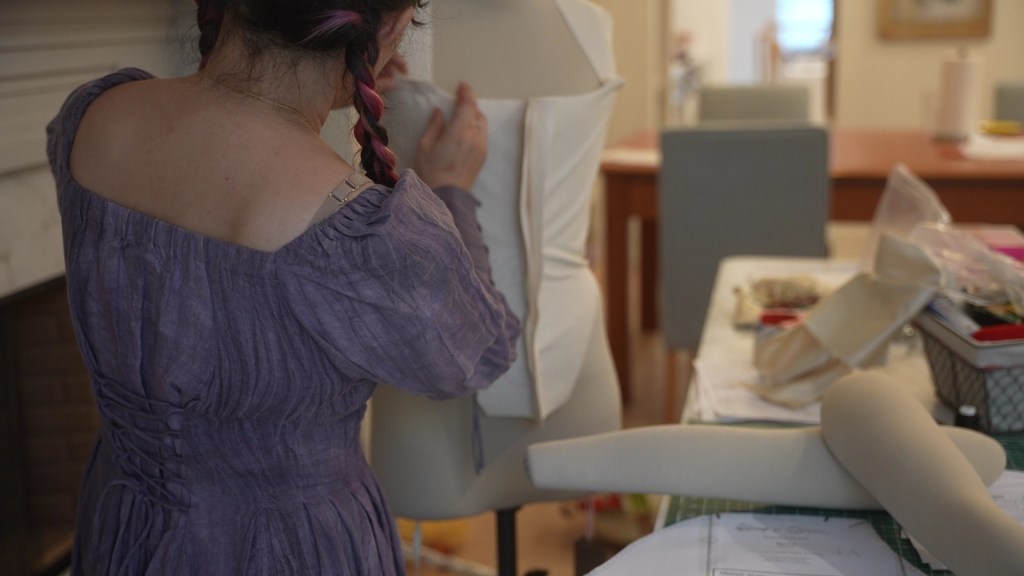
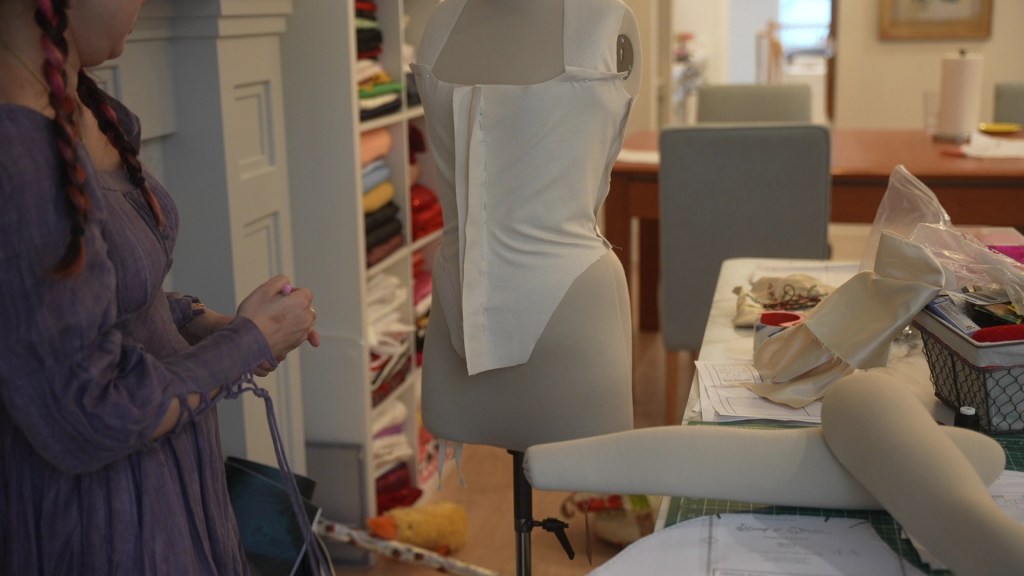
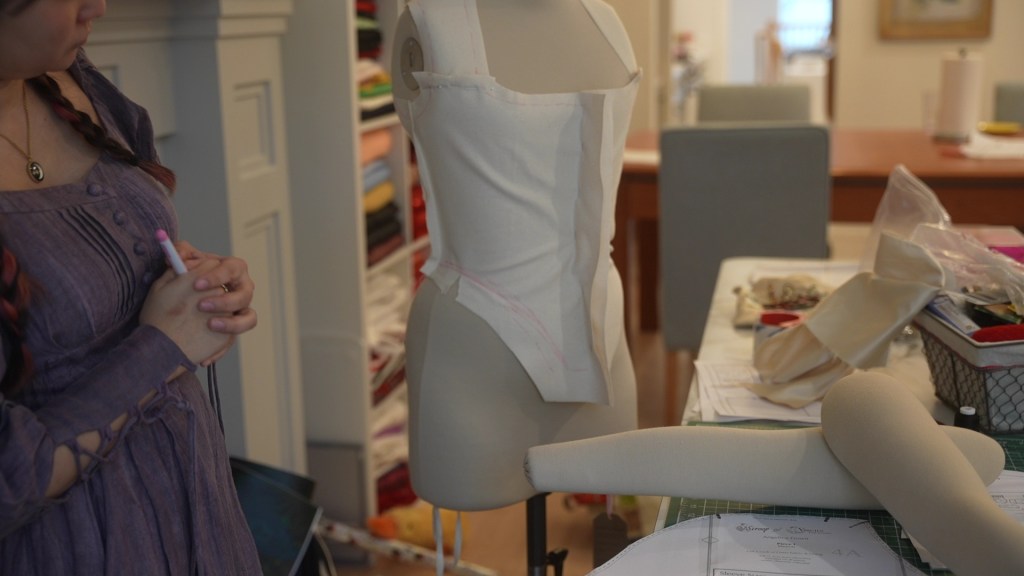
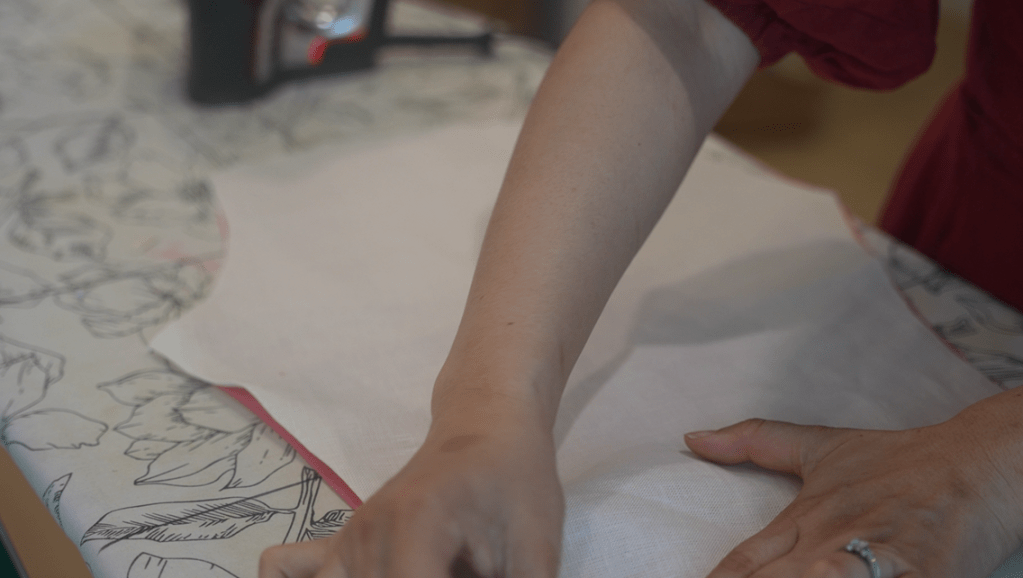
I drafted an apron top in one piece on my dress form, and then cut out some cotton batiste as a backer. The embroidered mull is so thin I wanted something to give it some stabilization.

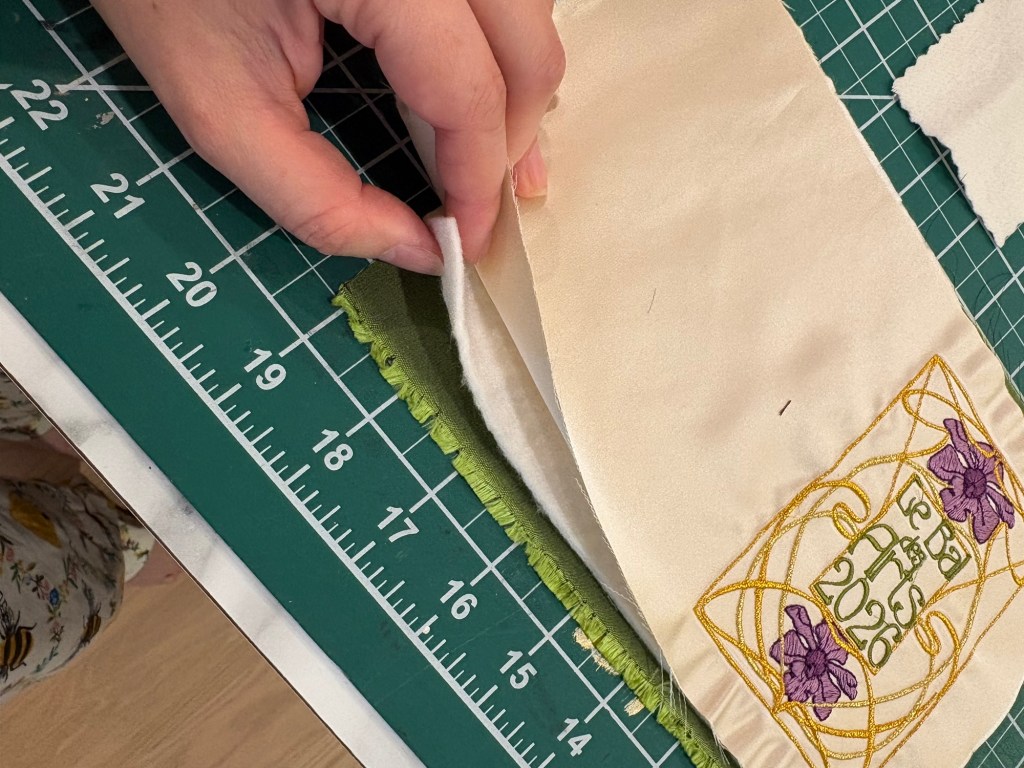
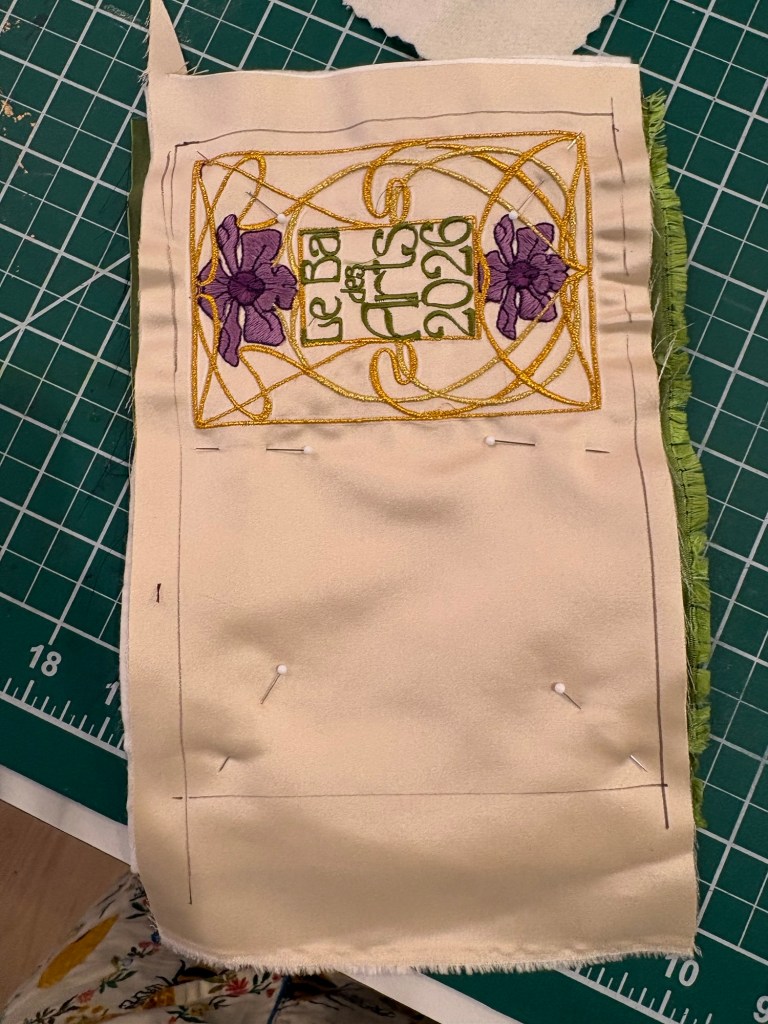
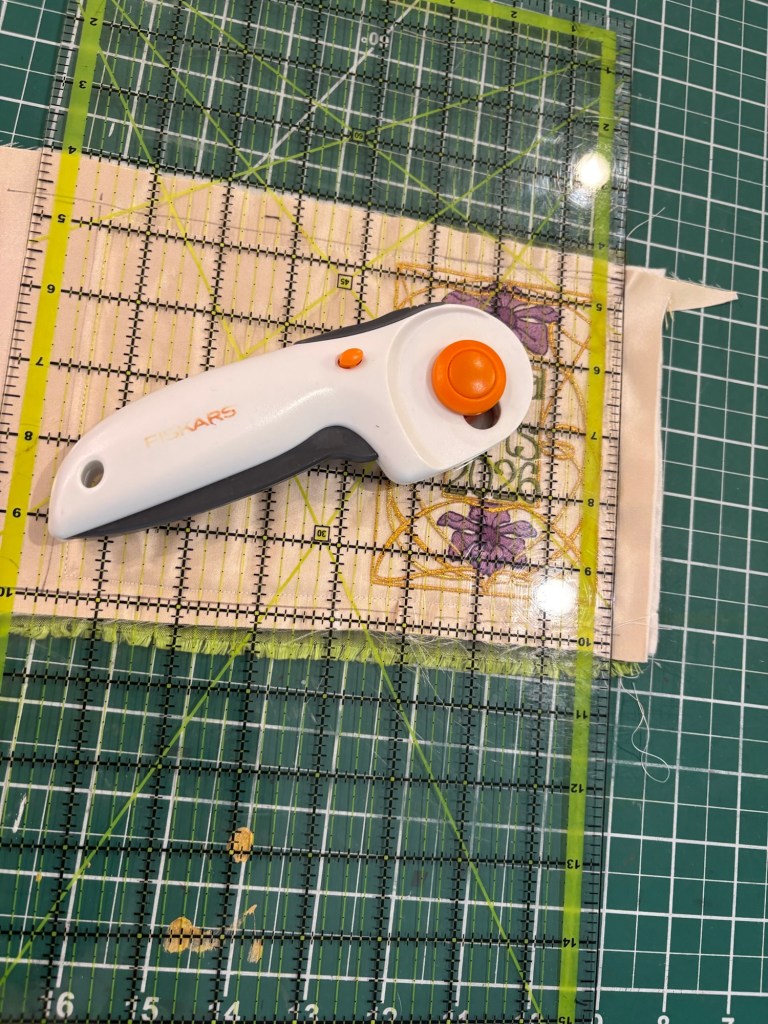
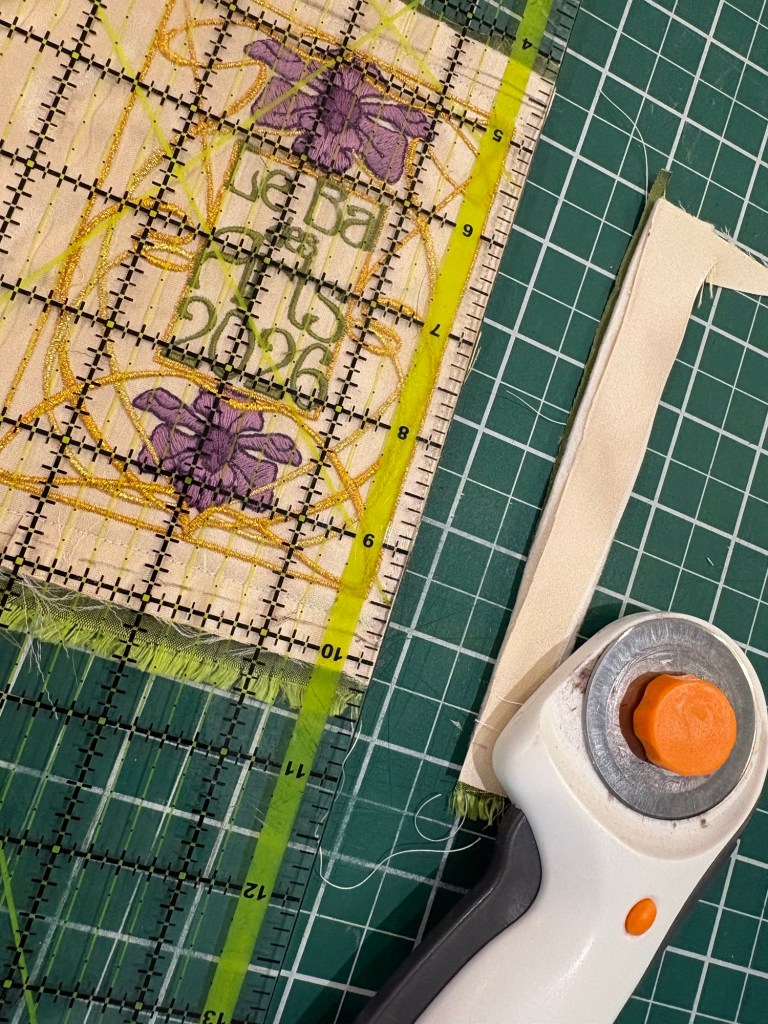
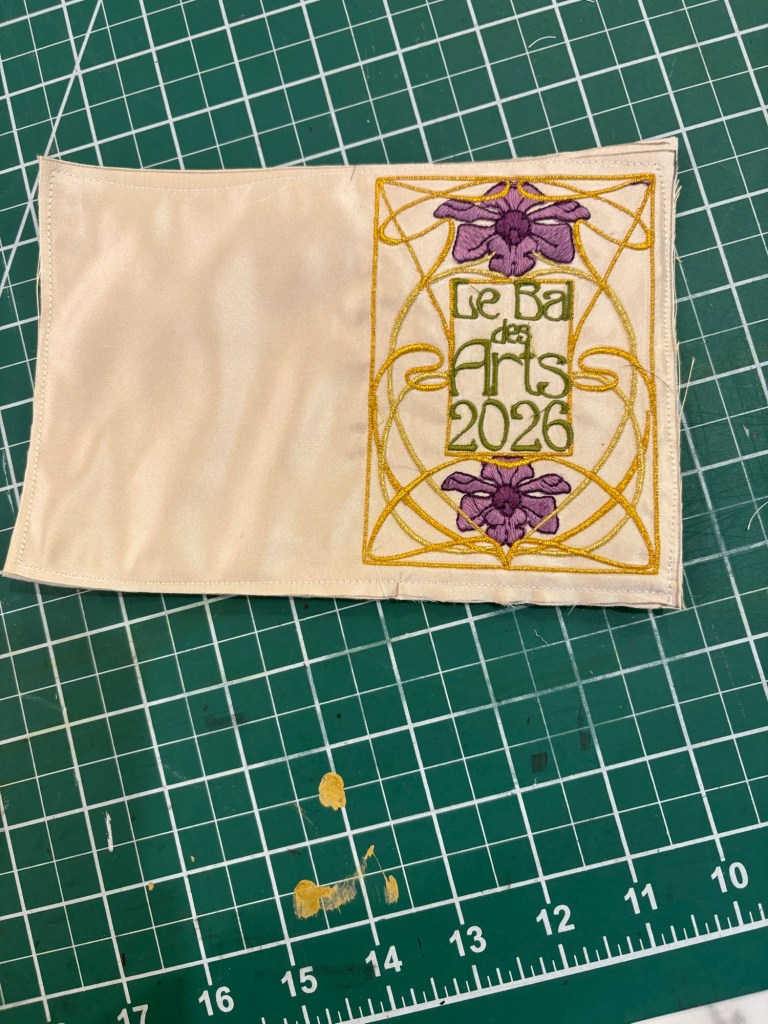
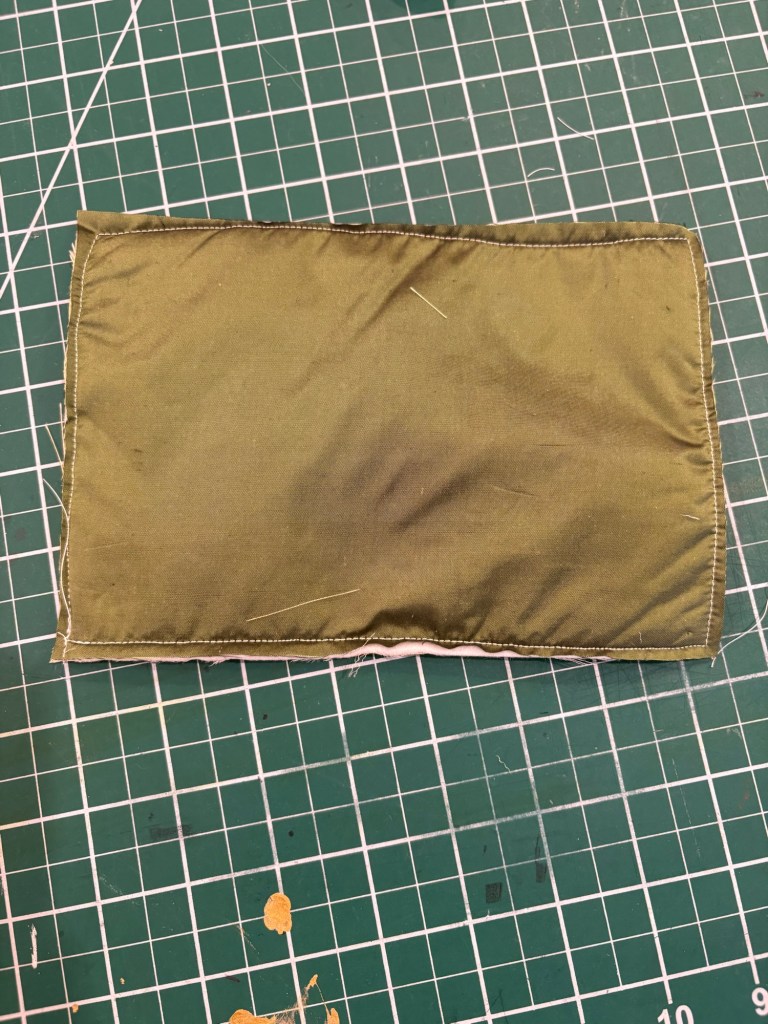
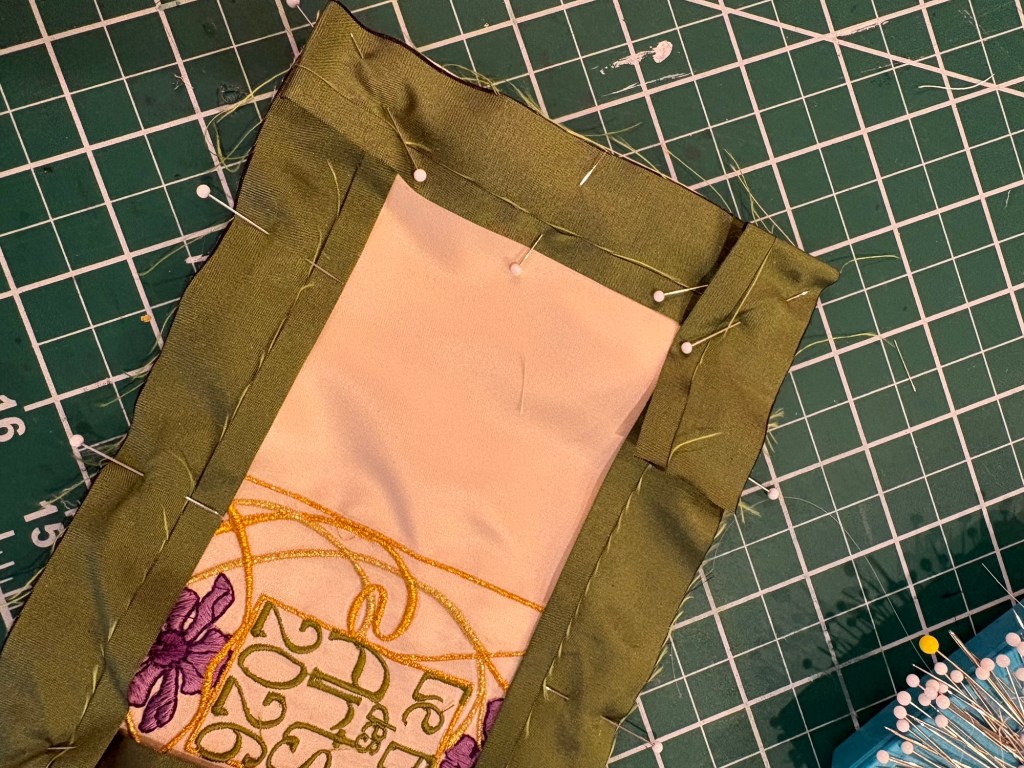
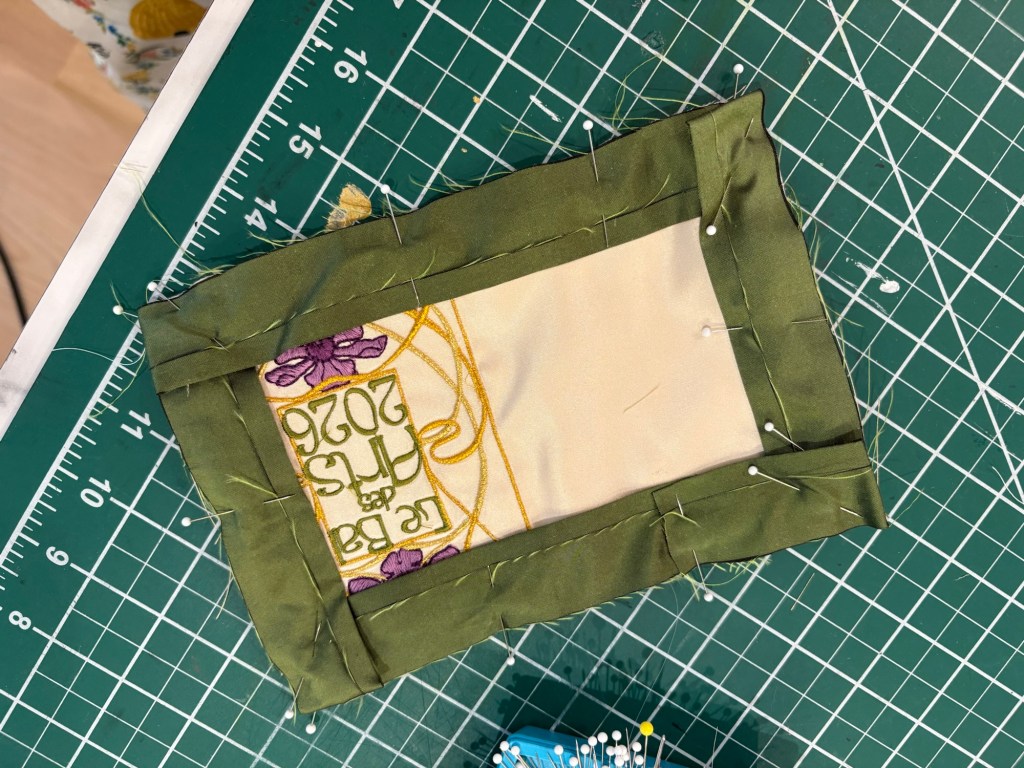
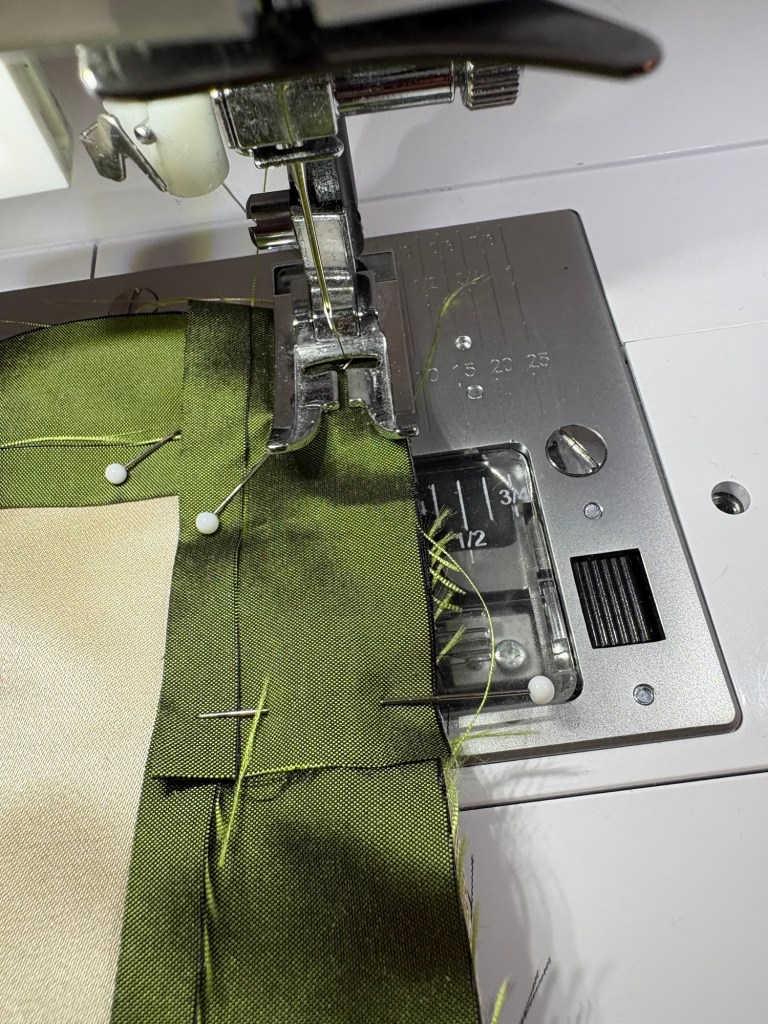
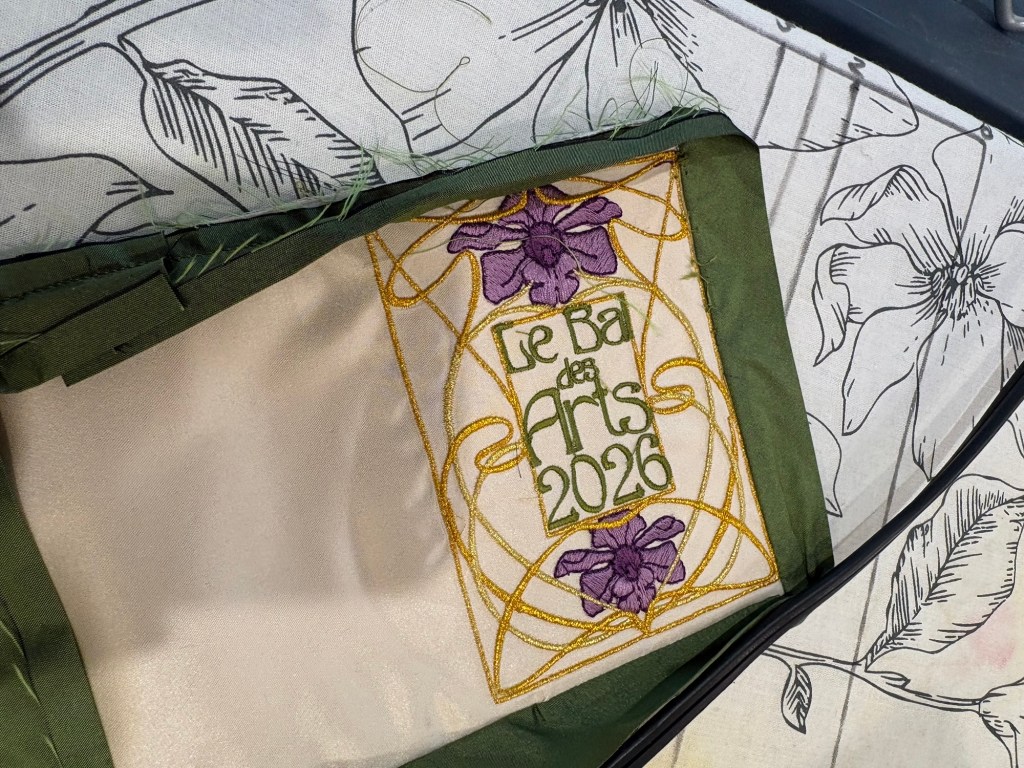
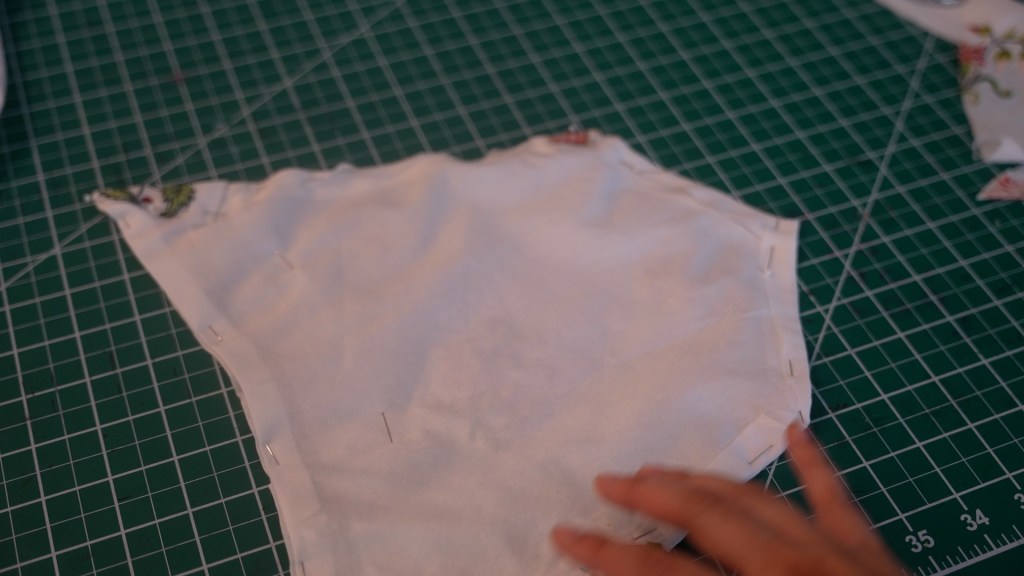
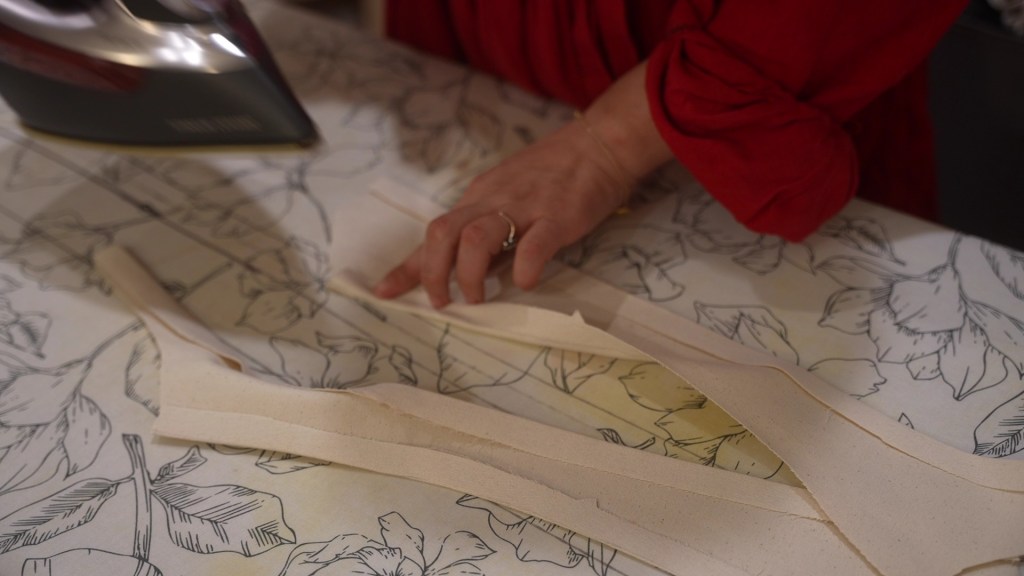
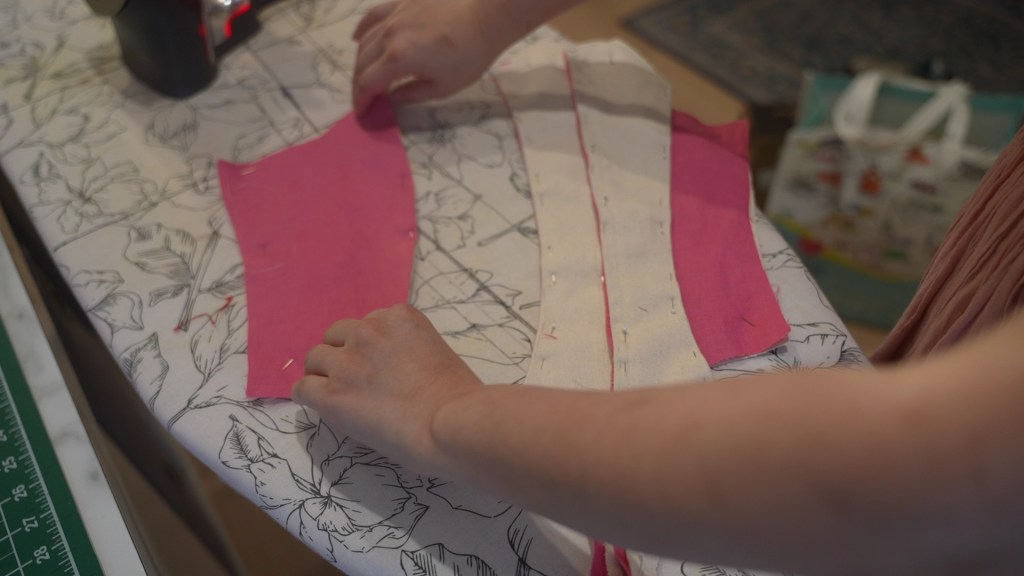
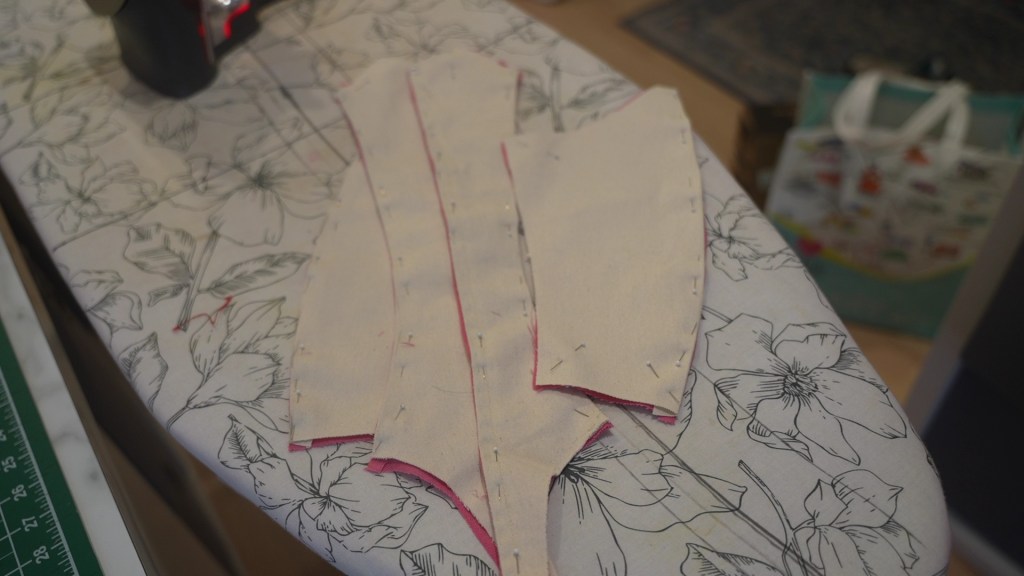
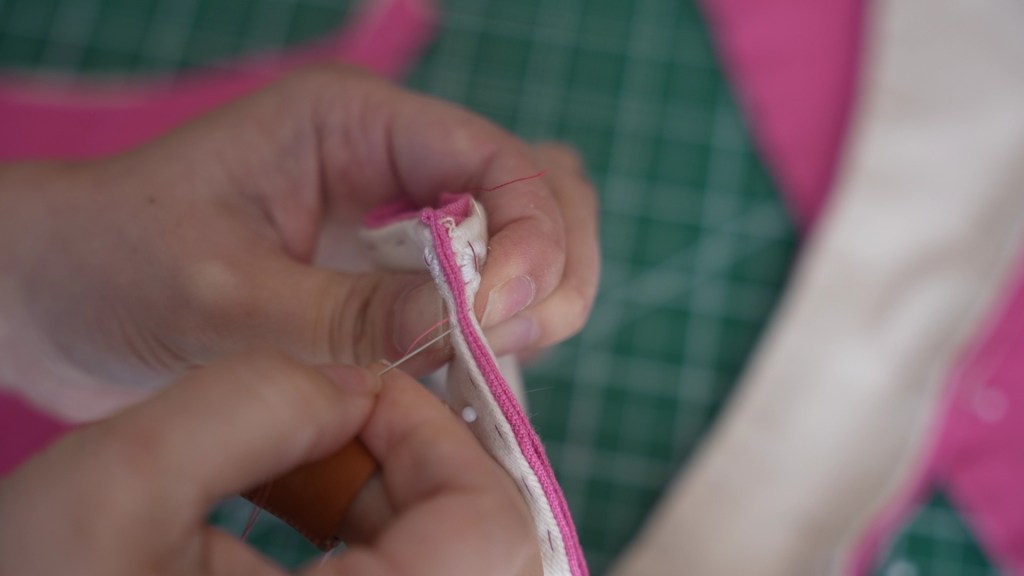
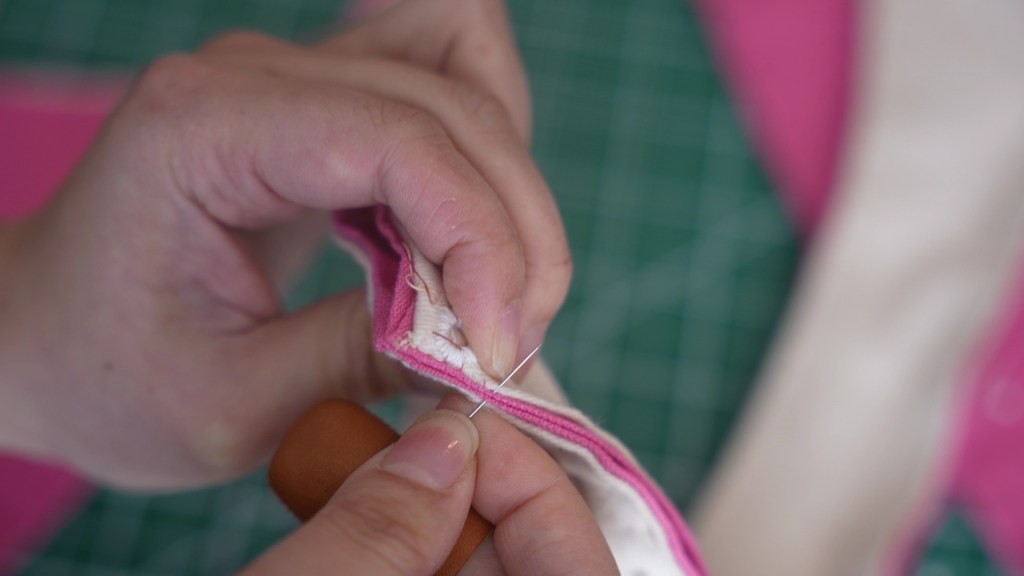
To do this I cut out two layers of cotton batiste, sewed it on three of the sides, and then flipped it inside out. I ironed it out, and sewed one edge closed by hand. I then covered it with pieces of the apron that I had made an error on until I had a configuration that I liked. I liked having the border on the top of the apron, to mirror the bottom, so I sewed the two down by hand using very tiny prick stitches.

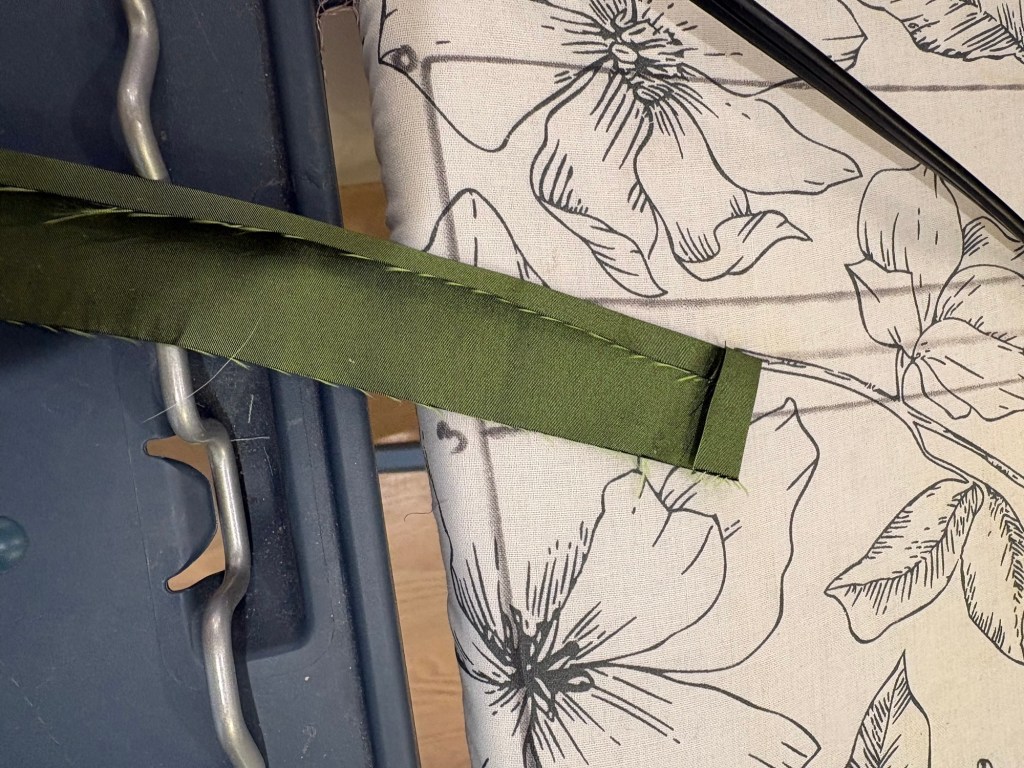
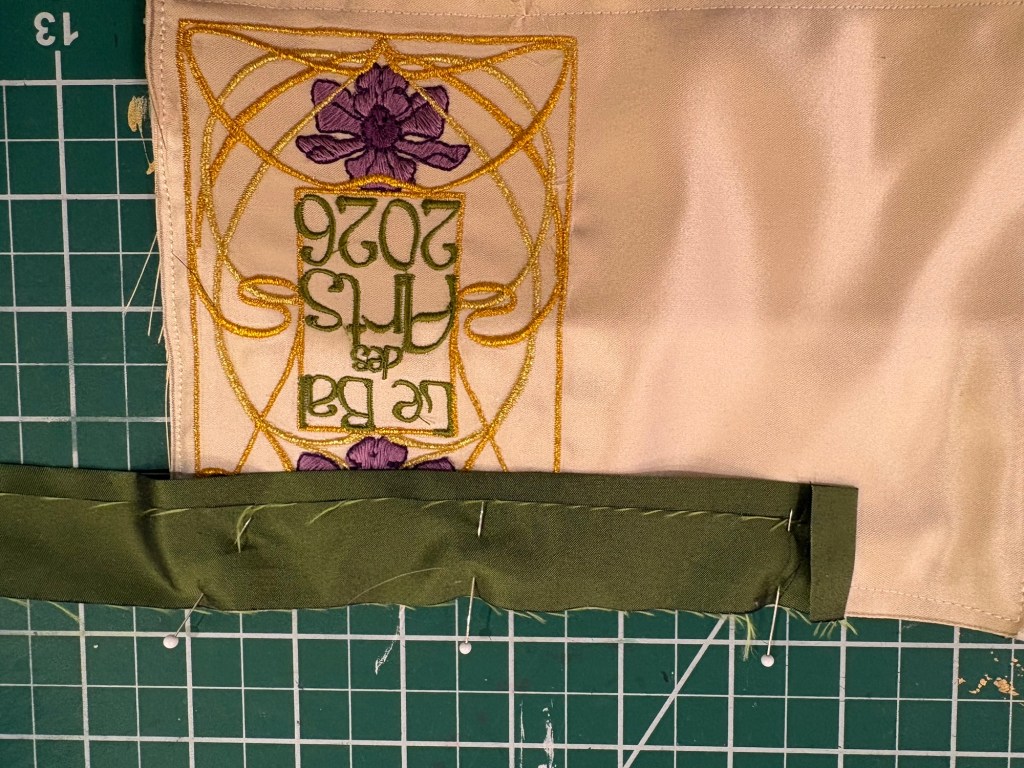
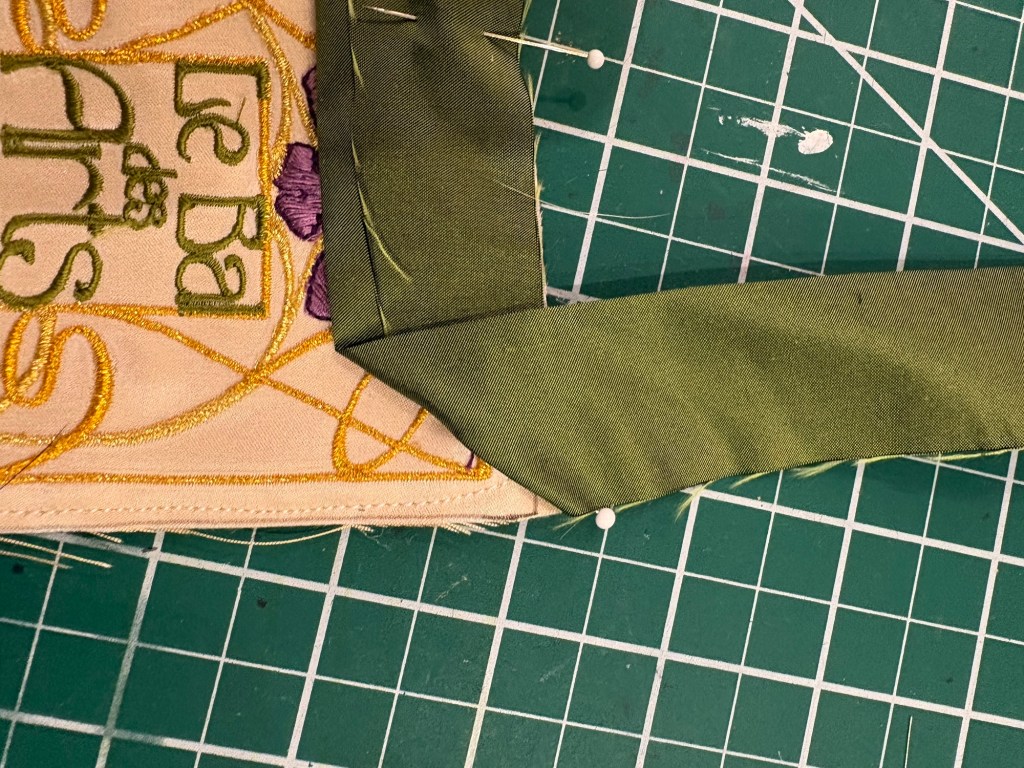
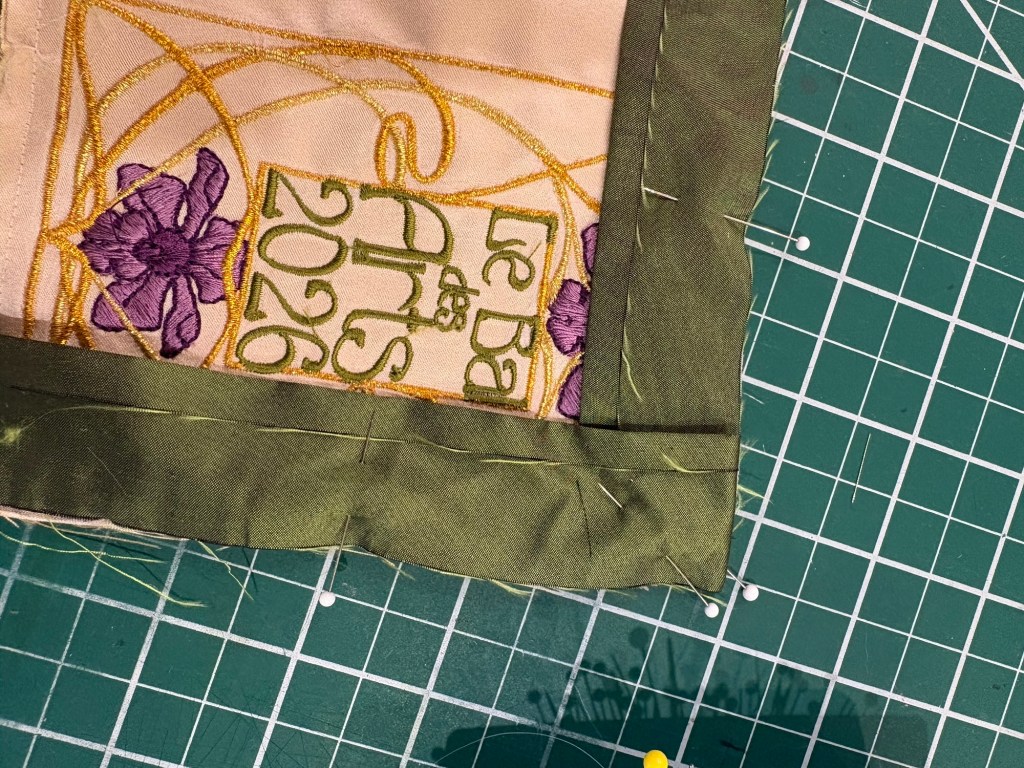
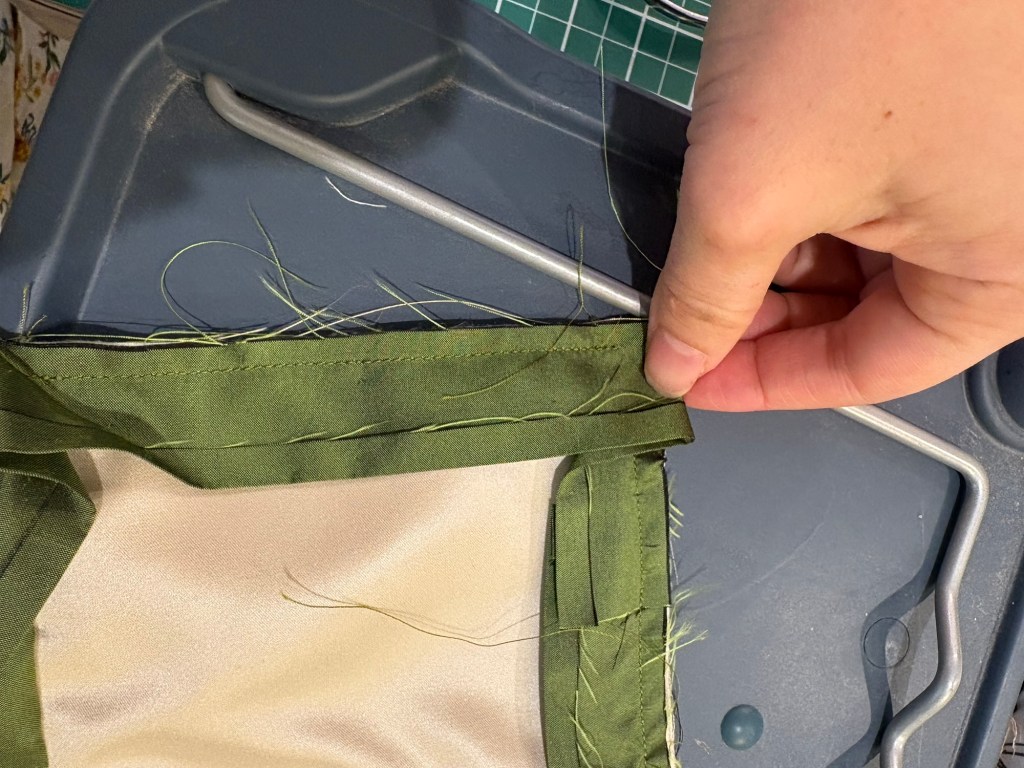
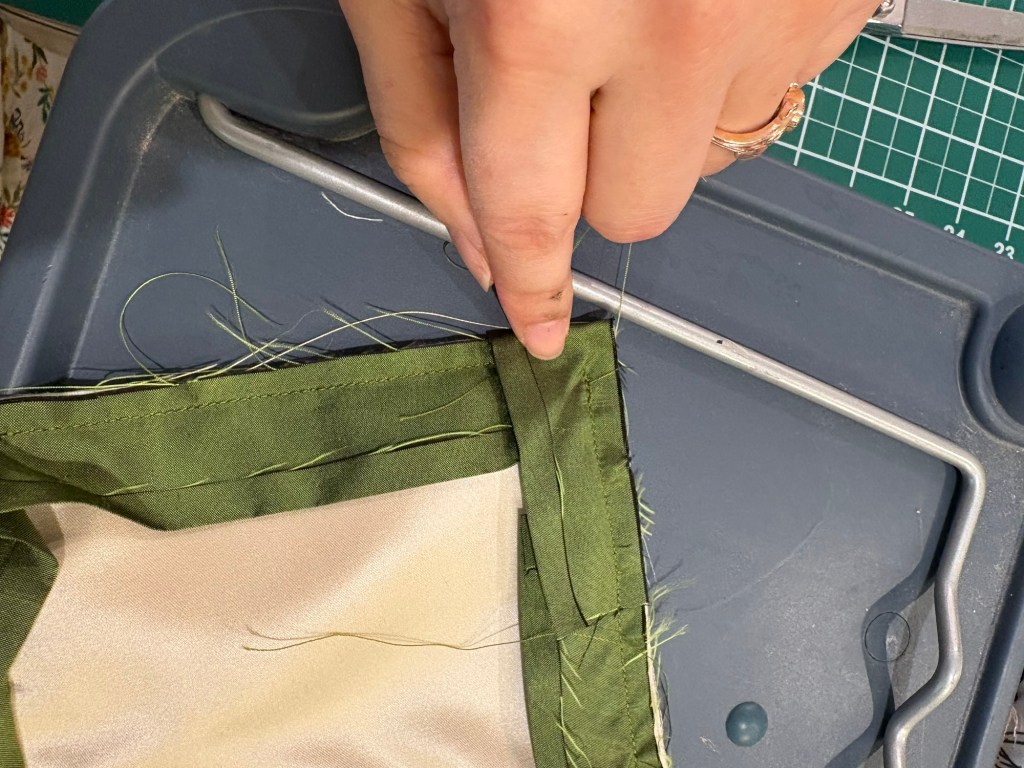
However, I wasn’t done. This would have been finished by historical metrics but I wanted to add in a section in the back to pin it to the dress, and thus the pins wouldn’t have to tear through the embroidery. So I added in some cotton tape in the back and made some tabs. I also sewed cotton tape all the way around to cover up the raw edges of the cotton mull.

Once that was done, I sewed the top of the apron to the skirt of the apron by hand.

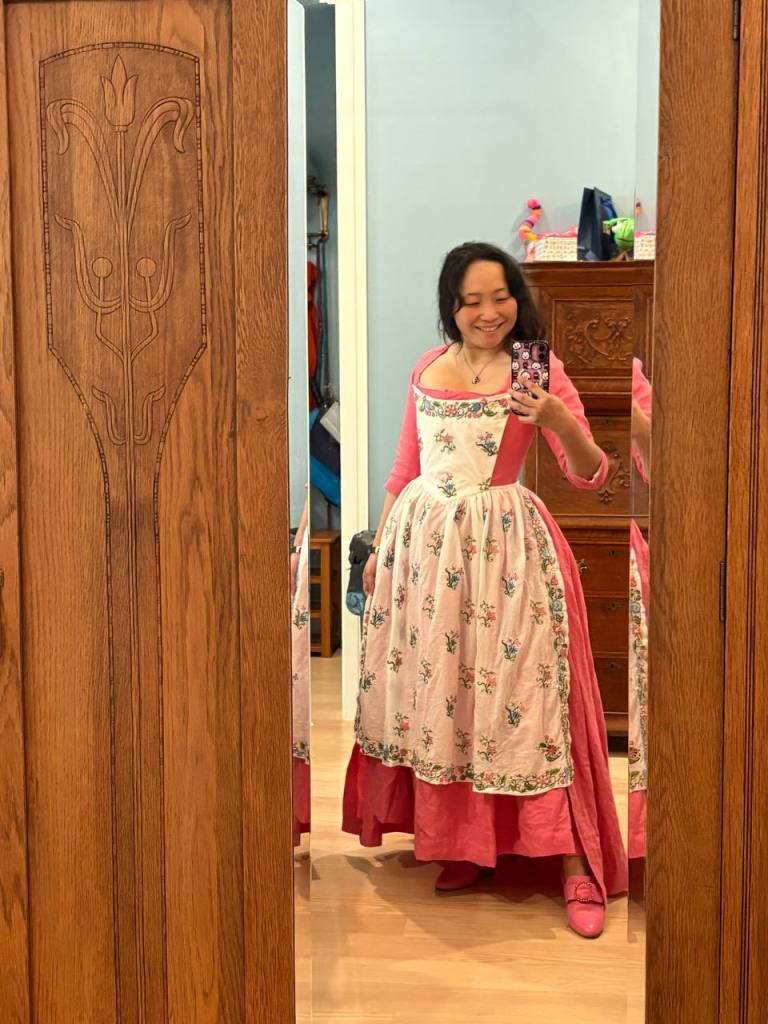
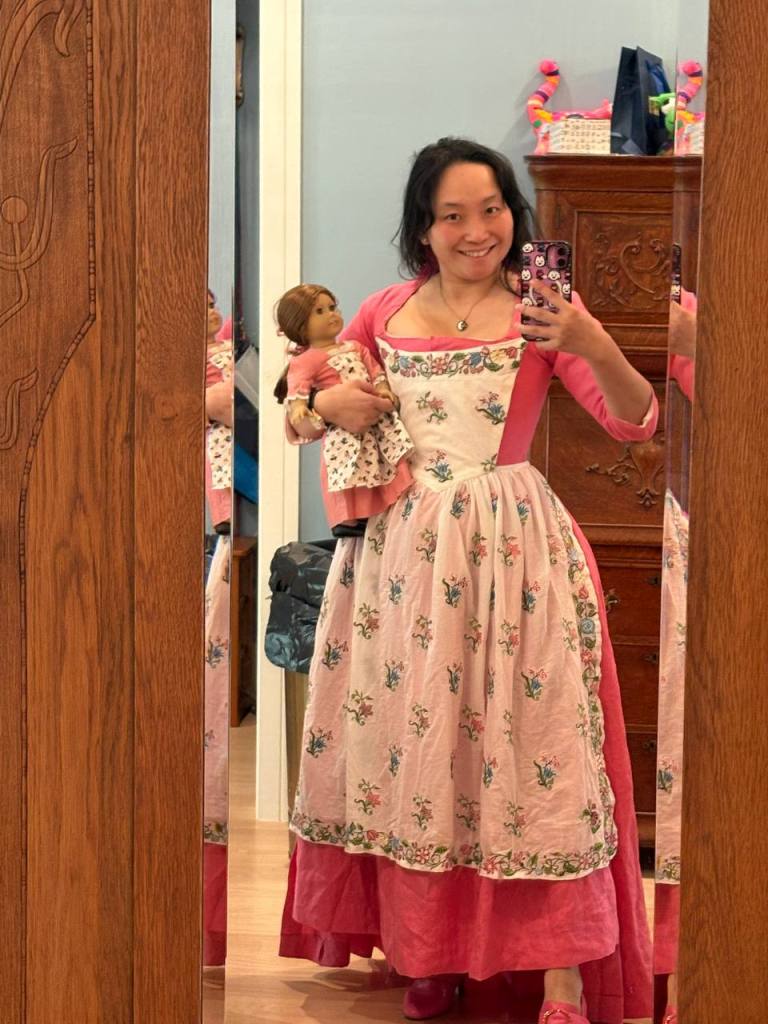
And the apron was done!

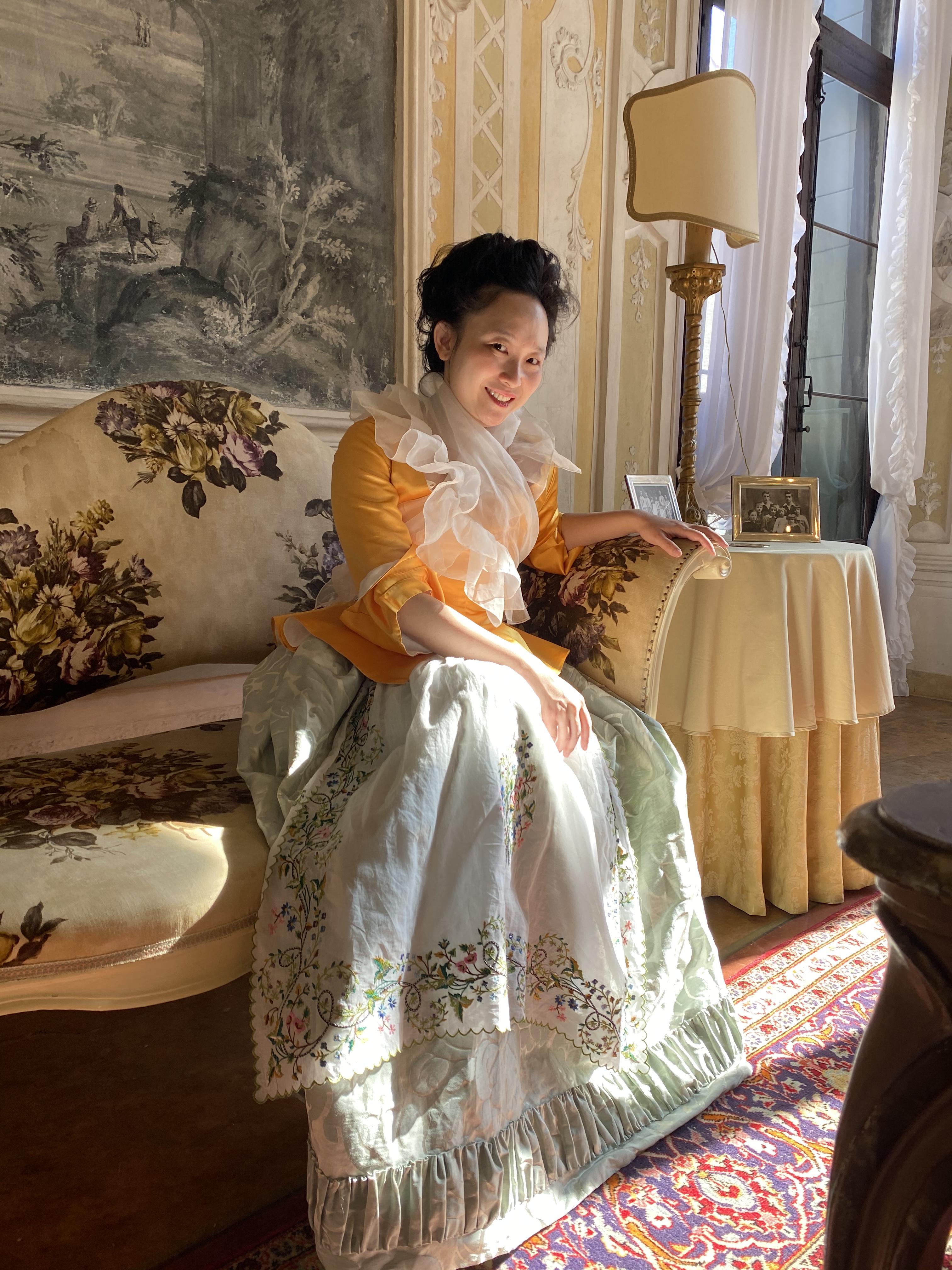
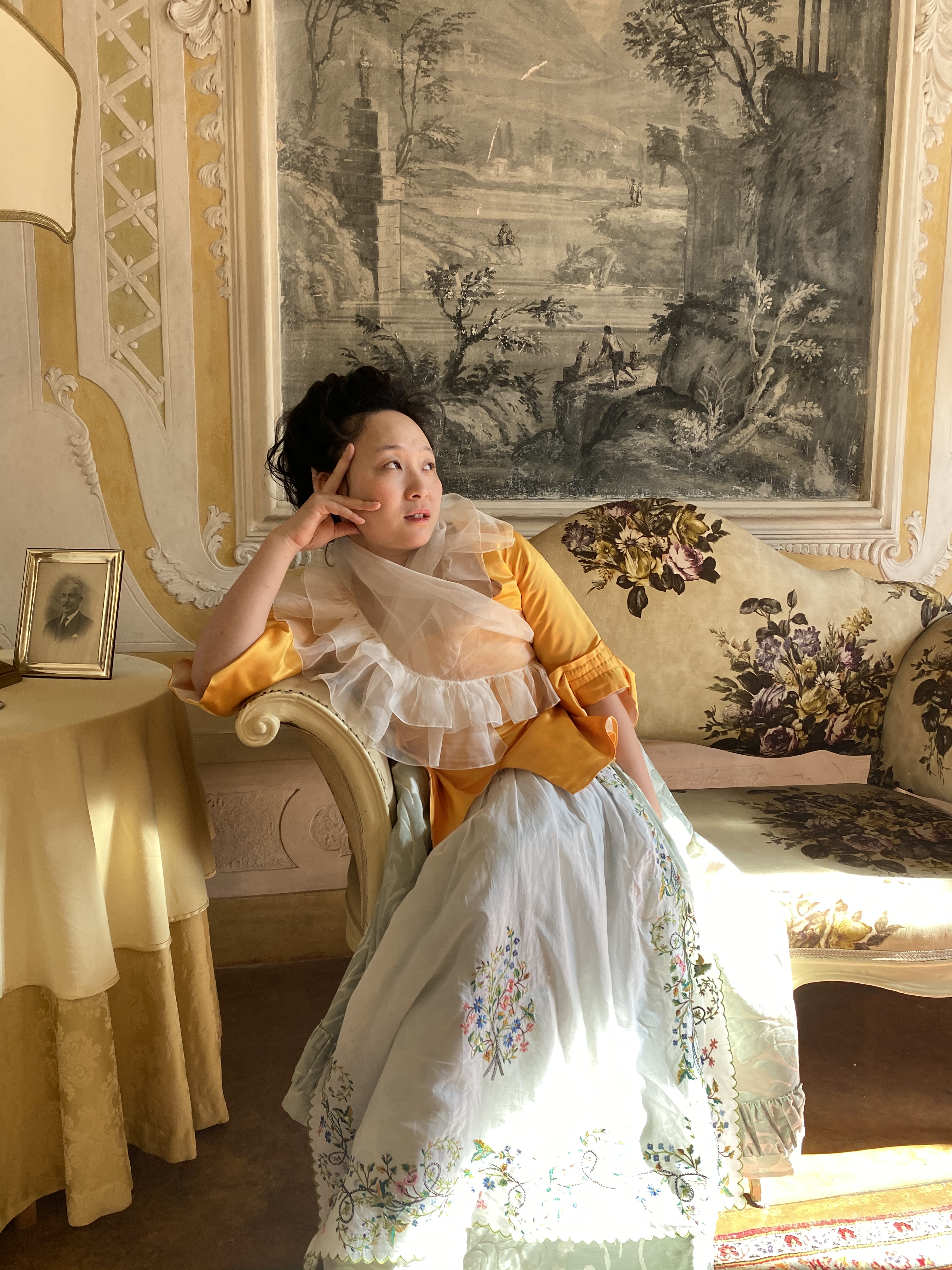
Honestly, I think the outfit with the apron is a million times prettier than without the apron and I loved it! I wore it to a friend’s birthday party where the theme was “dress as your favorite literary character”.

Now for those of you who want to make your own, I have partnered up with Baby Lock to bring you the embroidery files for free! Here is the link for anyone who wants it!

Making Felicity Merriman’s Birthday Dress from “Happy Birthday Felicity!”

Oh man it’s been a while since I made a blog post, but I wanted to share all about my new dress that I’ve been making, and I realized to some degree, that I think that blogs might be somewhat easier to use than video tutorials. Let me know in the comments what you think, but for the next few projects, I’m going to try to do a few blog tutorials and see if people find it easier to learn from and help with projects. In part, because it’s so much faster to scroll through and skim and read closely on the steps you want vs learning about the whole process. On the other hand, I feel like for certain things, it’s a thousand times easier to see a thing with video vs describing something. For instance, when learning a new stitch, I find a video inherently more helpful than a thousand words! So let’s see how well this works!

In any case, for this one, I’d like to talk all about making my Felicity’s Birthday Surprise dress.

This is right up there in my “favorite Felicity gowns ever” – it’s hard because she has so many. But I really wanted a pink Italian gown to wear, and this one is just so lovely and has so many wonderful little elements to it.

The original gown on the doll is a cotton dress with a little pinner apron. The pink dress itself is one that closes in the back – and very likely, the original dress that a ten year old girl wore would also close in the back.

I plan on making another post for the apron in a week or two, but this is the write up about the dress itself.

In summary, this is what I used.

  • The Scroop Pattern – The Angelica Gown – View A
  • 8 yards of a 100% pink linen fabric from Sai Silks in NYC.
  • 2 yards of cotton twill for the lining
  • Lightweight linen for the lining
  • 6mm wide boning from Burnley and Trowbridge
  • ½” cotton tape from Burnley and Trowbridge and ⅛ cotton tape
  • Silk thread (50wt #48 to match my linen) for handsewing and machine sewing
  • Tulip needles – #9 sewing needles

The Scroop Pattern comes with some great instructions, but here is my write up on how I made it, since I used a combination of 3-5 different sources other than this pattern, so if my instructions seem different from the pattern, that is why:

  1. 18th century Dressmaking by Abby Cox and Lauren Stowell
  2. The English Gown pattern by At the Sign of the Golden Scissors
  3. Patterns of Fashion by Janet Arnold –

So first off, I used the front, back, back, and shoulder pieces to make a mock up. The mockup overall fit great except that the front was just far too long on me. I ended up putting it on and redrawing the front to make it just the right shape to fit my torso. But otherwise, I didn’t have to change the back or straps all too much.

Once that was all set, I took it off and used the pieces I had cut to edit the paper pattern pieces to exactly how I wanted it, also adding in the 1/2 “ seam allowance with a transparent ruler and a marker.

My favorite ruler by far is this one, that folds for easy stowaway.

I then tried it on and it was perfect!

I then started by cutting out the linen fabric as well as the cotton twill I planned on using as a lining. Now mind you, a historically accurate gown would be lined in linen. However, linen is very wibbly wobby and has a strong tendency to stretch, and I really didn’t want the interior of this to stretch. Meanwhile, cotton twill, especially the kind of I love (the Gardenia twill from burlapfabric.com) is really strong, soft and doesn’t stretch much at all. So I prefer to make my linings out of that one. However, I am very picky about the feel of sleeves, and prefer to use a thin handkerchief weight or medium weight linen for my sleeve linings. Just a heads up if you notice that the lining for my sleeves are different.

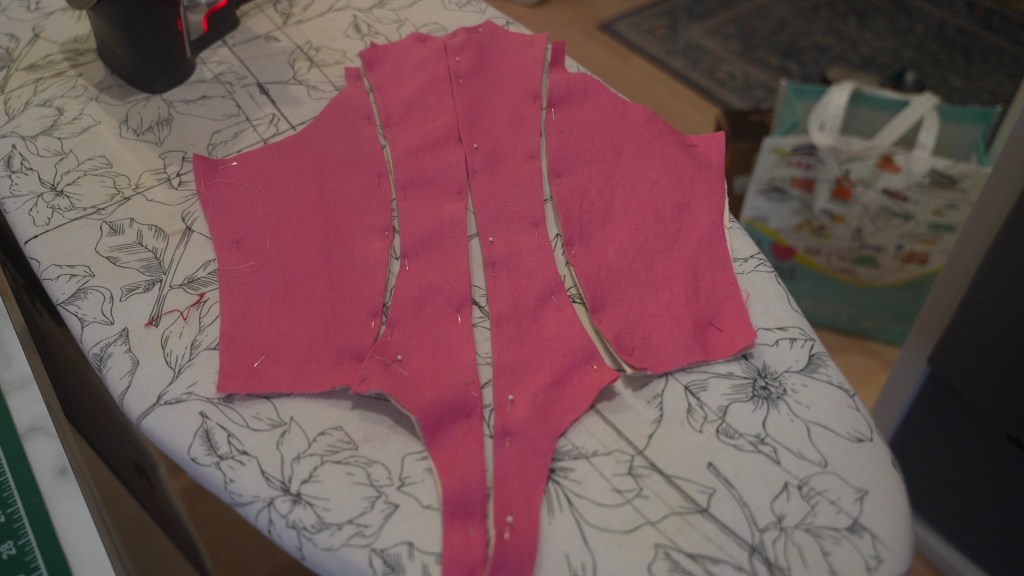
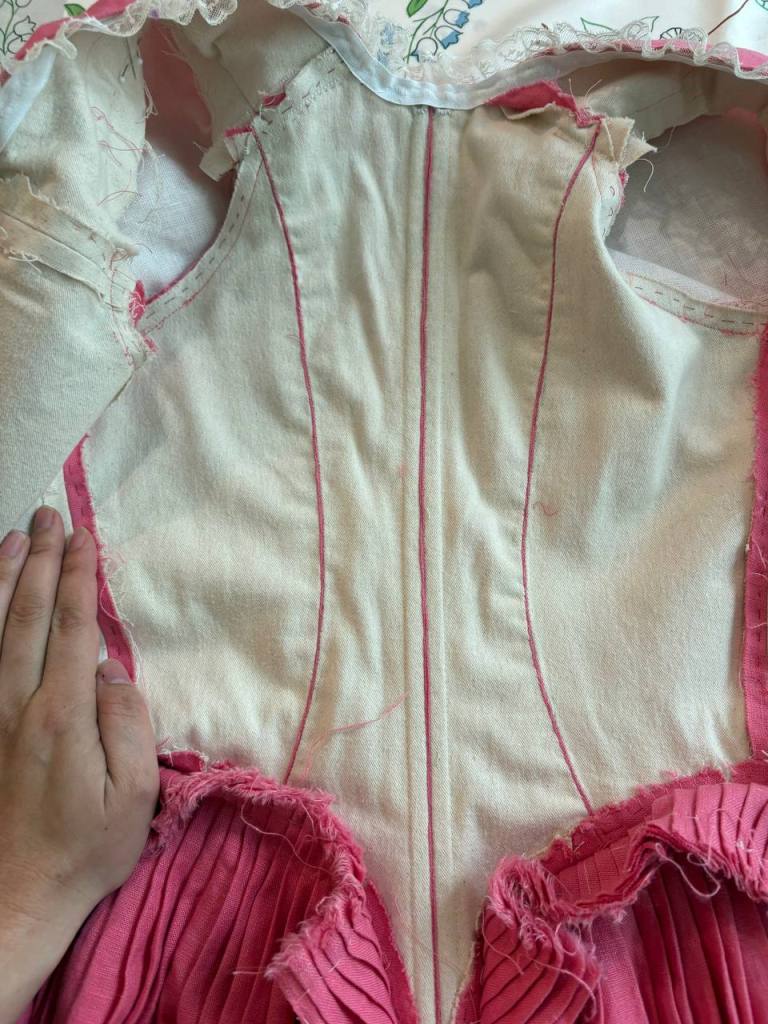
Anyways, once all the pieces were cut out, I started out with the back. Here I used my American Duchess book instructions. I folded the center back, and marked a place at the top of the center back neck to sew in an eyelet by hand. I then sewed in a 6mm wide channel my machine on my Babylock Soprano. Why do things no one will see by hand anyway? I did that for both back pieces. This way, a piece of boning can be inserted into the back later and removed for easy cleaning as well. I then ironed down the seam allowance on the top, and all the sides but not the bottom of the lining. I ironed down the seam allowances on the exterior pink lining pieces as well.

I then pinned the wrong sides together of the back and the back side pieces together. This was basted together using a brightly colored thread.

Now this was sewn together using the English stitch. Arguably, this could have been done by Machine, but I honestly love how this makes thes lining look – where you have all the wrong sides already in with a thin line of the exterior fabric showing at the very center of the stitch. It’s so neat, and strong, and it’s honestly a lot of fun to sew, so I didn’t mind doing it by hand. Seriously – that’s my thing – I do all the fun parts by hand, and if I ever tire of it, I make my machine do it!\

I’d say a good 90% of this gown was done by hand. The not fun 10% was done by my Baby Lock Soprano.

So the English stitch is where you have all those fabrics all pinned together, the seam allowances already tucked away. You pin the two pieces you’ve basted, right sides together, wrong sides out. Then you get a very strong piece of thread a thimble, and you start from one end, skip the lining, go to the fabric, stitch through all three layers (the outside fabric, the outside fabric, the lining) right at the edge, and then pull through. Then from the side you’re on, do that back, always skipping the layer closest to the needle. If this is still unclear to you, check out my video on my Meet Felicity Dress – https://youtu.be/dT8wZTs_MO8 – it’s right there for you to watch. (See? This is where youtube is superior to blogging!) Also, this was explained beautifully in Abby Cox’s book so that should help too.

Please notice the edges along the bottom were kept raw. This gets folded down and stitched by hand, the edges left raw on the inside. Don’t fret though – this is completely historically accurate. You’d be shocked at how many seams were left raw and unfinished in 18th century garments on the inside. Even ball gowns, beautifully finished in every way on the outside will have just unfolded, unstitched edges on the inside.

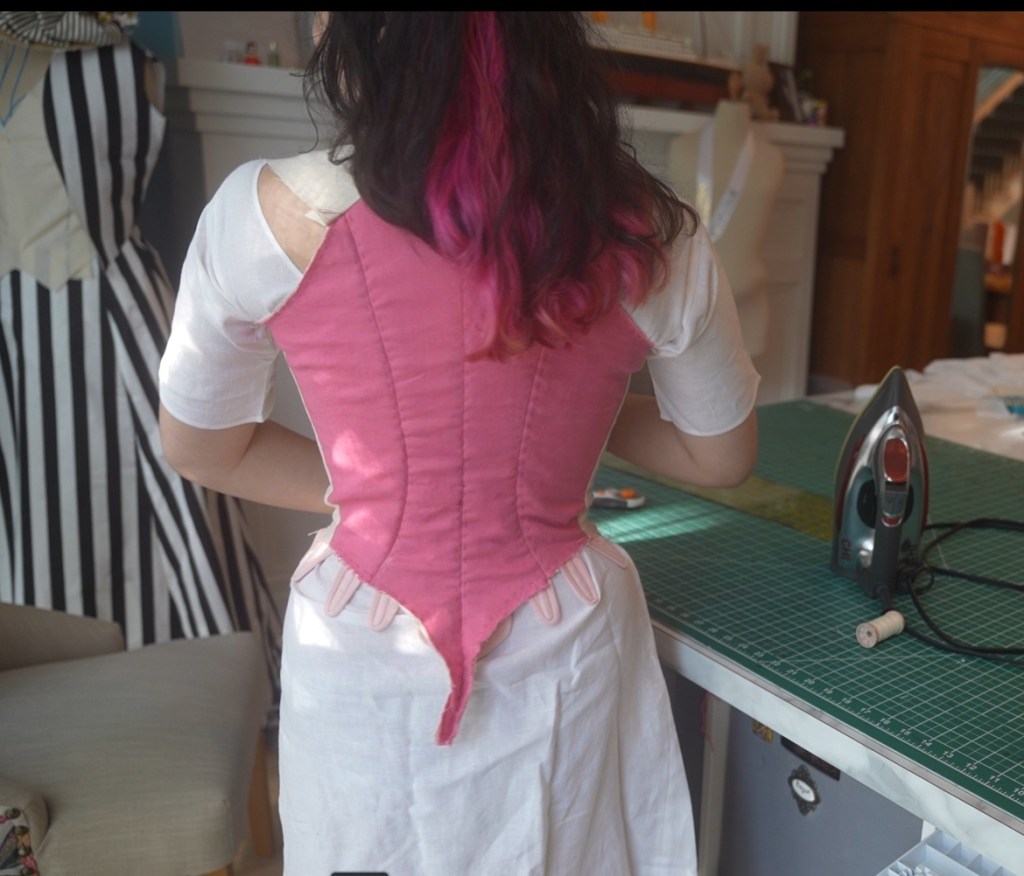
So I did the English stitch for the center back seam as well as the two side seams between the back pieces and the next side piece. I have a finished picture of the back because I forgot to take a photo of it before I added it to the sides.

Now for the front piece, which also acts as the side piece. I started with the lining portion first.

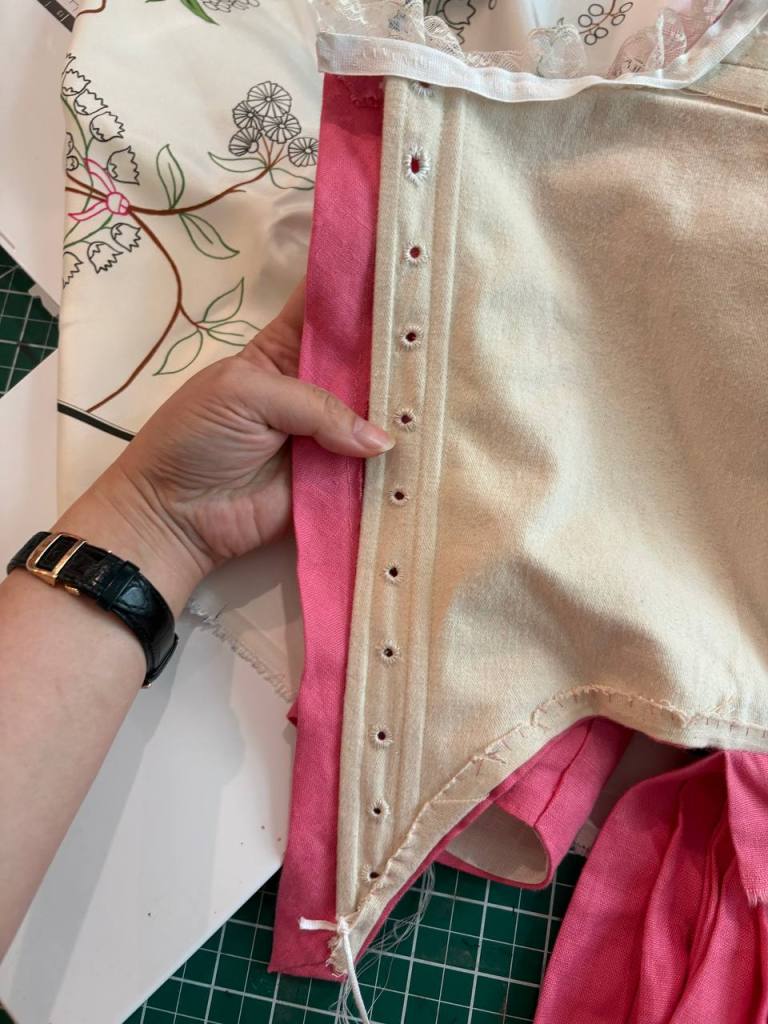
I cut this out in some strong cotton twill, and folded over the line at the center front. I sewed in the channels in the center front by machine. This has three channels – the center front for boning, the next column empty so you can sew in eyelets, and then another channel for boning. These channels are made by folding over the front edge under. I did sew the eyelets in by hand using a very sharp awl and some buttonhole thread.

By the way, I HIGHLY recommend the tapered awl by Clover if you don’t have one yet. https://a.co/d/6plHlag But never travel with it – I had my last one taken away by TSA.

Honestly, this step is so silly since it would only take me an hour and a half, but these two center pieces with the need to do the buttonholes – sat in my “two sew” bag for a good 8 months before I finally got around to sewing the eyelets. Once they were done, I then ironed down the seam allowances at the top and bottom, and sewed them flat on my machine (since this part is boring), and was finally ready to add it to the back.

This, I sewed in by machine to the prepared back pieces (meaning the four back pieces I’d already sewn together using the English stitch). I pinned on the straps and made sure that it fit, and it fit beautifully so I stitched that part down by machine.

Now I added in the front panel. The two front panels pieces were ironed around on all four edges, and then I pinned them, wrong sides together to the front panel lining piece in cotton twill. Now heads up, the front edge was about 1/2″ wider than the lining piece in front so that there would be overlapping in the center front of the gown. This was stitched down with a spaced back stitch by hand since this would be seen on the top, the bottom and the side back. I did NOT sew the front of the pink exterior fabric to the very front of the lining where the eyelets are – this way I can still lace it up in front, and then the fronts will then be pinned together.

The 18th century method is to iron down the seam allowances first, put the fabrics wrong side together, and then sew it using tiny pin prick stitches. It’s very satisfying but of course, more time consuming. I do find the fiddly bits a lot of fun though!

I was now ready to add the sleeves. I stitched the sleeves by hand – I could go into it more – but since it’s fairly complex to describe, and I don’t want to take the wind out of someone else’s sails, I’ll just say that I used the method described in the English Dress Pattern by At the Sign of the Golden Scissors. It’s done by hand but is so satisfying to sew that I always just use that method. I did use machine to sew in the darts at the back of the sleeve, but did do everything else by hand.

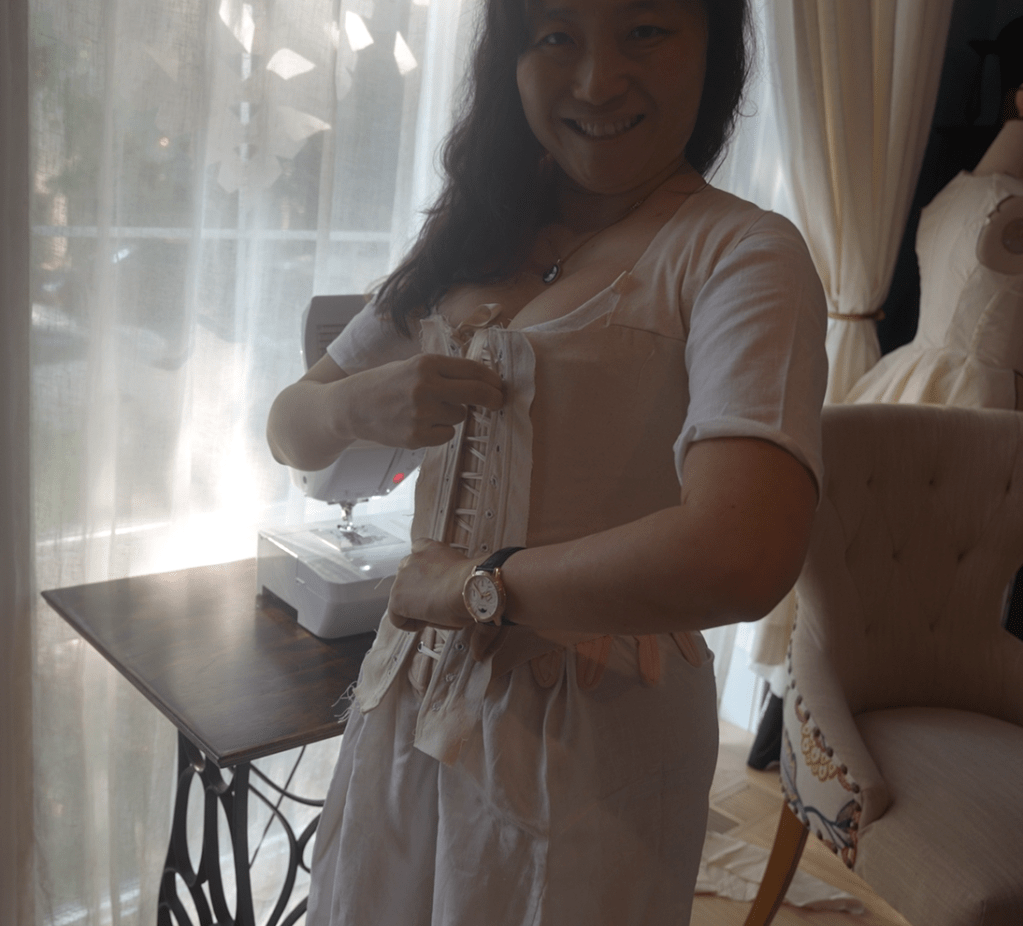
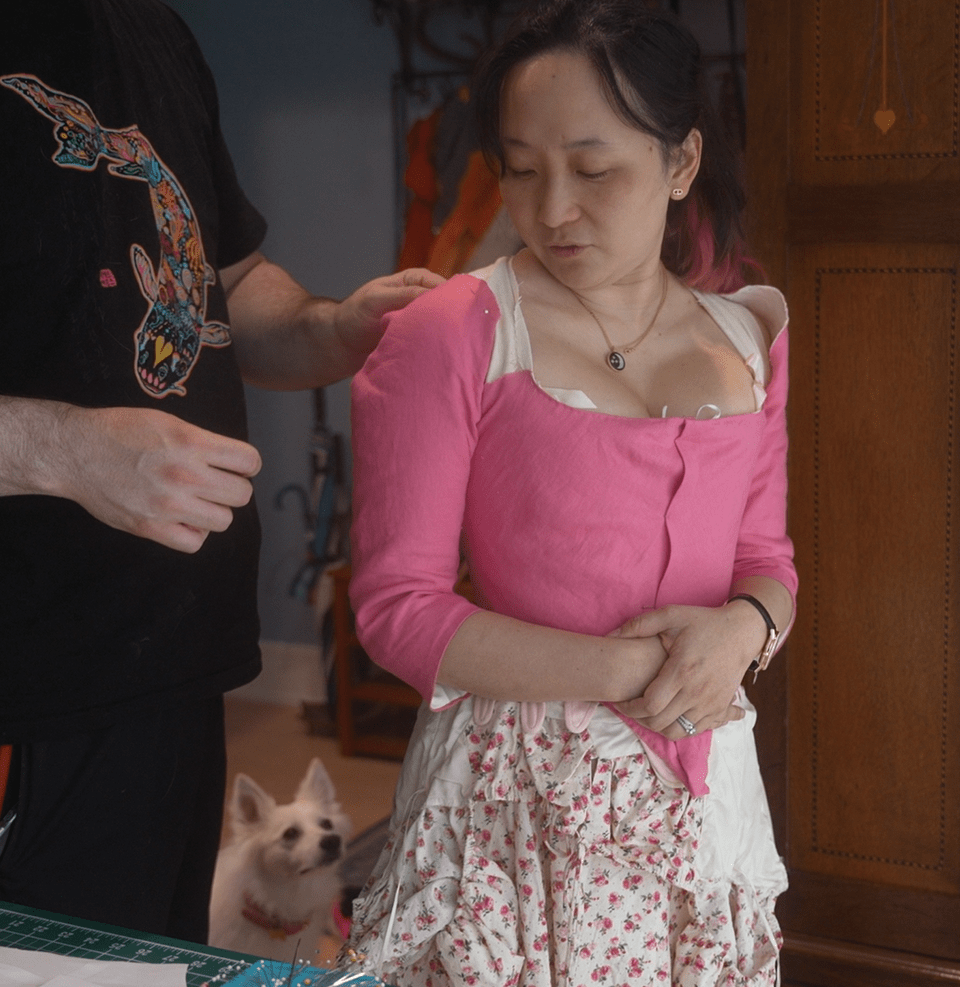
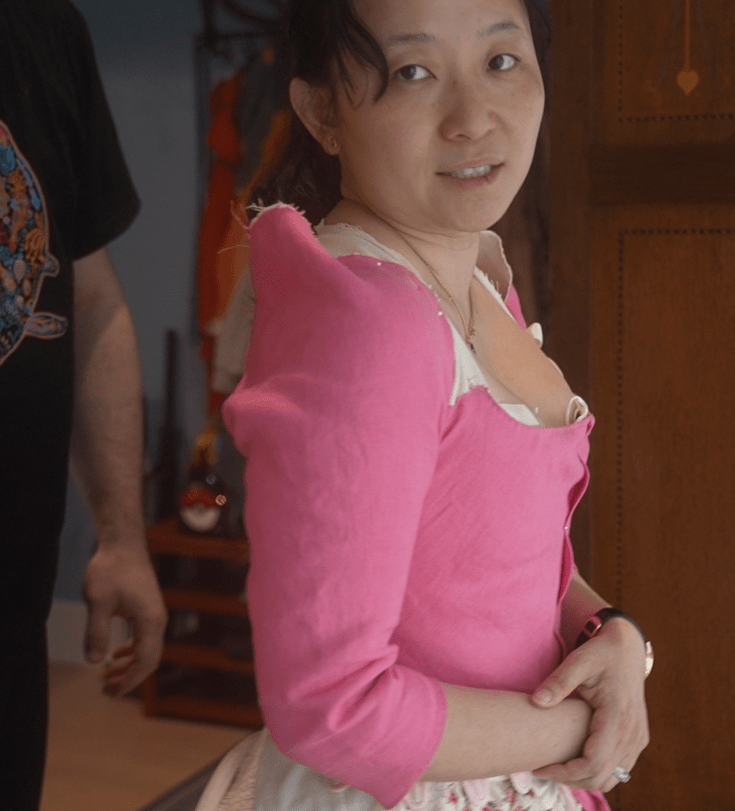
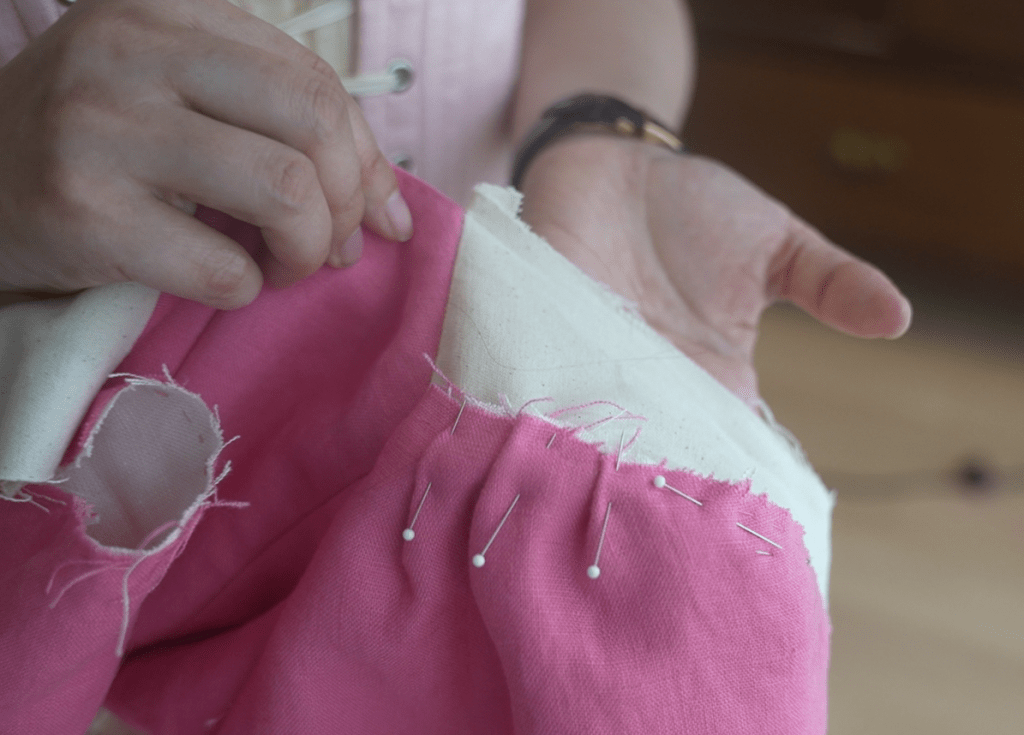
Once the sleeve was stitched, I attached it to the bodice along the bottom 6″, from the back point (where the strap meets the back arm hole, for around 6-7″. I then put on my corset, put on the dress, and closed the front (this is important), and then had my husband pin the sleeve onto the arm strap for me, pinning all the way back, smoothing the fabric over my shoulder head and pushing all the bulk to the back. This is how it was done historically as well. After, the excess fabric was pleated to 3 small pleats in the back, and then stitched to the shoulder strap with my machine.

I then covered up this mess with the linen fabric, with the seam allowance pre ironed in, and the wrong sides together. This was stitched down by hand.

MEANWHILE, I prepped the skirt.

I knew that I wanted the skirt to be 43″ long in the back and 40″ in the front, and go over my little split bum pad. I wanted this portion to be 120″ wide, or twice the selvedge. So I sewed two pieces of fabric together to make one long piece of fabric 45″ tall and 119″ wide.

I hemmed the front edge by folding it over twice and sewing the edge down by hand using a matching silk thread.

I hemmed the bottom 2″ all the way around.

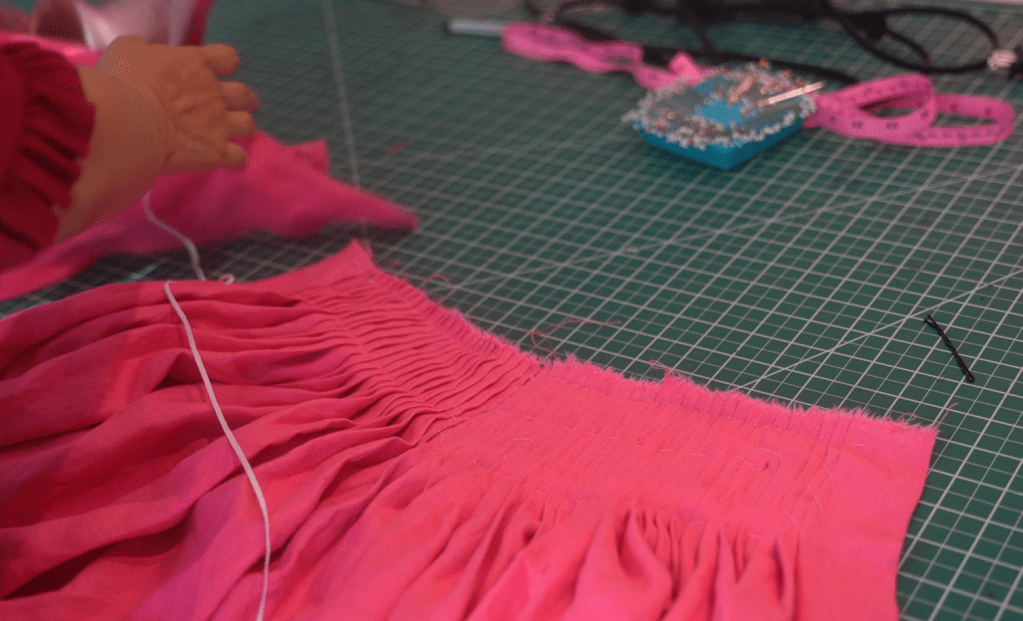
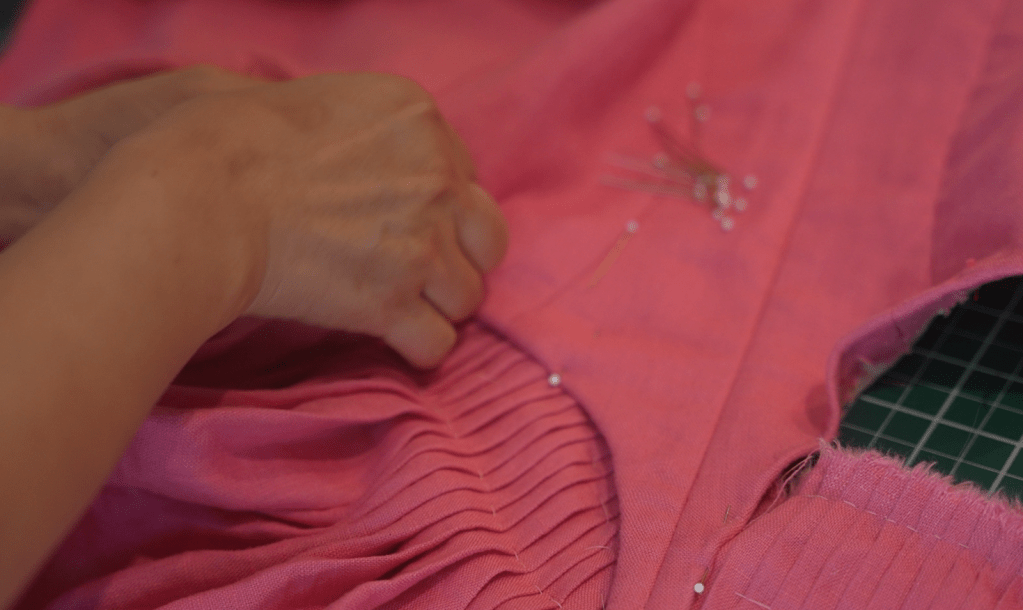
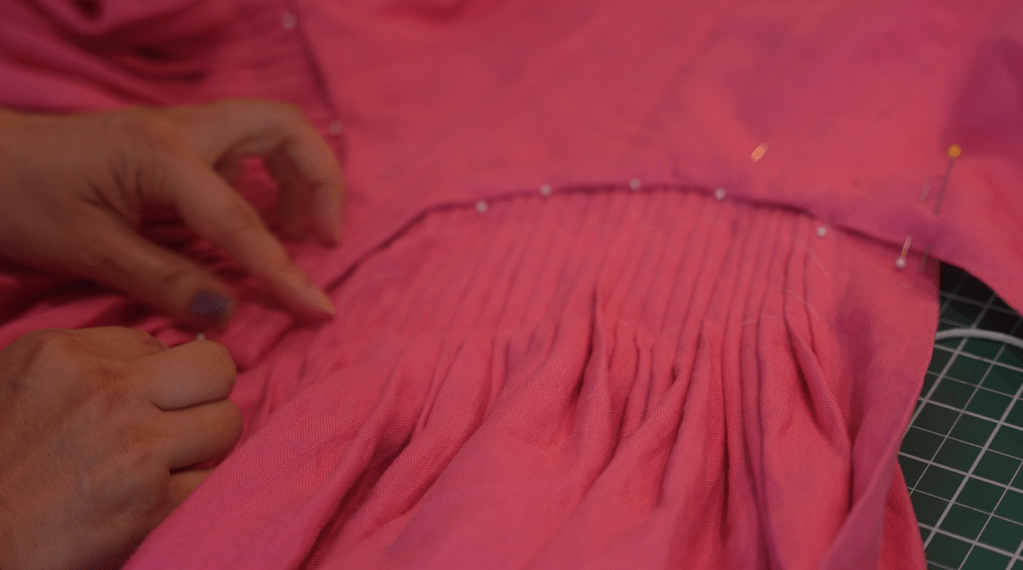
I then pleated the fabric up to around 8.5″ on either side of the center seam line with 1/4″ pleats. (The 8.5 was what I determerined to be the length from the point at the back to the side where I wanted it to sit in the front. This might be different for other people).

Once this was all pleated with pins, I sewed it down with a basting stitch in a contrasting thread for easy removal later.

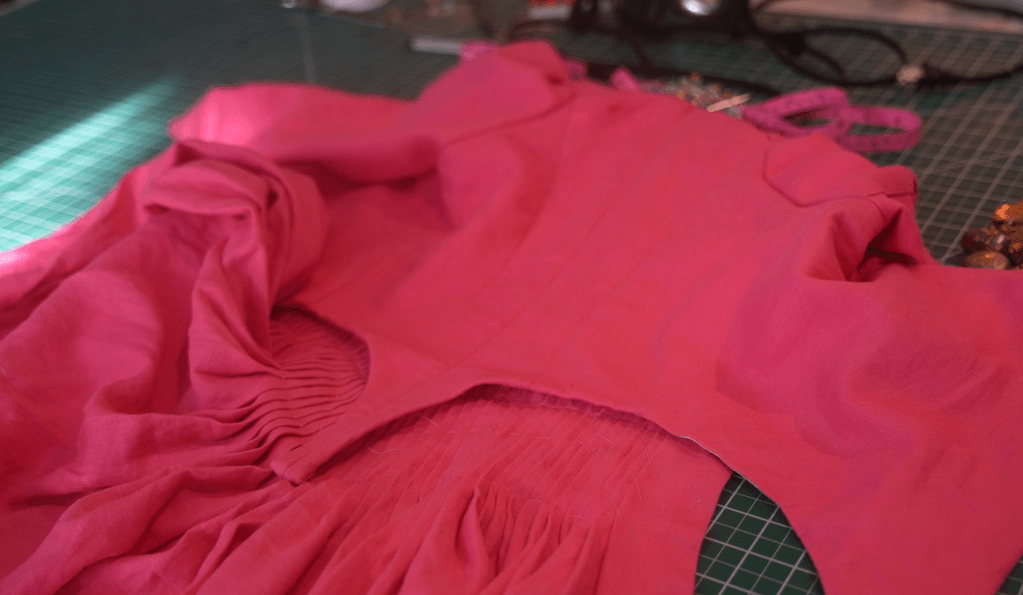
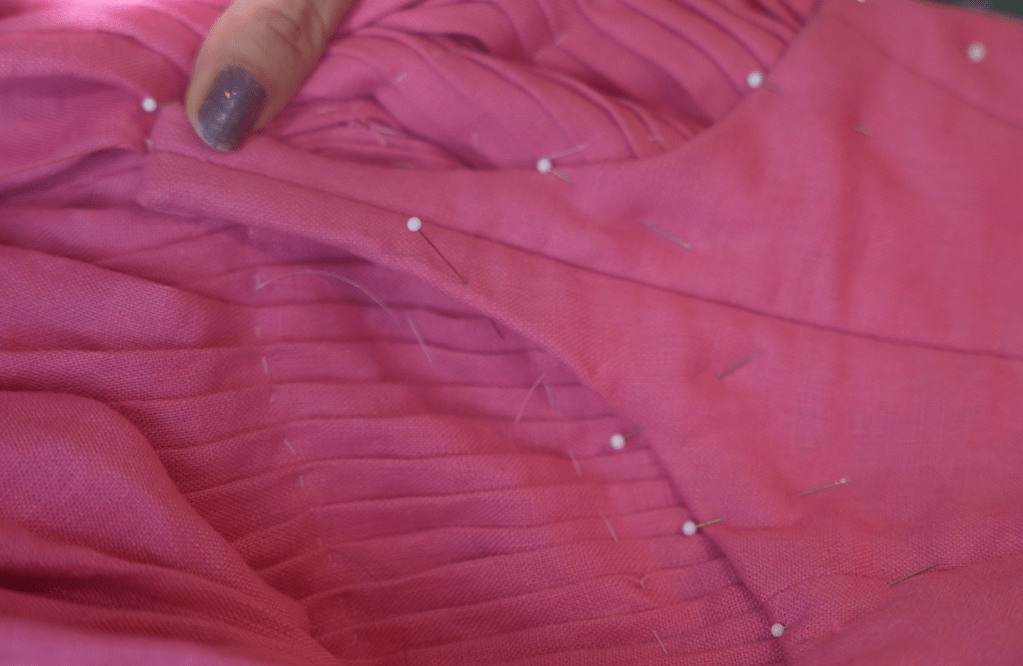
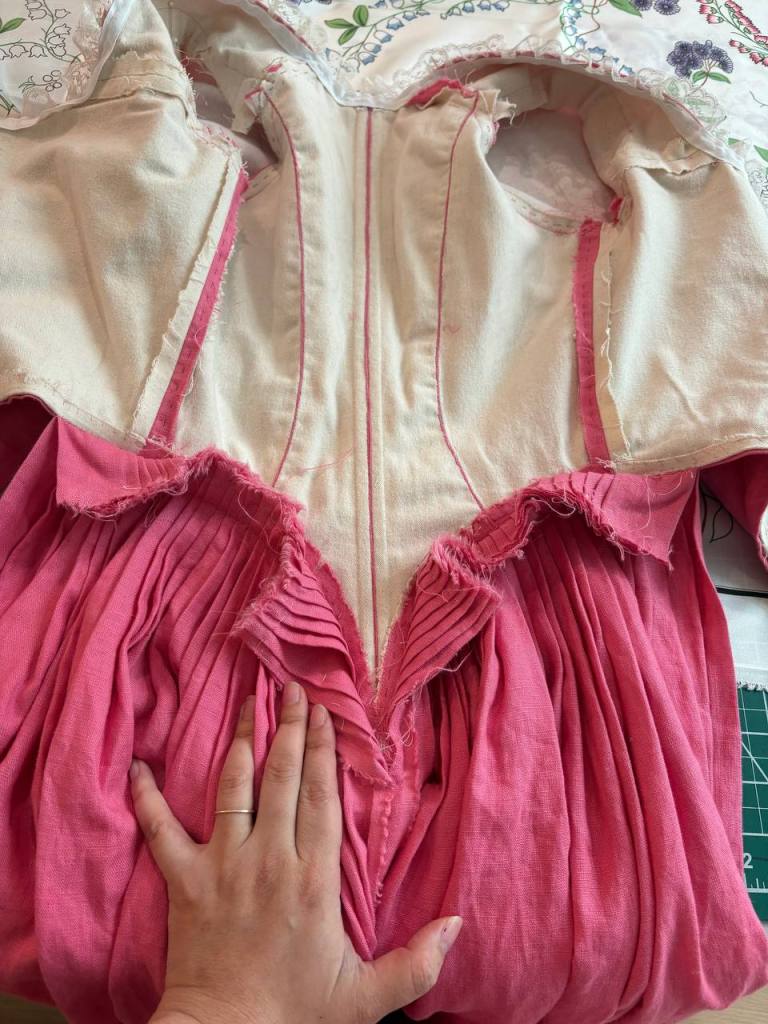
Then, using a very strong thread, well waxed, I stitched the skirt to the bottom edge of the bodice, 2-3 stitches per pleat.

The fabric on the inside gets pushed downwards. The center seam in the back is cut open so that it folds down easily.

And the dress portion is done!

The petticoat was done using the American Duchess method – as described in her book, and I didn’t vary this at all. Also I forgot to take photos so I’m going to skip this portion. 🙂

But yes!! The dress was done and I was madly in lvoe with how it came out.

I’ll have a new post about the apron early next month (with free patterns!) but I hope you love the dress as much as I do! Felicity was a great model!

Making Abigail Adam’s silk fichu: An adventure Embroidering on Silk Mesh

I think the absolute dream I have is to one day embroider on silk mesh in such a way that I can make my own 18th century lace. Honestly, with my first two machines, such a thing was not possible. The silk netting was too weak and the tension was too high that I got a ton of tears and heart break.

Luckily, my next machine was much better. The tension could be lowered to a significant degree and I was able to embroider on even very delicate silk netting. I now use a a Baby Lock Venture, and I’m finding that with significant play, making lace is feasible.

Suggestions:

  1. When making lace, use 2-3 layers of dissolvable interfacing. I use Baby Lock dissolvable, which is fairly thicker than most that I get on amazon, so I’m able to get away with only two layers. If I am using another brand, I tend to use 3 layers to make up for the thinness.
  2. Lower the top thread tension as much as humanly possible.
  3. Increase your bobbin pressure. Not a ton, but just enough to make sure none of it will show on the out side.
  4. Most importantly: LOWER your speed! I find that when I’m making lace it’s best to go at the lowest possible speed. I usually use 400 stitches/min which is the lowest on my Venture.

Materials:

I use silk netting – but completely honestly, finding real silk netting for less than 120/yard is very difficult. I used to have a source but last I checked, they were completely out of real silk netting. I would recommend polyester netting if you can’t find silk; it still generally embroiders well. DO avoid nylon netting at all costs – it’s weak and can’t handle all the buse you’ll be doing to it.

Thread: I use fairly lightweight Kimono Silk thread at 100wt. Works beautifully, comes in many colors, 10/10. Will totally recommend.

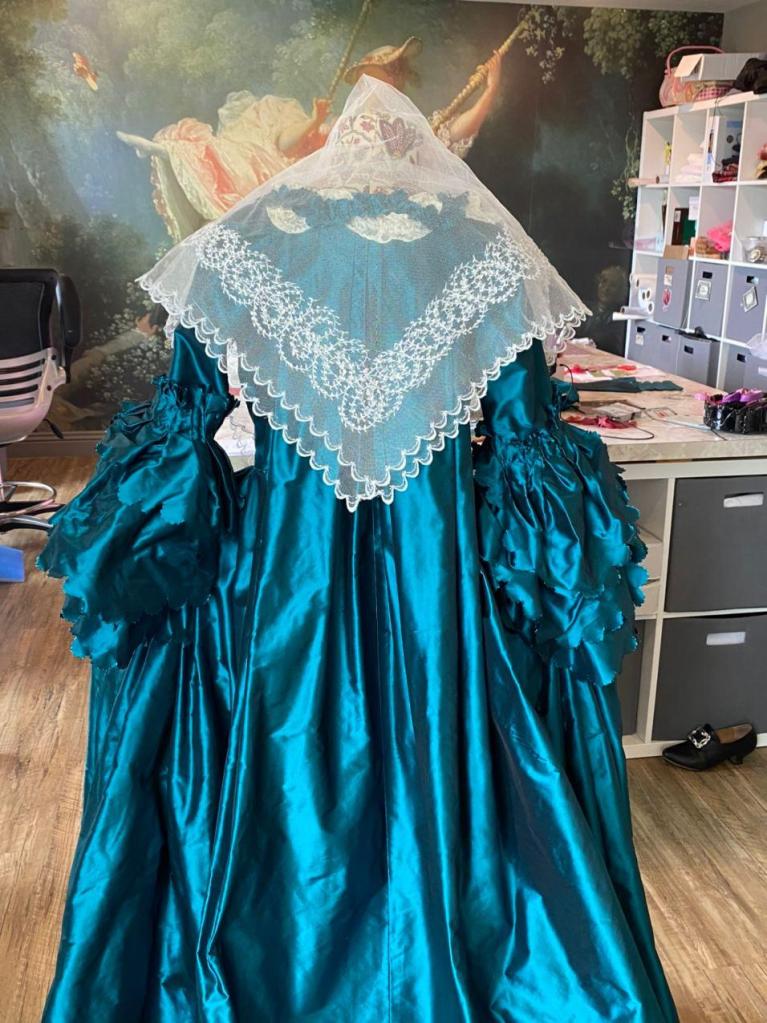
Now, let’s talk about Abigail Adam’s Fichu. I worked closely with Sara of Founding Mother on Instagram, who is a LEGIT actress who portrays Abigail Adams and a brilliant costumer to boot, to work on this. I had been thinking of digitizing this for a while, based on the painting by Gilbert Stuart.

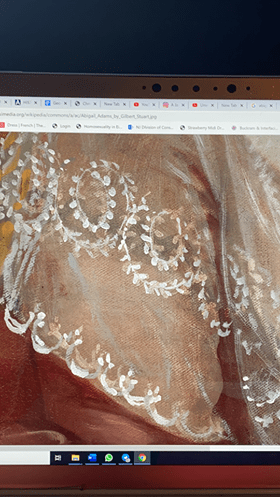
Here is a closeup of it; I’m just so impressed by how translucent it really is.

So from the painting, Sarah was able to deduce that the fichu is likely two layers, due to it being a square that is folded in half, diagonally. I’m inclined to agree wtih her, since from the painting, you can see the shadow of the second layer underneath it.

Now, one reason I was PARTICULARLY keen to digitize this is becaues a little portion of the ACTUAL FICHU EXISTS!!! A collector actually has a TIIINY piece of the fichu that survives, which, if actually the real one (and it looks accurate to me), shows it to have been silk embroidery on silk netting. I don’t feel comfortable sharing someone else’s licensed images, so I’ll just link his page here.

So… after Sarah and I decided to go with silk netting, I started digitizing the design.

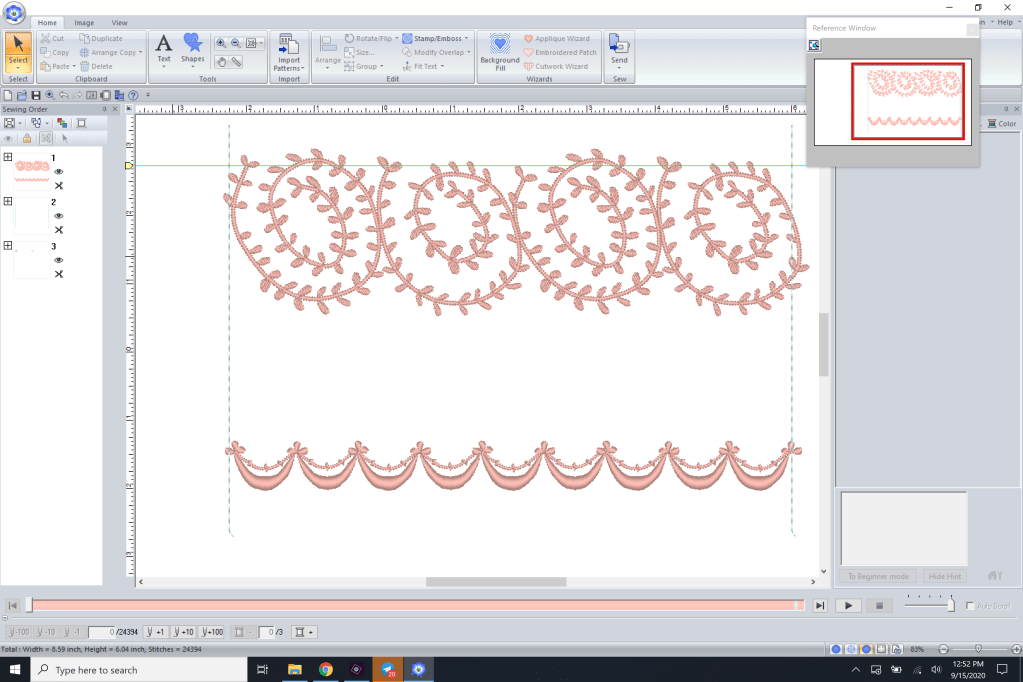
I initially started with the scallop border on my software, Palette 11 by Baby Lock. I used a stem stitch for the swags and a satin stitch for the actual scallops. I ended up switching to a fill stitch for the scallops (120 stitches/inch) and keeping with the stem stitch (0.04″ wide) for the swags.

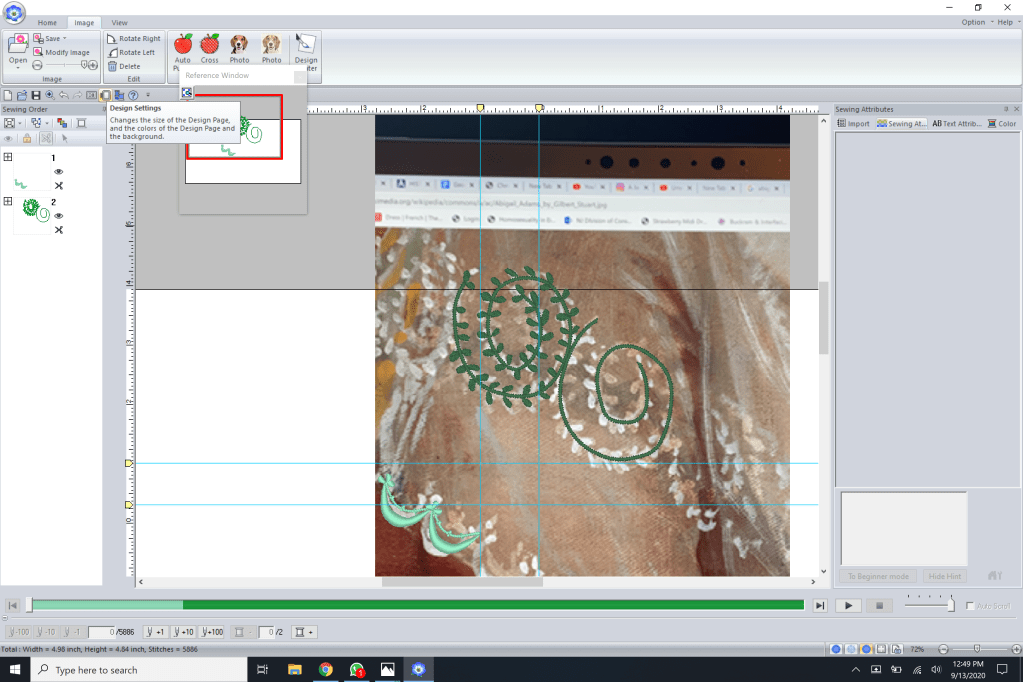
I then used the closeup of the portrait to zoom in and put the swirls close together. I ended up making 3 distinctly different swirls, and rotating them out in the actual final fichu. Having more then one that you switch out occasionally does a good job of making the embroidery look more handmade.

Sarah was able to tell me that she wanted the scallops to be about 7/8″ wide, so I used this as a guide to keep everything else in proportion.

And I was able to come up wih a repeating design that we were both happy with. Again, you’ll notice that each swirl and each swag is not exactly the same; this is intentional and actually much harder than justy copy/pasting a lot. But I feel this is so important when doing 18th century reproductions – so that it has a chance of looking hand made.

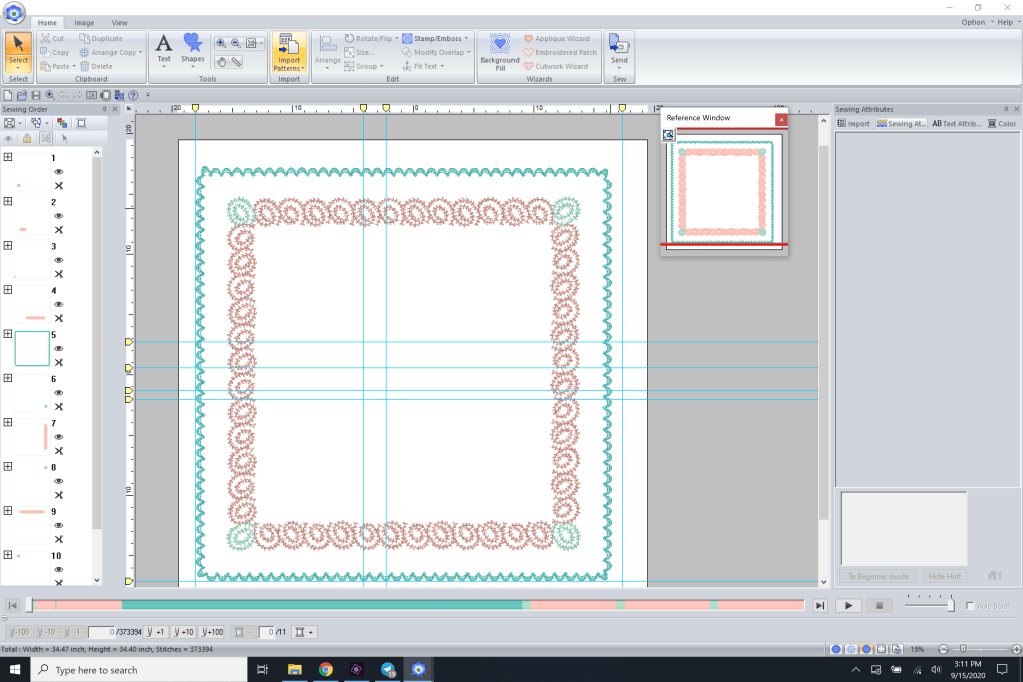
Now, I turned this into a square design.

We decided to make the final fichu 34″x34″.

Of note, square designs like this are a PAIN IN THE BUTT to embroider. The problem is that when you’re trying to embroider, especially something as malleable as silk net, it will shrink and pull. The problem with a square design is that when you have to end up EXACTLY where you started, things can get messy. I let Sarah know that there would be some “wonkiness” at the starting point, and I got started.

First, I broke up the design into 11 pieces so it would fit my machine.

You’ll notice that this looks just like the last design but I put lines where I planned to break up the design, and you’ll notice a 1, 2, and a 3, to show how I’m going counter clockwise (I’m chaotic good). With the design and plan ok’d by my client, Sarah, I got everything ready.

Then I started to embroider.

So of course, I started with the first panel. You’ll notice there are lines that help place the next part.

So I just started going at it! I initially planned on doing this 1 part every two days, do it over three weeks, since this particularly embroidery netting requires me to SIT next to the machine (in case it gets stuck so I can emergency stop it, since it tears SO easily). However, I got myself hooked and I did it in a week.

This is me lining up the last piece. As expected ad warned, there was a little bit of “wonkiness” right at the end to make it all line up properly.

But…. Let’s be real. Can you even see the wonkiness?

I then cut away the excess dissolvable interfacing and removed the marking stitches (do this BEFORE you was for the first time is my suggestion).

I then wahed it in warm water to get rid of the dissolvable interfacing.

And then I let it dry.

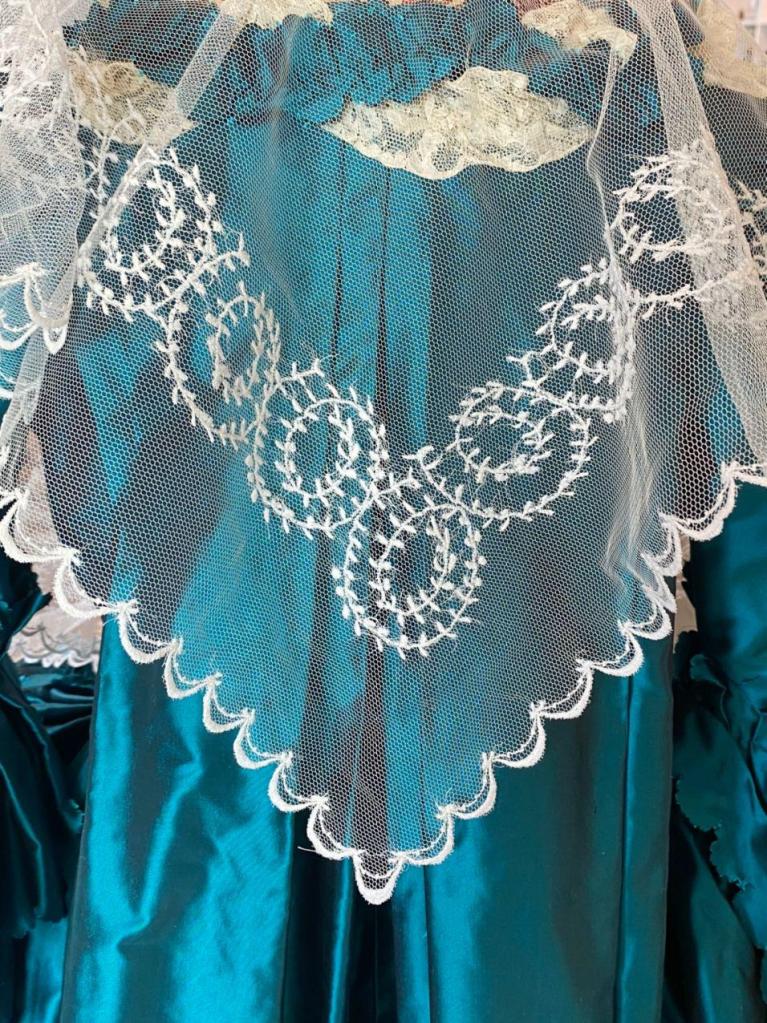
Then with a tiny pair of embroidery scissors and infinite patience, I sloooowwwwly cut away the outside netting and it left me with this.

Now, I’m pointing out the wonkiness here for Sarah’s sake… but can YOU see it?

How about now?

How about now?

So I’m pointing all this out to let all of you perfectionists know… It’s ok for things not to be perfect. I have studied actual 18th century garments and you can find mistakes everywhere. It’s ok! It’s human! It proves it’s man made. You’ll notice I intentionally put in “imperfections” to make it look more 18th century and hand made rather than machine embroidered.

In any case, Sarah loved it, and she is now working on the actual gown so she can really dress up as the Gilbert portrait! Also, I loved it too so I plan on making myself one too!

So… that’s all I’ve got folks! Happy embroidering!

PS: If you do want to embroider this for yourself, have a 14″x8″ hoop, and don’t want to digitize it yourself, I’m selling the files in my shop here: Sewstine shop

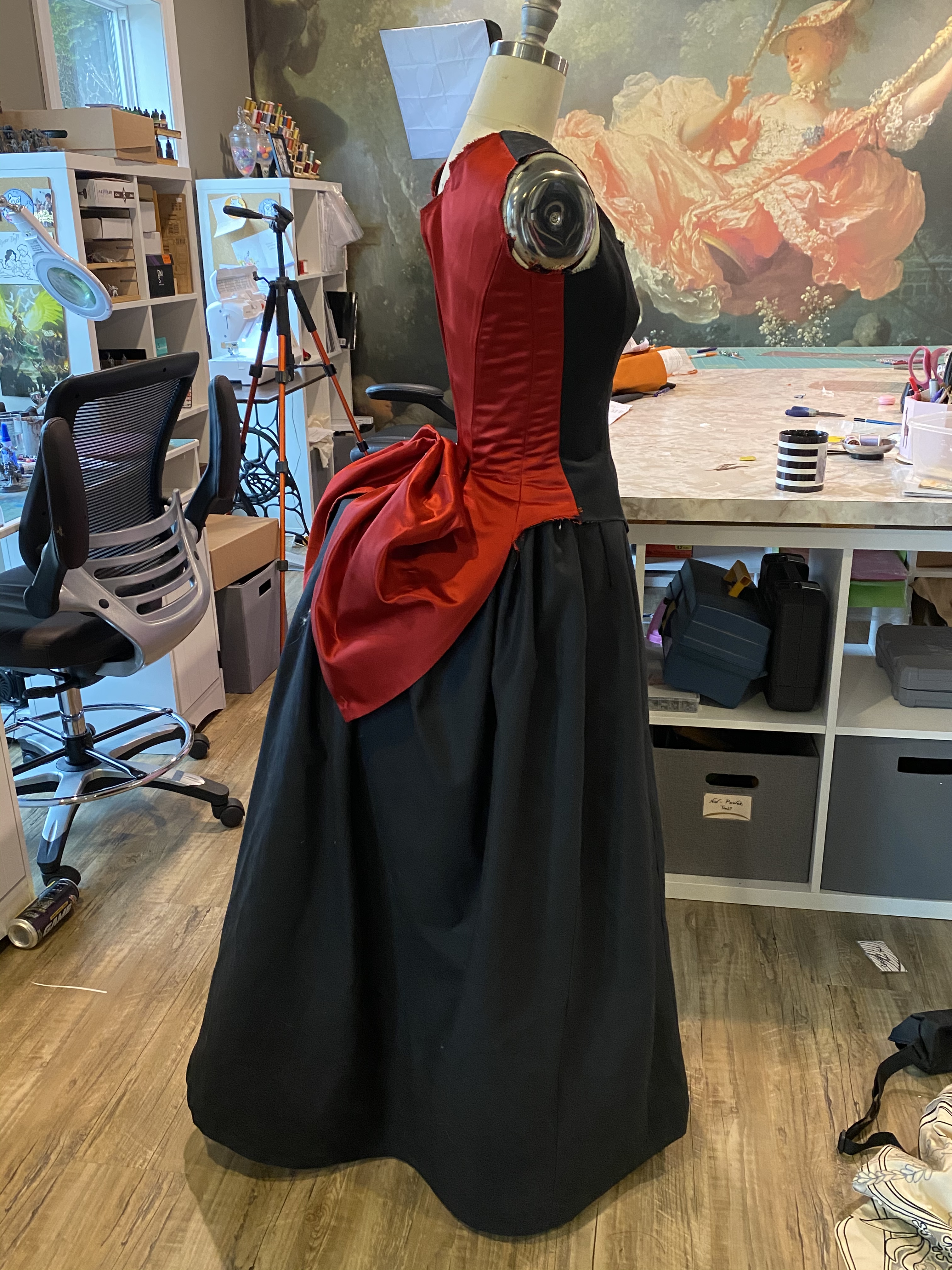
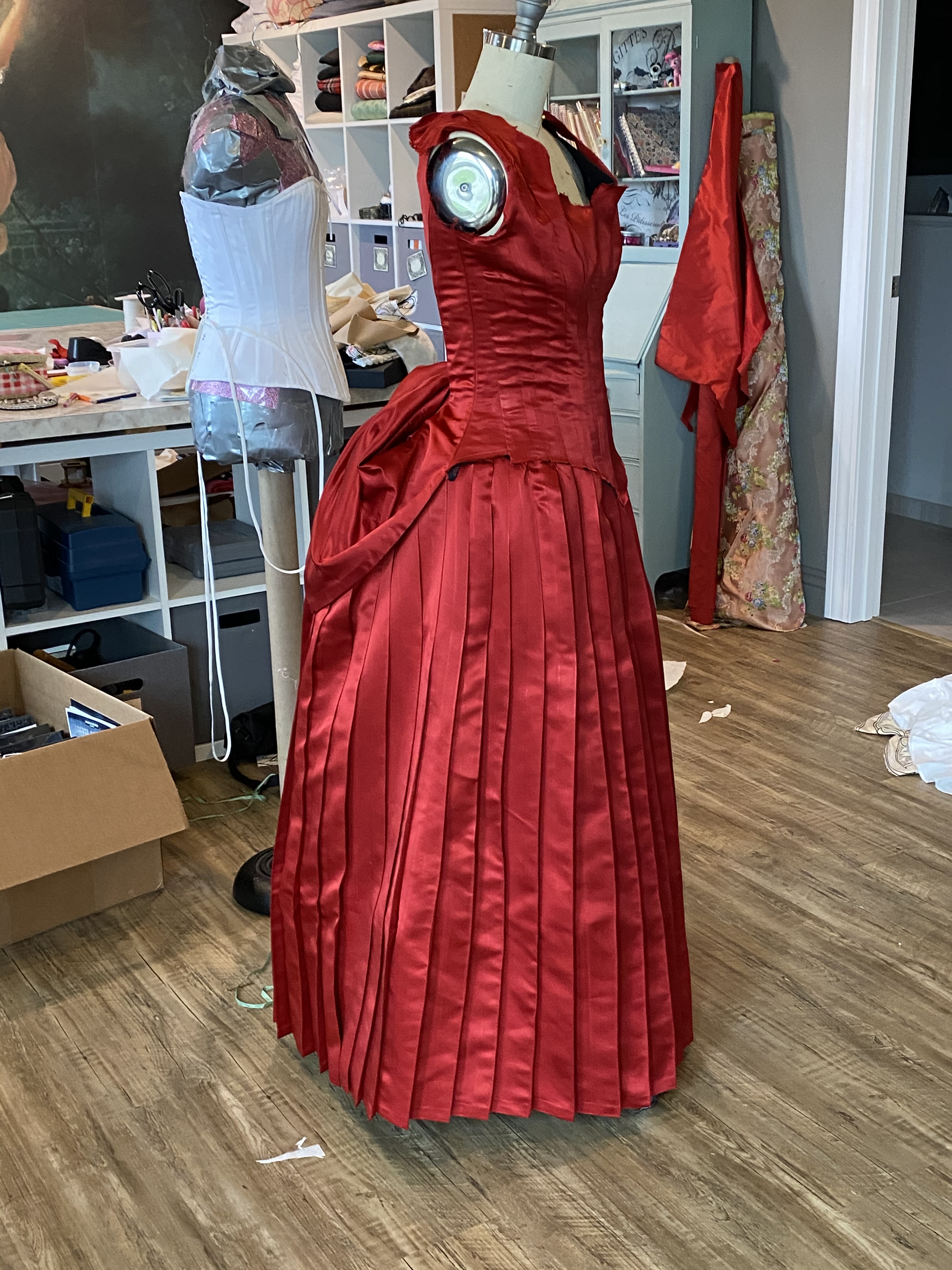
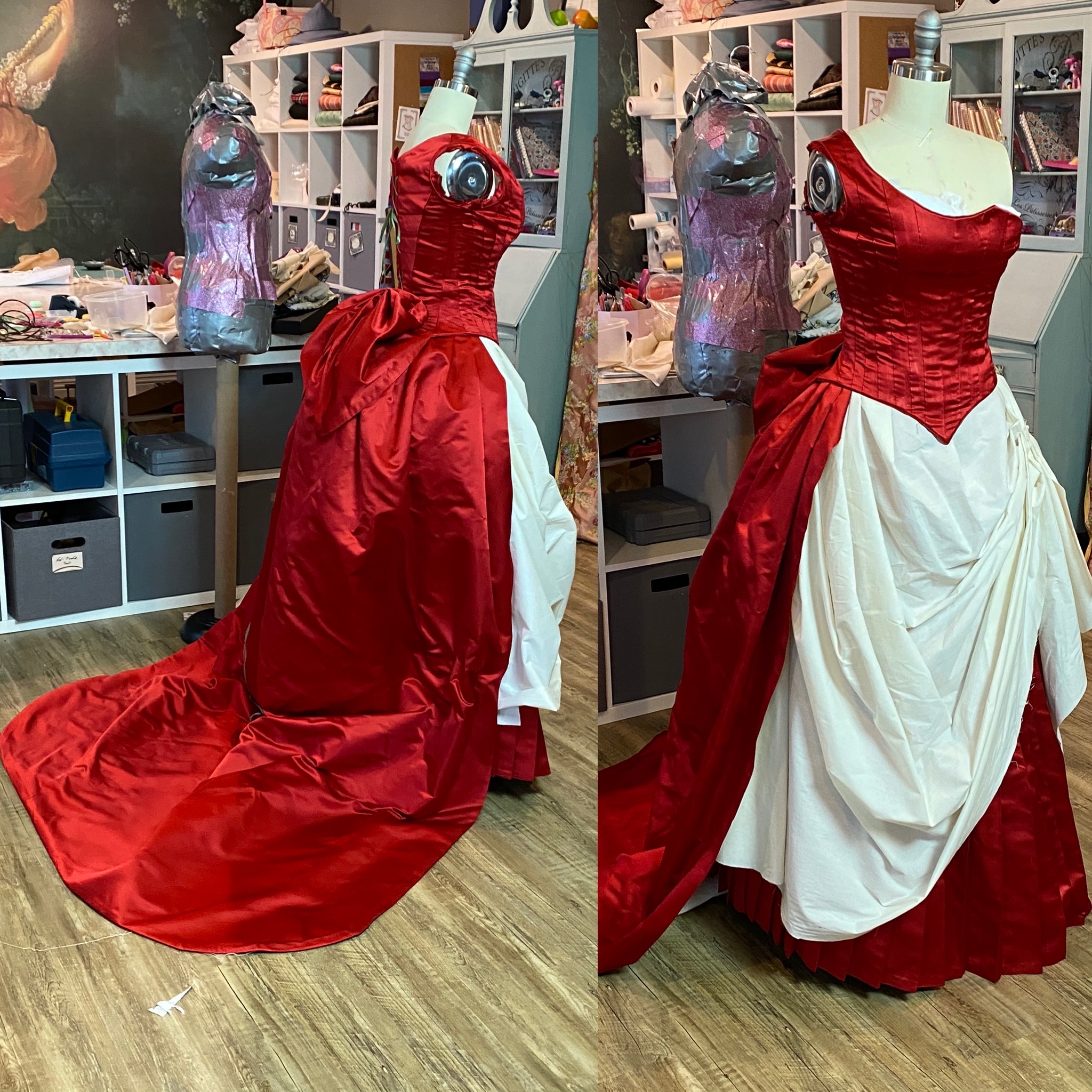
The Victorian Red Dress

I feel like any movie made in the 1990’s and early 2000’s set in the Victorian/Edwardian era had to have the female lead character in a red dress.

This defined her as our central female, and she stood out so beautifully in the film. You can see this in Mina Murray’s dress in Bram Stoker’s Dracula, Satine in Moulin Rouge (my personal favorite), and Countess Olenska in The Age of Innocence.

It was my dream to wear a Victorian red dress for prom. Sadly, my mother refused to sew me one and I didn’t have the skills back then. I ended up with a cute but not nearly dramatic number from BCBG.

So when I found out about the Prior Attire Ball in Bath in May 2020, I absolutely decided this was THE time to make this gown. (FYI: The ball was canceled due to COVID-19. Hope is to go next year)

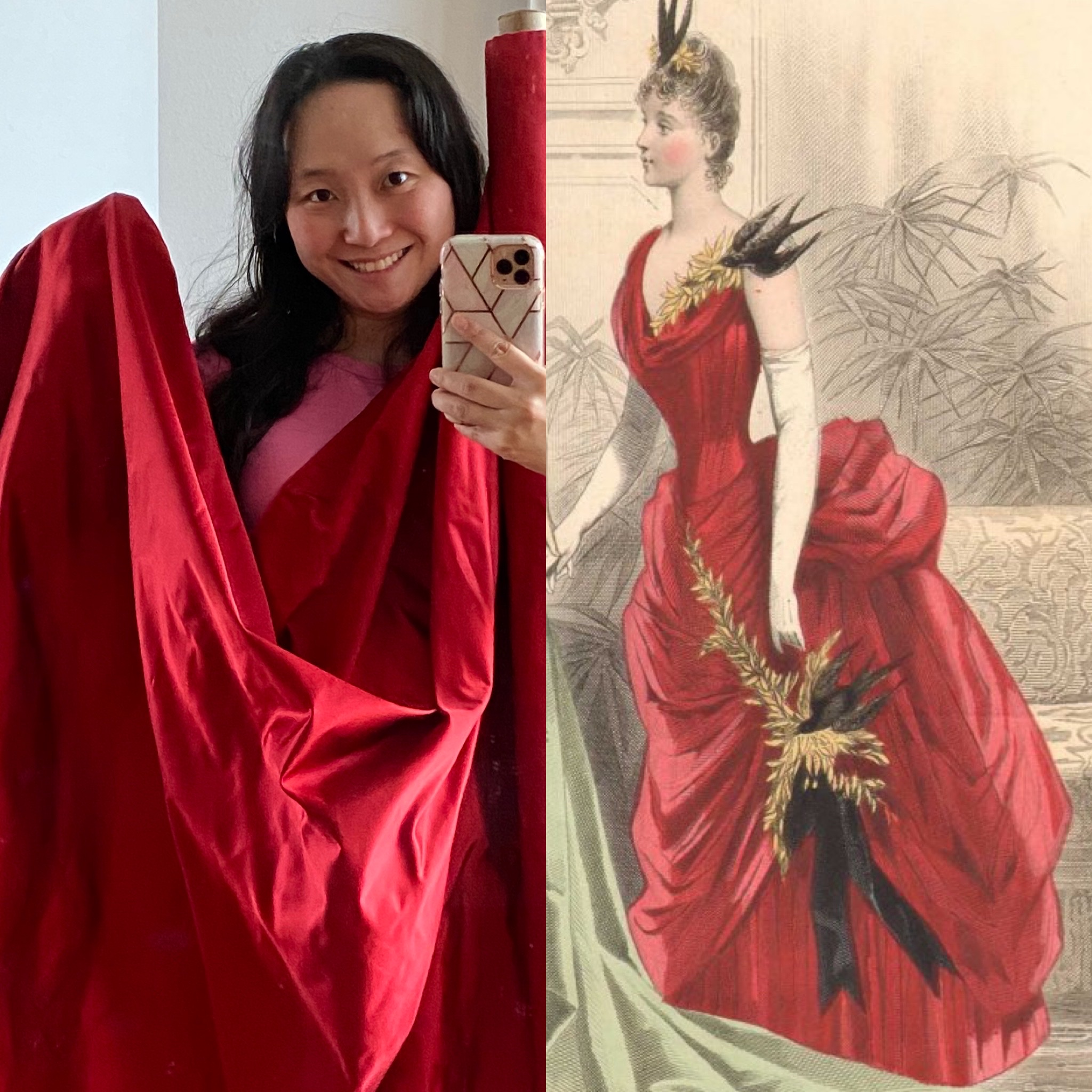
The best part was – I already had the perfect fabric in mind. For months now, I had been collecting samples of red silk satins from different shops – NYDesigner Fabrics, Mood, Silk Baron… but Mood won out. They had THE PERFECT red – called “Roja Red”, and it was a gorgeous Silk Duchesse.

I bought 11 yards of this.

roja-red-silk-duchesse-satin-pv9500-14-11

b73eb4d8-f96b-40b7-9e29-01133967f868

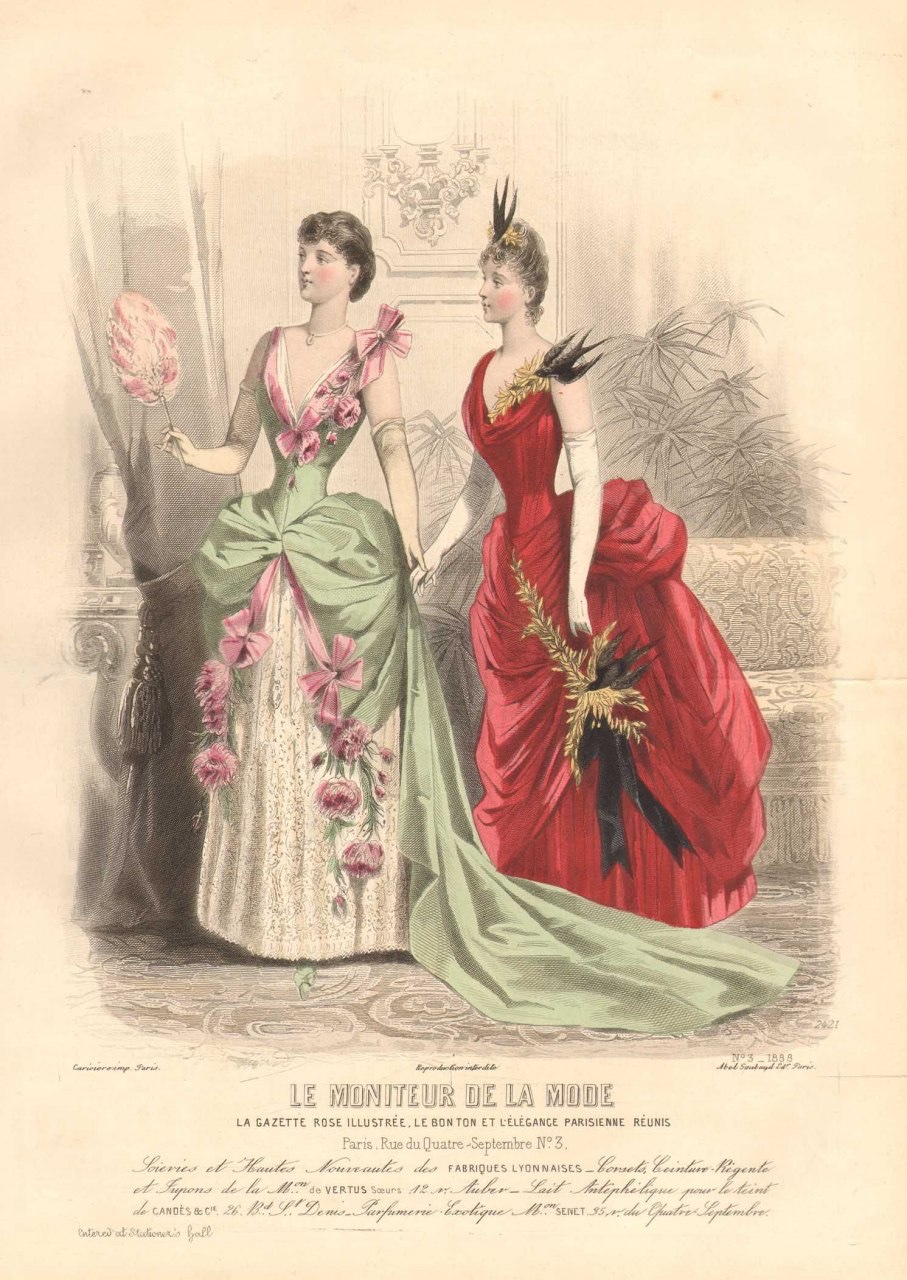
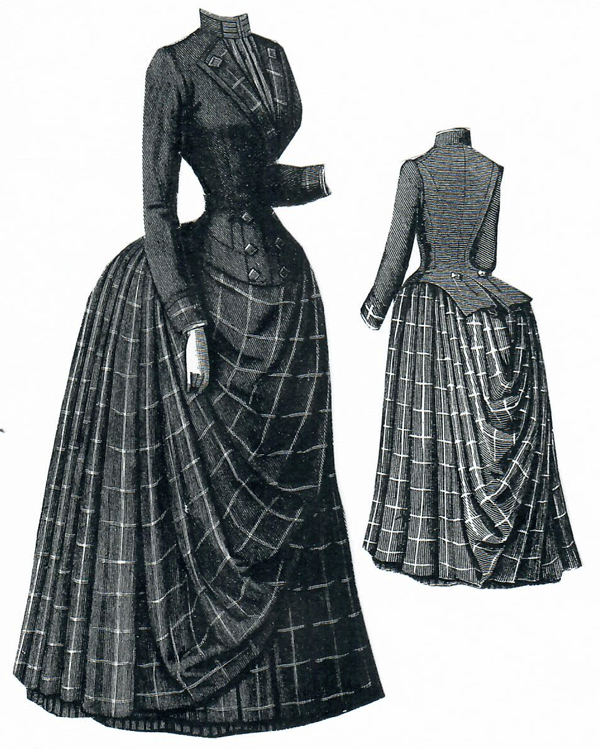
The goal was an 1880’s bustle dress, based on this particular fashion plate from 1887:

img_2320

I loved it! The black birds, (or are they crows?), the pleated underskirt, the draping…

So for the bodice, there was no perfect pattern so I used theTruly Victorian 1886 bodice.

467-1

For the underskirt, I used my go to: the Truly VictorianFour Gore underskirt.

261-1

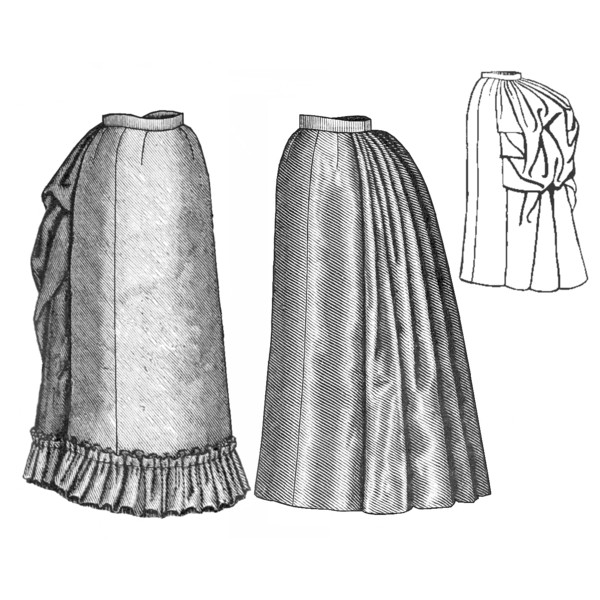
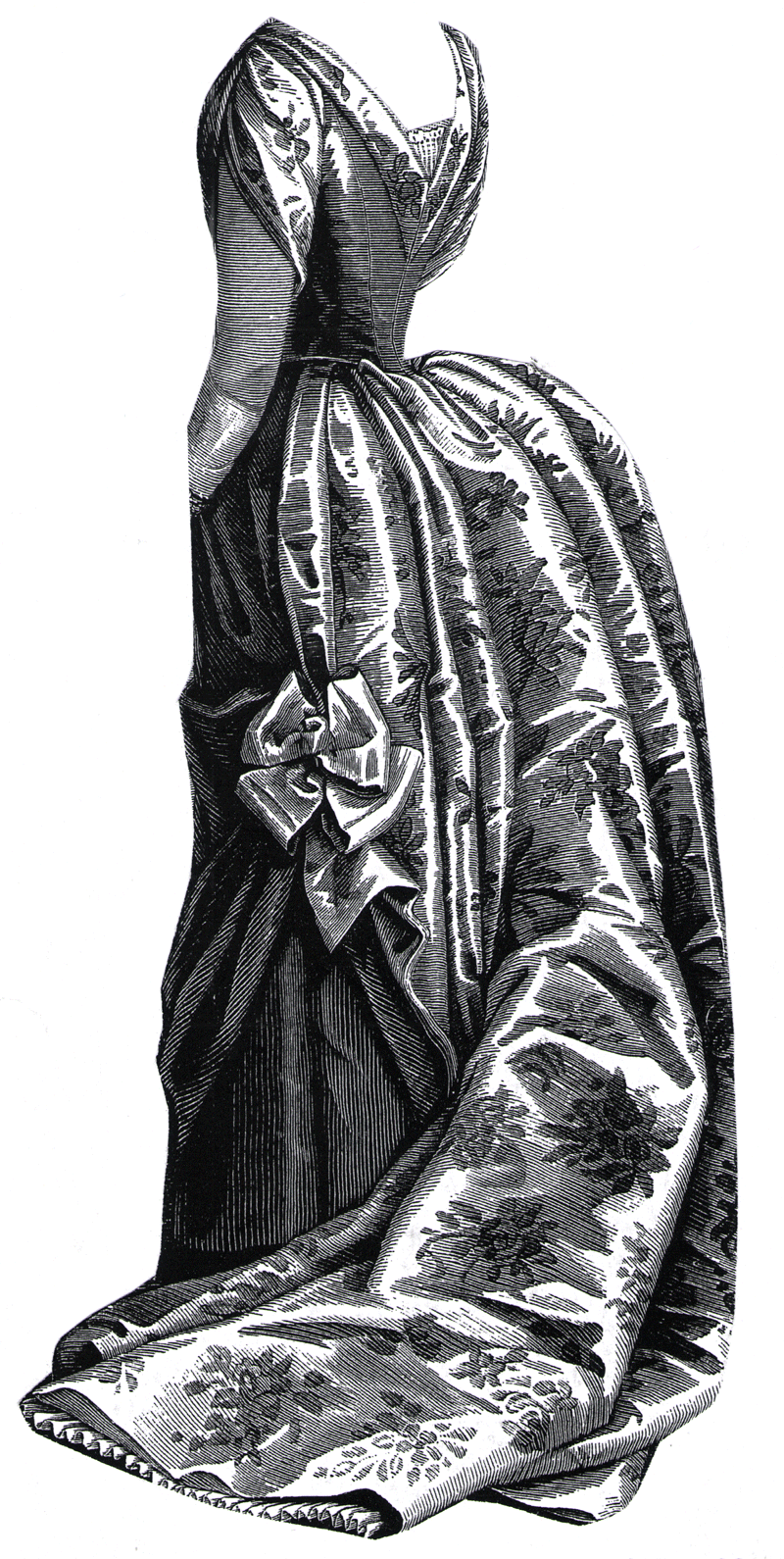
For the overskirt, I thought this oneby Ageless Patterns looked quite similar so I went with that one.

1273
Ageless Pattern 1273 – 1888 Red Satin & Brocade Toilette


For the most part, the construction of the dress was very similar to my Black and White striped gown, but there were also differences. I highly recommend also reading thatblog postif you’re interested in this era.So I’ll disc

uss each one here.

Bodice:

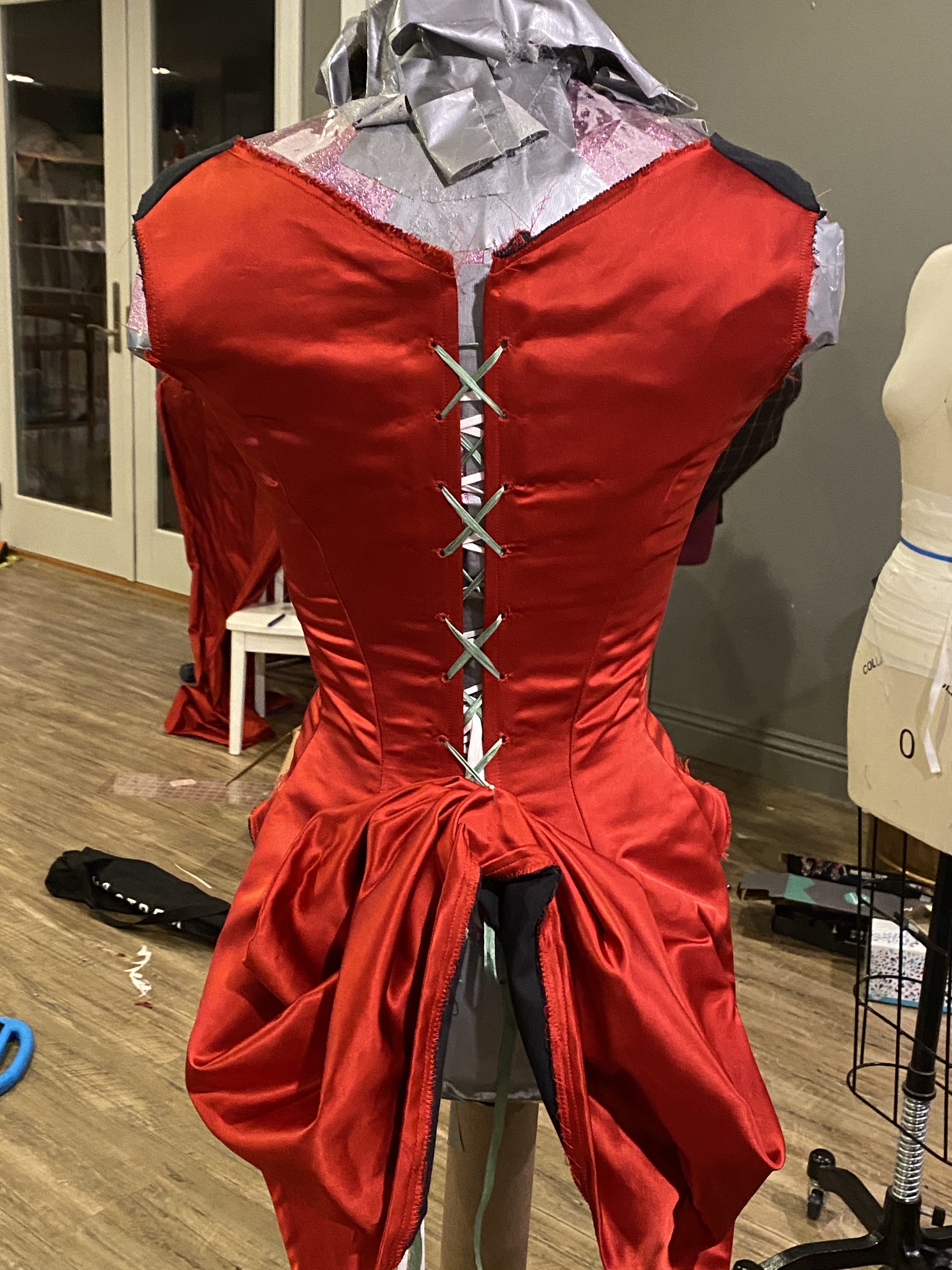
I used the lining pieces of the Truly Victorian pattern to make a basic muslin. I then sewed it up using cotton twill for the final. Please note that the back pieces, I flat lined with the silk duchesse. So at this point, it looked like a V neck with a lining only front (I used black lining) and red silk duchesse back.

Then I cut out a large piece of red silk fabric, and just pleated it onto the lining, putting the pleats similarly to the original fashion plate. Then I hand sewed it down using tiny stitches. I do wish I pulled at the fabric more as I did this step as the bodice is still rather wrinkled.

Once I did this, I put this on and drew out the shape of the cutout I wanted on the left (please note the original drawing above is assymetic with a spagetti strap on the left).

After doing this, I cleaned up the edge using a tiny piping I made from silk bias tape. After the piping was done along the edge, I turned in the edge underneath, and sewed it onto the lining.

Once all this was done, I sewed in pieces of boning onto each seam  inside. This took forever – I think there were 11 pieces of boning that went into this. Then I tried it on.

The gown has a back closure with eyelets, so I had sewed the eyelets onto the back at some point in all of this.

img_2578

After this, I had to wait for some silk georgette to come in- finding a matching silk georgette was difficult but I did find some. I cut some wide silk georgette about 24 inches wide on the bias, sewed it as a 12″ wide sash, and sewed it by hand onto the gown neckline, draping it in a way that I thought was pretty.

At this point, I put in hooks and bars at the waist so the back bow could hang at the waist properly.

Now for the black birds, procuring appropriate blackbirds was difficult. I had some foam ones in mind but the shop closed temporarily due to COVID-19, and I after waiting a month, I ended up purchasing them from another place.

The new birds were perfect, but they were a little too wide. I ended up dremeling the bird in half, drilling in some holes into the bird, and then sewing them in place by hand.

FINALLY, the top was done. Please note I don’t have any photos of this process. 😦


Underskirt:

To do the pleated underskirt, I made the base of the skirt out of cotton twill and finished it to the best of my ability according to the instructions.

img_2565

To do the pleats, I got the silk fabric, and cut a piece that was the correct height, but wide to about 150″. I hand hemmed the bottom using tiny stitches, then pleated and starched the pleats on my ironing board.

img_2551

After everything was pleated, I then sewed in a piece of linen tape to the back of the pleats, giving about an inch and a half of leeway with the tape for each pleat (to allow movement for the pleat), sewing down each pleat with a few stitches and a few knots. This took quite some time but three hours in a zoom meeting with friends made this go much faster!

After this, I sewed this in place at the waist, gathering up the pleats as needed to fit the waist to the waistband, and making sure that the length was correct.

img_2612

Overskirt:


The pattern I used came with three pieces for the overskirt – two for the front, and one for the back. The back was simple – I just pleated it and added it to the waist. However, the front two pieces took actually quite a bit of playing – nothing seemed to be correct!

I actually ended up doing this about four five times, and eventually, I managed to find a draping I loved.

515dd79d-e628-4cb2-b68e-aa83ae4beabf

Once I had a design I liked, I cut out the pieces. I flatlined all the silk pieces in thick muslin. FOr the back of the skirt, I faced any visible portions with black silk taffeta so the white of the muslin would not be visible. Instead, you’d see beautiful black silk!

For the front portion of the skirt, I faced it with black silk duchesse so that the texture of the fabric would not be visible.

Finally, I finished this all off with hook and eye bars at the waist, buttons to close up the sides of the overskirt, loops so I could bustle up the overskirt… and… if this sounds unclear to you, please wait for my next post where I describe how to put this on. 🙂


Please note the version above shows white silk organza instead of the red silk georgette. This was during the peak of the first wave when shipping was wretchedly slow and I couldn’t get my hands on the crows as well as the silk georgette.

It’s crazy how big a difference the crows make:


And voila! All done! I will be doing a photoshoot in mid July with the incomparable Lindsey Hinderer so I’m holding off on final photos til then… but… I’ll keep you posted!

The Night Circus Gown AKA The Black and White Striped 1887 Dress of Dreams

I’m not sure if any of you read the Night Circus by Erin Morganstern, but it was quite popular for a time when it first came out in 2010. I have opinions on the ending, but overall, the imagery is gorgeous and made me think at great length about Victorian circus fashion.

In it, the author describes in great detail the black and white outfits that all the characters wear. It has the wonderful, vivid imagery, and even though I’ve loved black and white outfits before it (thank you Tim Burton), there is nothing like a book confirming that your passions are beautiful.

So… with that said, let’s talk about this dress!

A few months back, I found out that the Met Museum has an online portfolio of fashion plates that are free to the public to browse and use. If you want four hours of your life to vanish in a flash, please go take a look and MARVEL at it. 🙂

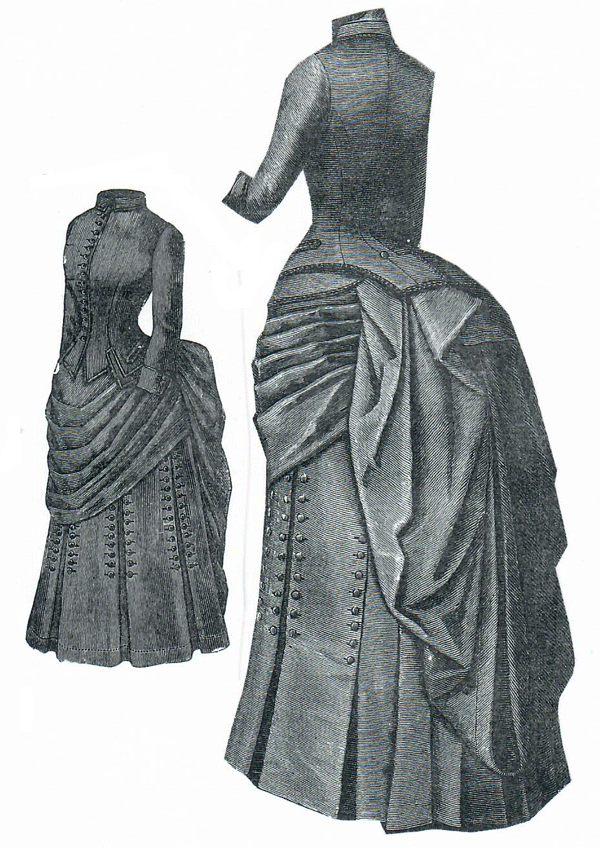
In particular, I found myself drawn to this one:

p15324coll12_7947_full

The red and white stripes, the bustling, the ruffles on the collar… I loved ALL of it. And I had to make it. It’s honestly kind of wonderful when you find something and you fall in love all at once – it really does take a lot of pain out of the decision making. It looks wonderfully summery and I wanted to make it out of cotton so that I could wear it in the warmer months – currently all my Victorian wear is wool (tartan gown?) so I was looking forward to making something a little lighter.

The best part was, I knew I had the perfect fabric in mind already. I did look a little bit for a red/white stripe, but in particular, I had one I already loved – and I KNEW this gown would be perfect in a black and white stripe as well.

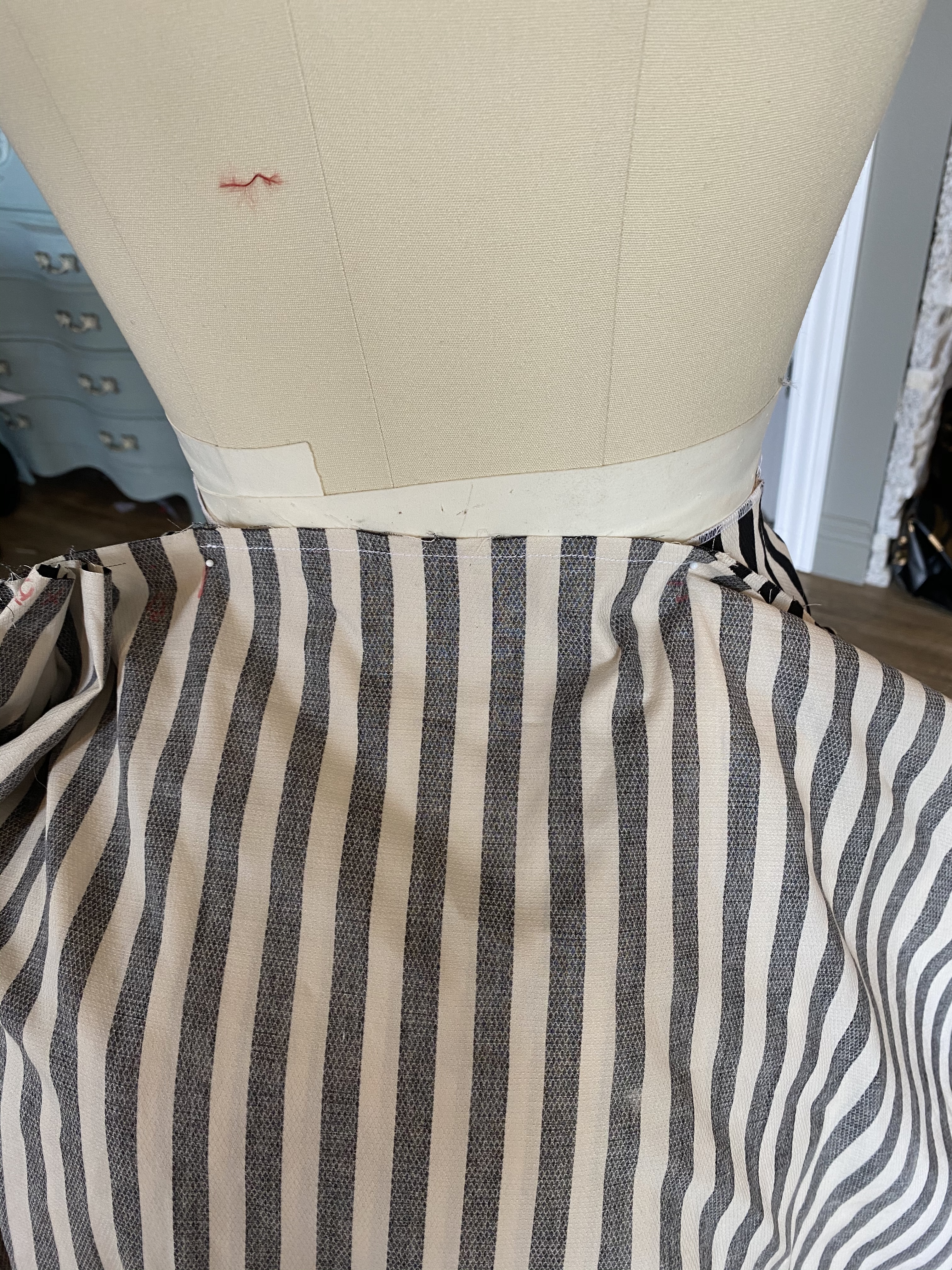
black-white-striped-cotton-dobby-306380-11

If you look closely at the image, you’ll see that the white has a diamond weave pattern – which I just LOVED. You’ll notice that Victorian fabrics tend not to have straight stripes but stripes with some sort of interest to it, be it a moire weave, some embroidery, or stripes within stripes. If you look at the red stripes on the fashion plate, you’ll notice it has some sort of polka dot WITHIN it. So cool. So I loved the diamond on this, and immediately purchased 12 yards from Mood. PS: They also have this in Navy/White if any of you want to use that too. I don’t have any ideas for it at present, but part of me wonders if it would make the most wonderful seaside gown in Navy!

So after all this, I got the fabric, and I loved it!


The only thing… honestly, perhaps the white was a little too white for my Tim Burton meets Night Circus meets Fashion plate gown? Normally then I might dye it, but with every store for miles being closed, where could I possibly get an ivory dye?

An idea hit me as I was drinking my morning coffee (two double shots of espresso with some milk. In the winter I foam it but now I’m too tired to do even that). I would use tea! I had tons and tons of black tea in the house.

So I ended up making about 5 gallons of tea, putting some water in to dilute it just a bit, putting it in my kid’s bath tub, and letting my fabric soak for about 5 minutes – or until the color looked about right. Honestly, I have NO Idea what the tea/water ratio was. I cut my 12 yards of fabric into 4 yard chunks, and dyed 4 yards at a time, all in the same tea water. Maybe the first batch may have come out darker – but for the life of me, when it was dry, I couldn’t tell – which is what matters anyway.

After it came out of the water, I did rinse it well in cold water, and then tossed it into my dryer to dry. Afterwards, I had some lovely fabric of an ivory and black stripe, with a hint of earl grey scent, which really just made me feel even MORE Victorian. Once this was fully dry, I ironed the fabric, and I realized this had the added benefit that I had now accidentally preshrunk my fabric. Awesome time saver!

Meanwhile, I had to figure out the pattern of my outfit. This was considerably more time consuming. I figured the dress would consist of four parts:

  1. A jacket
  2. An underskirt
  3. An overskirt
  4. A dickey

I knew I wanted a shawl front suit like jacket. For the jacket, I picked this pattern by Ageless Patterns.

2467
1887 Brown Plain & Plaid Wool Costume

In particular, I chose this one because it had the combination of the correct front (I figured changing this collar to the shawl collar that connected to the back was an easy fix). There was a side basque portion on the bottom part I’d have to remove to make it the shape I wanted, but… overall, easy fixes.

For the Underskirt, I chose to go with the Truly Victorian pattern I ALWAYS use – the1885 Four-Gore Underskirt– since it has a wonderful shape, and I’d used it so many times before. It goes together so easily, has the right shape, and I really do recommend it for anyone who has a

For the Overskirt, I went with this one, also from Ageless Patterns.

1887 Dark Blue Ladies' Cloth Dress
1887 Dark Blue Ladies’ Cloth Dress by Ageless Patterns

So, LOVE this overskirt. If you want JUST the overskirt (I wanted the whole pattern), I highly recommend buying that pattern by itself, which is available also on Ageless Patterns for about half the price.

In any case, let’s talk about drafting the bodice first.

The original bodice for the jacket is for a 38″ bust and 26″ waist. My waist is 25.5″ (on a good day), but my bust is definitely 31-32″. So taking out 6 inches in the bodice was going to be a THING.

So to do this, I started by making the jacket pattern as is from the pattern. If I know I have to extend inches, I usually add a certain amount, but this time, knowing I’d only have to take in, I did not.

Then after cutting the pieces out in muslin, I sewed it together in bright contrast thread. DO NOT IRON YOUR SEAMS.

Then I put on my undergarments, and put it on with the seams facing out (inside out).

I then stood in front of the mirror, and put it on, and pinched in all the areas I would have to take in. Please note that it’s not just horizontally taking it in – I had to take in about 4″ from each shoulder as well.  I filmed myself doing this so if you’re interested, please follow my youtube channel… I should be putting up that video in the next few weeks.

Then I changed what I felt needed to be changed, altered the front shawl collar so it would meet the shoulder seam, and then made a version 2.

So you can see this and how it fits there.

In moving the shoulder up, I had to move the armhole downwards, so that was altered a bit.

Afterwards, I had to figure out the back collar.

The original clearly has either a yoke or a sailor collar with pleats. After playing with both, I chose to make it a sailor collar. The yellow version that I’m showing here is the yoke version.

I ended up picking a sailor collar because I decided it would be easier to make the ruffles work with that than the yoke.

So now that I had the jacket pattern decided and finalized (after 3 mockups, I started on the jacket proper out of the fabric.

Usually when I match up so obvious a stripe, I start by cutting out two pieces at a time, sewing them together, and then cutting the next two based on where I want the stripe placement, and then just going two pieces at a time. This is slow going but I tend to like my stripe placement best that way.

I also flat lined all my pieces with cotton poplin. This is from mood but you can probably use cotton poplin from anywhere.

So, if you look at original Worth gowns and Victorian gowns – they didn’t care about a clean and perfect lining. Why should they? The garments wouldn’t touch their skin – and they have corsets and shifts underneath so they didn’t care about the itchiness. I decided I wouldn’t care either so I just flat lined everything and didn’t put a separate lining in.

To make flat lining fast, I usedEncanted Rose Costuming’s idea and serged verything with my Babylock Victory.

Oh man guys… now that I’ve tried industrial serging, I don’t think I’ll ever go back. It’s so FAST. And it threads itself using jet air technology. LOVE!

So after these were all flat lined and serged together, I started sewing it up on my Babylock Soprano.

See what I mean? I just go one pair at a time. First the back seam, and then the two side seams.

img_2985

Then the two side seams…

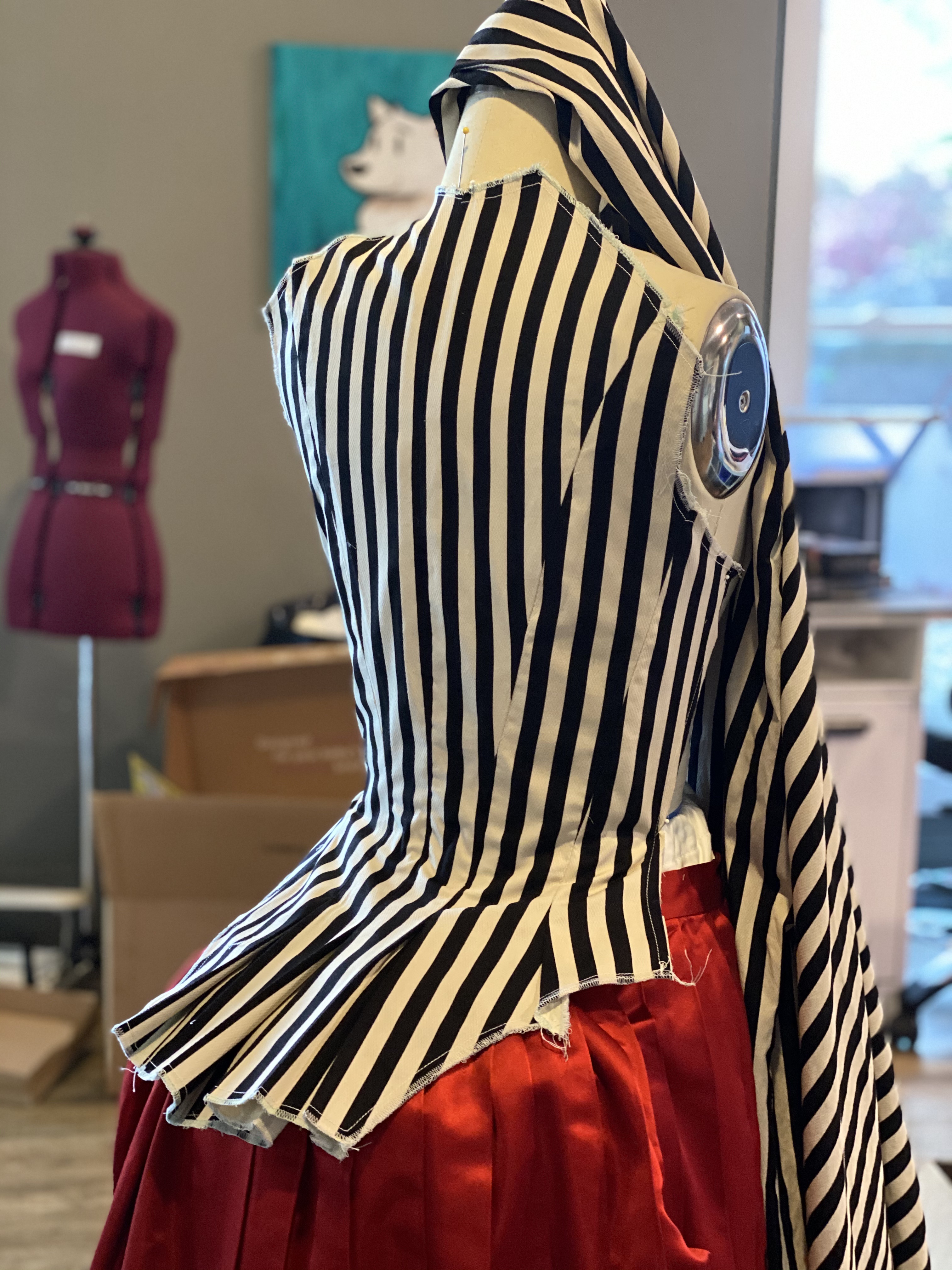
Then I started on the front. The front was a little different since I wanted to pad stitch the collar after I sewed it on. So that’s what I did. I sewed everything on, and then I took some time to pad stitch the collars so that they would fall back beautifully. SO much padstitching, but I do love how beautifully it works to make a collar flat and beautiful.


If you’re thinking that looks like a lot of fun to try on, I had to try it on at this point… you know… for science. 😉

img_3045


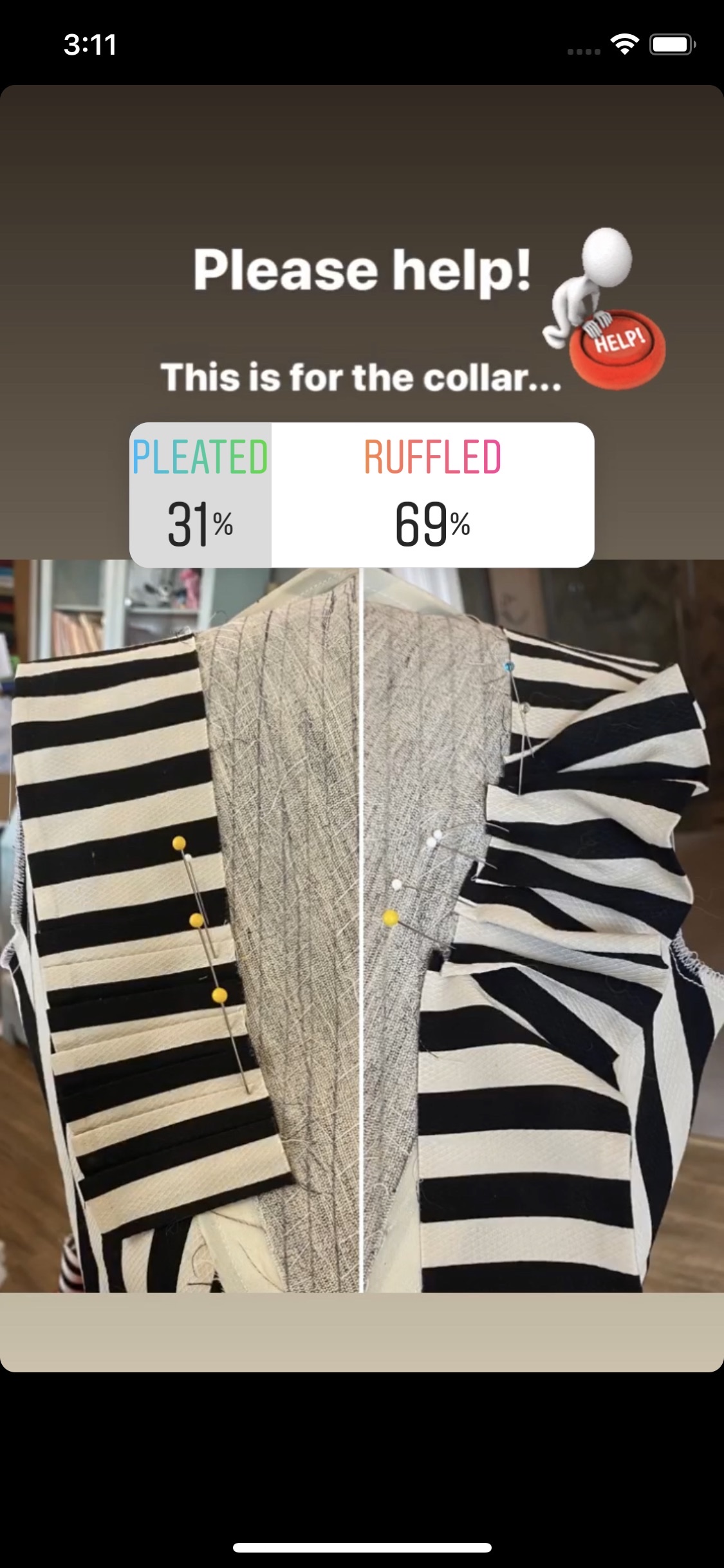
For the life of me, I couldn’t decide if I wanted to pleat or ruffle the collar, so I did a sample of both and put in on my instagram. The original image looked pleated but I really did think ruffling looked better. Pleating lost, ruffling won, so I went with ruffles.

Please note that I hand hemmed the edges of the fabric so that there would be no visible stripe running throug the ruffled bits of fabric.

So that was hemmed, ruffled, and then sewn on to the collar.

It was really coming together! I LOVED it.

Once that was in, I machine sewed, hemmed and put the sleeves on.

I had to try it on again of course. To make sure that the sleeves fit. Also because I loved it. I also pad stitched the collar and sewed that on as well.

Now that that was coming together, I started on the underskirt.

For the underskirt, I used the Truly Victorian pattern, unaltered except for the height. For the front three pieces (front center and the two sides), I chose to flat line it in regular tarlatan. This was a recommendation from Costuming Drama and Bernadette Banner and I’m so glad they recommended it! It’s wonderfully light, airy, and cool, as well as cheap! So it gave it that wonderful stiff body for the front, while keeping it nice and stiff. Did I mention it’s 2 dollars a yard!? (as of 5/26/2020).

The back of the skirt, the portion that is ruffled and pelated up, I flat lined in cotton poplin again.

Honestly, if you use a serger for nothing else, please use it to flat line your skirts. My victory must have flat lined all my pieces within ten minutes. It was so wonderful to get that tedious task done so quickly, and serging the tarlatan fixed the “sharp pointy bits” problem that Tarlatan tends to have.

For the darts in the skirt, I just cut out the darts, and hand felled the tarlatan to the dart that was already sewn in the fabric.

Then I added a waistband and the underskirt was done.

img_3271

You can really see what wonderful body the underskirt has on the dress form already!

Ok. Now time for the difficult part… the overskirt on this was TRICKY.

Step 1. Cut the fabric for the back portion, out per the pattern diagrams. Please note that the fold is along the BOTTOM of the hem – so it’s fold is parallel to the floor.

Step 2. Put the right sides TOGETHER.

img_3373

Step 3: Sew the pattern together from the marked point 1 to marked point 2.

img_3376

Step 4. Then pleat the four free sides of the fabric as marked along the pattern.

Step 5. Cut the slit along the bottom of the fold along the left as directed to on the pattern. Then for the back portion, gather the fabric til you get to the slit, and then sew that gather flat, and turn it back, so that the fabric shows, and you pit in to the center of the waist, as shown below. (RIGHT?! Isn’t this nuts?!)

Step 6: Then pull the right side inside out and drape upwards.

Step 7: Play with things til it’s pretty. I suggest looking at the original diagram a lot.

Do I love it? Yes. Is it nutty and took several hours of my life just to figure out the directions? Yes.

So… please note that I didn’t line the back of the overskirt with anything, but I did choose to line the front of the overskirt with cotton poplin.

Then I sewed these together.

Meanwhile, my jacket needed to be completed.

I ended up boning the back, side back, the side, and the front dart with synthetic whalebone that I machine sewed to the bodice. I hand hemmed all edges, sewing the turned over edges of the bottom to the flat lining only. And then I closed up the closures with bar clips from Joanns.

I added a vintage rayon bow to the front as well as sashes to the sides.

Meanwhile, I made a dickey from the pattern included with the bodice pattern.

So to do the dickey, I iron on some interfacing to some cotton, then cut it out. I covered it in some fabric that I hand pleated to make it attractive to me, and then hand felled the edges. Then I did the same for the neck piece and added some button holes. I’m afraid at this point, I meant to take photos and totally forgot.

Please note that for ALL hems – underskirt, overskirts front/back, etc, I chose to hand hem everything so that there would be no machine stitching over the different colored stripes.

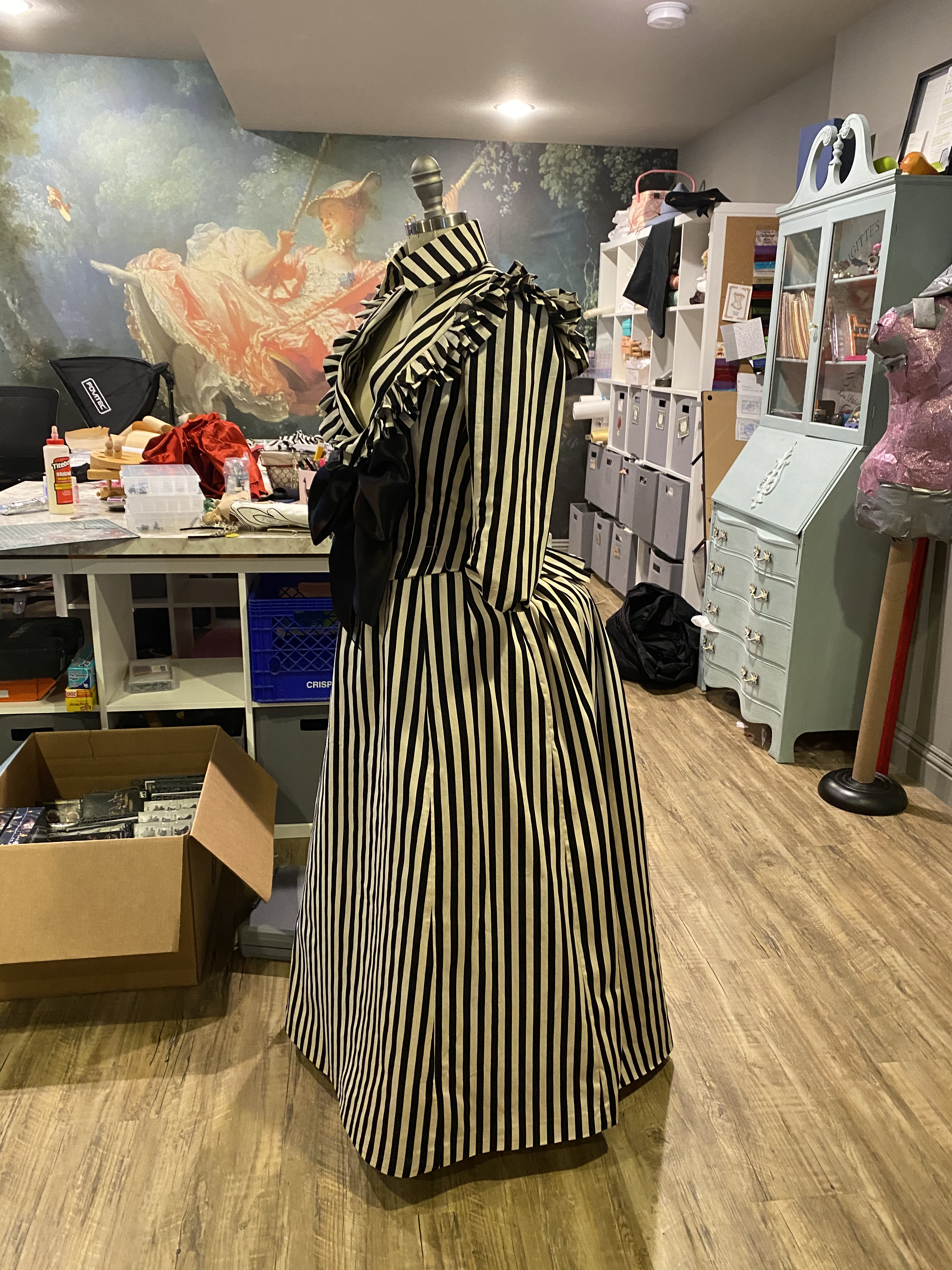
But really, at this point, it was done!

So I did do a video of me getting dressed in this outfit, since there is are finnicky portions to getting dressed in Victorian. There are also some shots of me walking and dancing about with this if you want to see how the dress moves.

if you’re at all interested, you can watch it here.


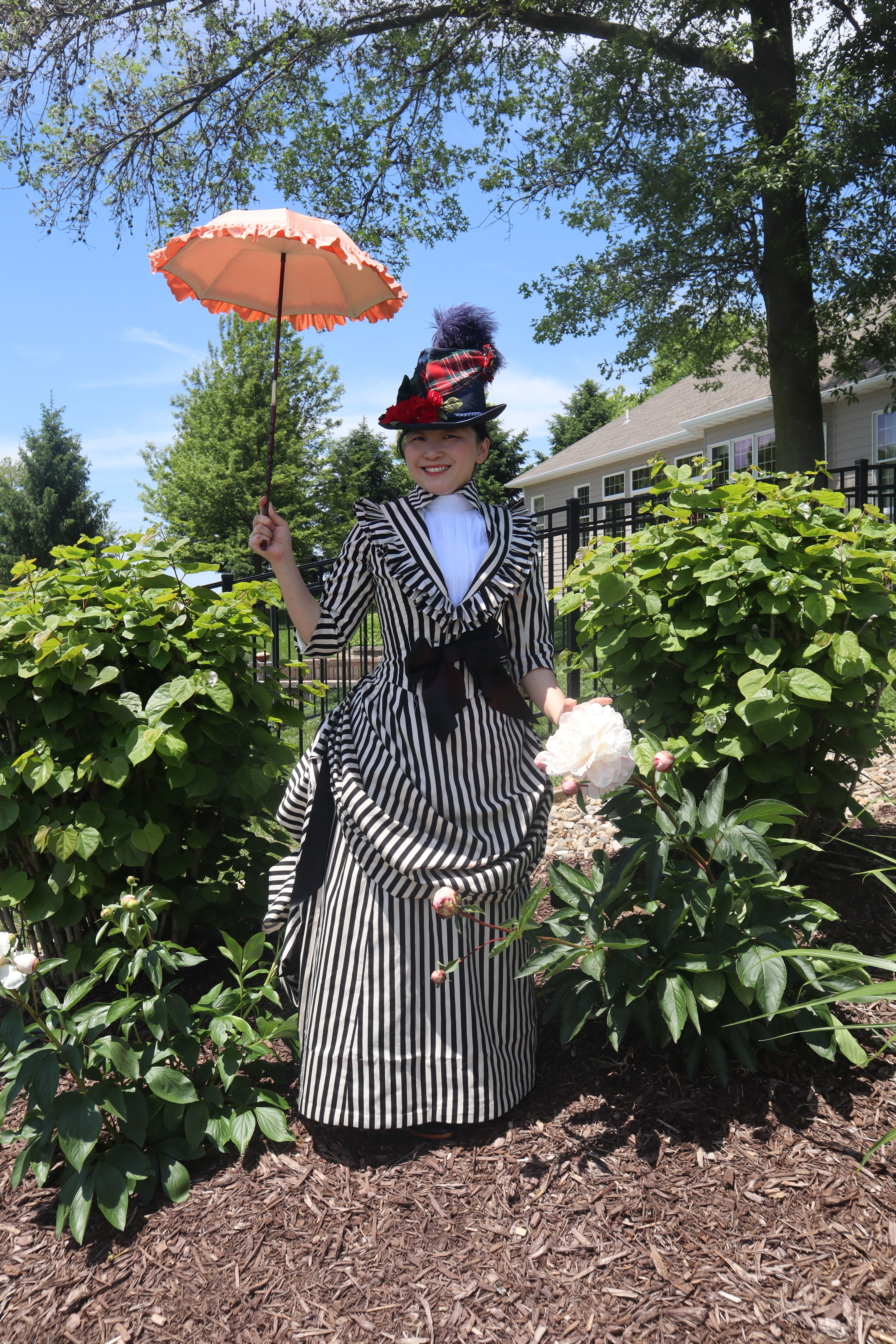
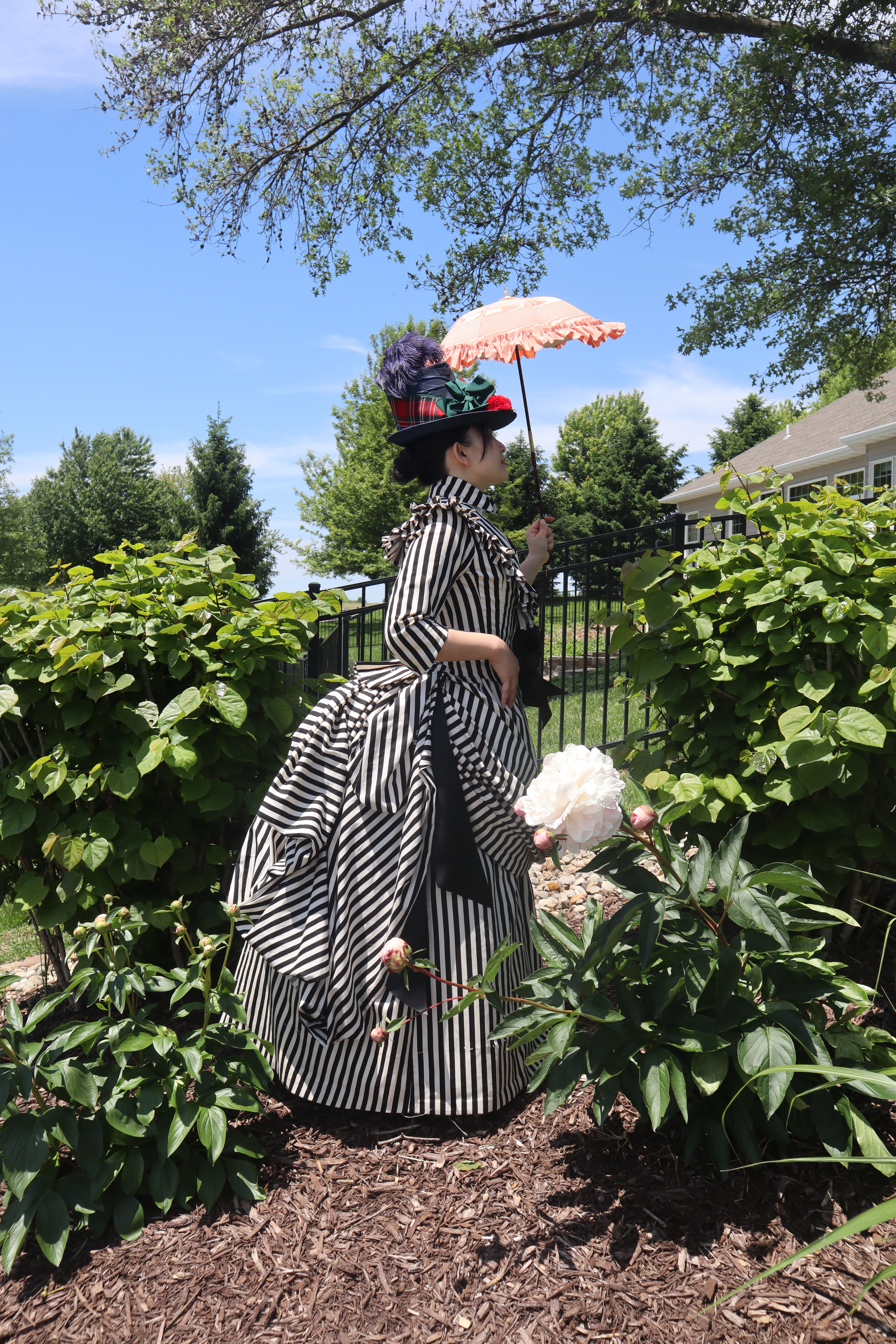
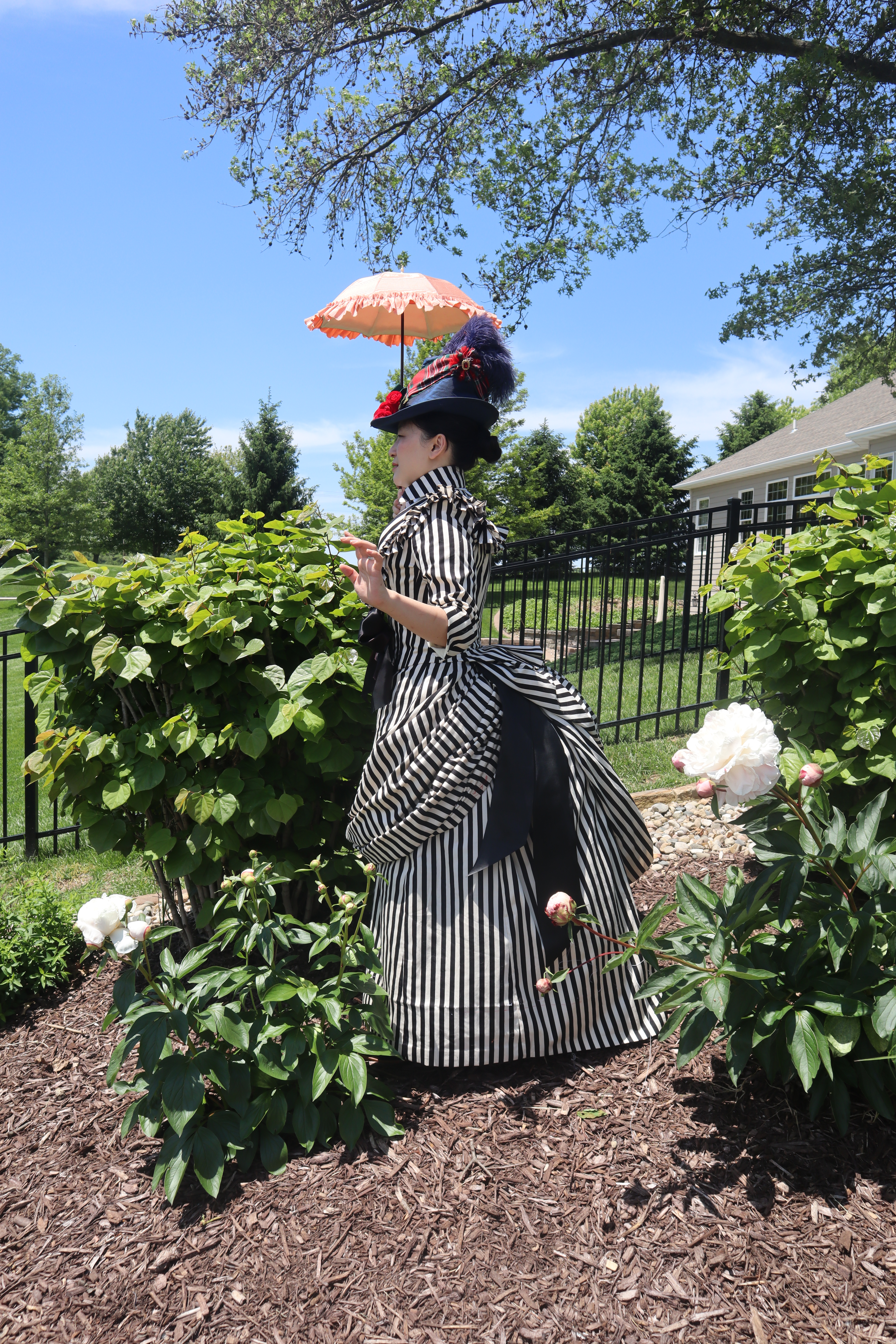
Meanwhile, here are some more photos of it in action:

IMG_0356IMG_0383IMG_0369IMG_0382IMG_0400IMG_0391IMG_0387


In any case, thank you all so much for joining me on my striped dress of dreams journey! This was a fun one!


The 1780s embroidered apron

I think for the longest time, being able to get embroidery to work on a nigh flimsy fabric, like a thin muslin was the goal.

I tried to do this for my Regency dress in 2018, but for the most part, I ended up having to compromise on my vision heavily.

To make machine embroidery on flimsy fabric work, I came to realize I needed several ingredients:

  1. A machine that could handle the tension
  2. A flimsy transparent fabric that was still strong enough to handle the embroidery
  3. Interfacing that was heavy enough, but then would dissolve away to nothing.

In particular, I was very inspired by this fichu that was sold at Augusta auctions for a mere 430 dollars.

CREATOR: gd-jpeg v1.0 (using IJG JPEG v62), quality = 100

As beautiful as this is… the real inventiveness lay in the exquisite tiny embroidery.

There are some detail shots, but for the most part, I couldn’t get a good closeup of the complete embroidery, which is what I usually need in order to digitize. Part of the charm of this embroidery is the brilliant use of silver metallic embroidery, especially on the leaves.

I was utterly in love, and it honestly took me about 3 months to digitize this. So the way that I price my digital files is as such:

  • 1-15 dollars: If it took me about 1-5 hours to digitize, test stitch, fix, test stitch again
  • 15-50 dollars: If it took me 10-25 hours to digitize, test stitch, fix, test stitch again
  • 60-120 dollars: If it took me 30-50 hours to digitize, test stitch, fix, test stitch again x 5 (ie: court suits take a LOT of time)

This was done on the Palette 11, and a lot of the time was spent trying to puzzle the design out, and find a way to make it repeatable. I actually ended up making parts of it up – but I can’t tell, and hopefully you can’t tell either.

So a couple of digitizing rules for this one:

  1. Satin stitch is my go to stitch for the flowers and leaves. This is the stitch that looks most like historical stitching.
  2. For the stems, I use the stem stitch rather than the zig zag stitch.
  3. For the ribbon that extends all the way around, I used a zig zag stitch.
  4. I usually use 100-141 stitches/inch stitch density. This does increase or decrease depending on the thinness of the thread, the delicate constitution of the fabric, and the overall effect I’m going for. To put it simply – for thinner fabrics, I tend to use 115-120 stitches/inch. For thicker embroidery on silk duchesse (like court suits), I use 140 stitches/inch.

If you don’t want to digitize this yourself and would rather buy my files, I do sell these files.

There also is no good scalloped edge instant border, so I ended up having to free hand that. I was extremely pleased with how it turned out, considering it was free handed.

For the fabric, I must have experimented with about 12 different voiles and batistes from multiple sources. I tried muslin, batiste, voiles, and organdies from many sellers. Generally, organdy and voiles were too thin. Batistes, poplins and muslins worked, but generally, they didn’t have that translucent filmy quality I was going for. Finally, I found a cotton mull from Burnley and Trowbridge that was perfect.

It really had the right weight, the correct feel, and the filminess I was looking for. I bought about 15 yards. (each fichu or apron takes about 2 yards).

Afterwards, I started embroidering.

These are the tools I used:

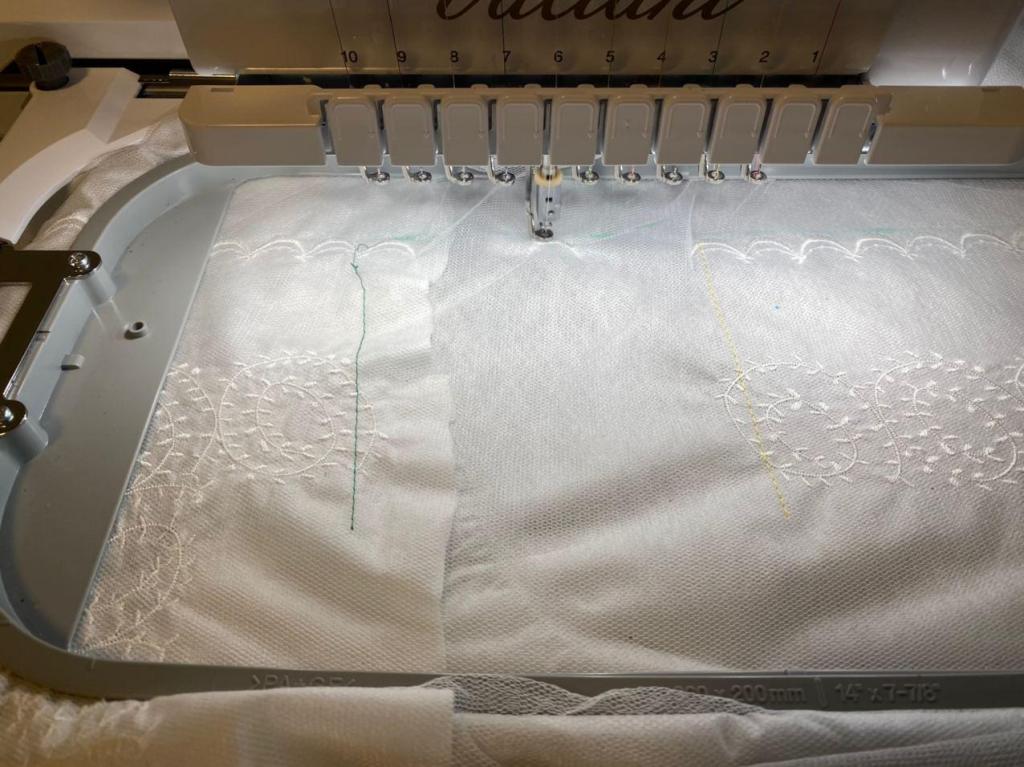
Machine: Baby Lock Valiant. There are somewhere between 15-17 colors in this (two shades of green, brown, black, metallic, two shades of pink, 2 shades of purple, three shades of blue, three shades of red…) – which in my opinion is integral to the charisma of this piece. There are 35-43 color changes per repeat – which may sound difficult on a one needle (though I have had customers who did this), but was fairly doable on my ten needle. I highly recommend turning the tension way down, and embroidering at a slightly lower speed (I did 700spm) for this project.

Thread: As usual, I used Tire Silk 50wt threads. They don’t sponsor me, but I wish they would. They’re really the only brand of silk thread I found strong enough, colorful enough, and silky enough to suit my silk thread needs – so you’ll find that (except for lace making), they’re my go to for silk thread. (Cotton threads and poly threads are a different matter, and I’ll discuss those at some other time).

Stabilizer: For my stabilizer, I chose to use Baby Lock brand dissolvable interfacing. It is quite thick and strong, so I was able to get away with only 2 layers. Another brand I like (if this one is hard to come by) is H2O brand, which is available on amazon. I am able to use this one, but for thinner projects like these, I usually have to use 3 layers of that one.

So for each hoop, I used one layer of my fabric, two layers of the Baby Lock Stabilizer, and then started embroidering.

You’ll notice that on the left, you see a straight vertical line. This is my positioning line – the next file will go right there. The apron is about 9 files to go around all three sides, and then afterwards, I put in the center motif as well as well.

The center motif is one I’m particularly fond of – all the different colors do so much to bring it to life:

After all the panels are embroidered, I suggest cutting off excess interfacing.

You can see how the interfacing has been cut, particularly around the center motif there.

img_0355

You can also see the different placement lines.

This is the time to remove them – BEFORE you wash the fabric. I highly recommend going in with a pair of tweezers and a tiny pair of embroidery scissors and cutting them off. Once you wash it, these tend to stick all together, so removing it BEFORE washing is key I find.

Once that’s been done, it’s time to wash away the interfacing!


Of note, I do want to say that washing it once with water and soap never seems to be enough. I usually wash it a good 2-3 times depending on how soft I want it to get. For somthing like a soft apron or fichu, I usually wash it three times by hand, and then let it air dry.

After this, I use a nice steamy iron to iron it flat, pulling at the embroidery as I do to remove all the wrinkles. The steam also does wonders to soften up the cotton fabric.

bef99881-145d-476b-9cbb-dde240a0657f

After this, I sit on my couch with a tiny pair of embroidery scissors by Gingher, and cut away the excess fabric at the green line, being very careful not to cut the green silk zig zag stiched edge. The interfacing acts as a glue so even if you do, it tends not to unravel.

img_0367

Once it’s all cut, I gather the top of the apron, and sew it to a piece of linen tape (a la the instructions from the American Duchess 18th century sewing book) and voila! Apron!

749e7090-c714-4021-9562-447a18f76181

It’s really wonderful how due to the many colors in the apron, this tends to just go with everything. img_1756img_1753img_1763


I would say that this is one of my faster projects. The digitization for this embroidery probably took about 25-30 hours. (I ended up redoing a lot of it, and there was a bunch of experimenting with different fabrics).  However, once the whole thing was digitized, embroidering this takes about 30 hours for an apron, 23 hours for a fichu.

Washing, drying, times three, cutting out, and sewing was tedious but probably took about two hours total.

Overall, a fun project for a dedicated embroiderer who wants to make something really colorful and fun.

I hope this was helpful guys! 🙂


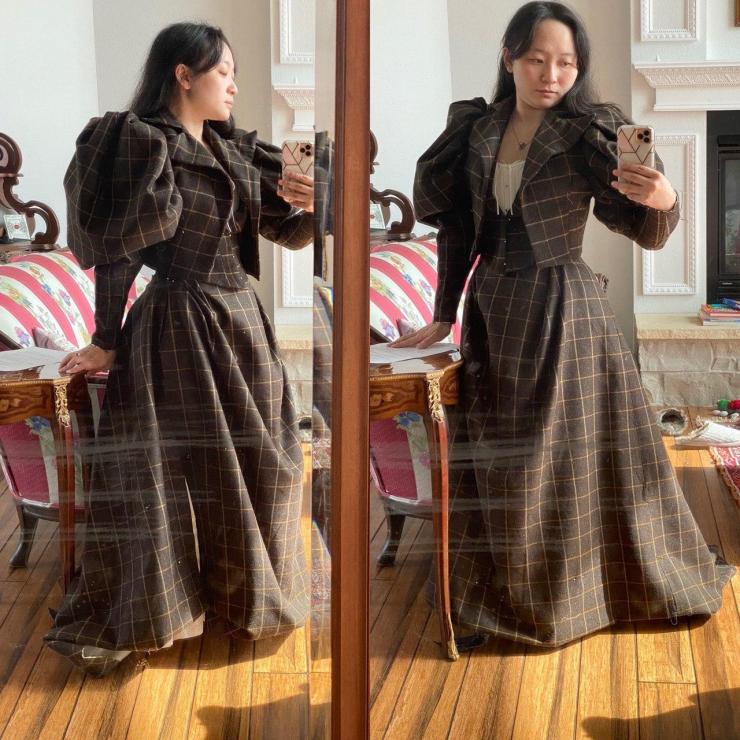
My 1890’s Puffed Sleeve Dress

I remember reading Anne of Green Gables, and how she went on and on about puffed sleeves. I had little puffled sleeves on my pink dress as a little girl and they made me happy to no end, so I could very much understand why she wanted them as well.

In Chapter 11, this is Anne’s response when Marilla makes her up a sensible dress without puffed sleeves:

“Oh, I AM grateful,” protested Anne.  “But I’d be ever so much gratefuller if–if you’d made just one of them with puffed sleeves.  Puffed sleeves are so fashionable now. It would give me such a thrill, Marilla, just to wear a dress with puffed sleeves.”

MARILLA SAID NO!!!!

My heart just went to Anne so much. Marilla gave an explanation about how puffed sleeves are wasteful, and at the time, that made no sense to me.

And check out this amazing comic by Hark a Vagrant! I reference this constantly.


photo_2020-04-07_08-56-16

In fact, I’ll just be sitting at the table and randomly say “Sleeeeeeves,” and my husband will reprimand me and tell me to have more respectable reveries. I married the right man.

So while I was hammering out all our outfits for Venice, I kept coming back to imagining myself running around in 1890s, in a dress with over the top puffed sleeves.

Here is an example that I just love:

bdf8d65c64854f02ed1792a0fb22e1d0
Worth evening dress ca. 1890 From the Preservation Society of Newport County


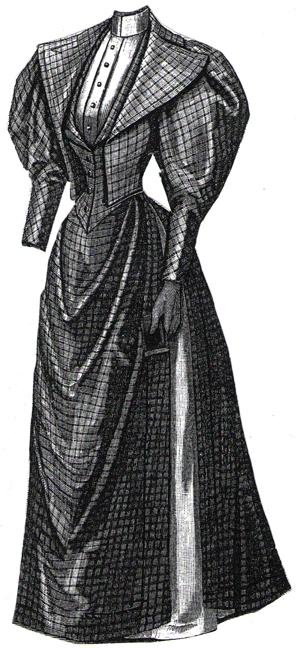
So I started shopping around for patterns. I love that this era has actual patterns printed in that time period that are reproduced, and there are companies online that make these available to you. I was entranced with this particular pattern from Ageless patterns:

1953
Agelesspatterns.com #1953: 1894 Chevoit Costume w/Vest & Waiter Jacket

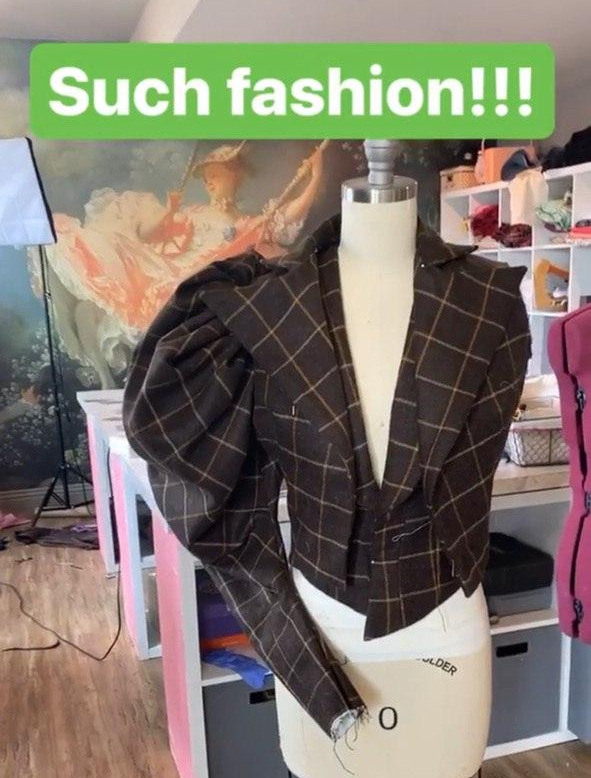
I kept staring at it, and wanting to make it in a lovely brown checked wool. Perhaps more dour and serious than Anne would like it, but around this period, fine tailoring started making an apperance in women’s clothing… and a brown suit seemed perfect my fancy.

So, I ended up ordering the pattern. Please note that their ordering process is a little dated – but it works quite well and the proprieter of the site is very trustworthy and I’ve never had a problem with it.

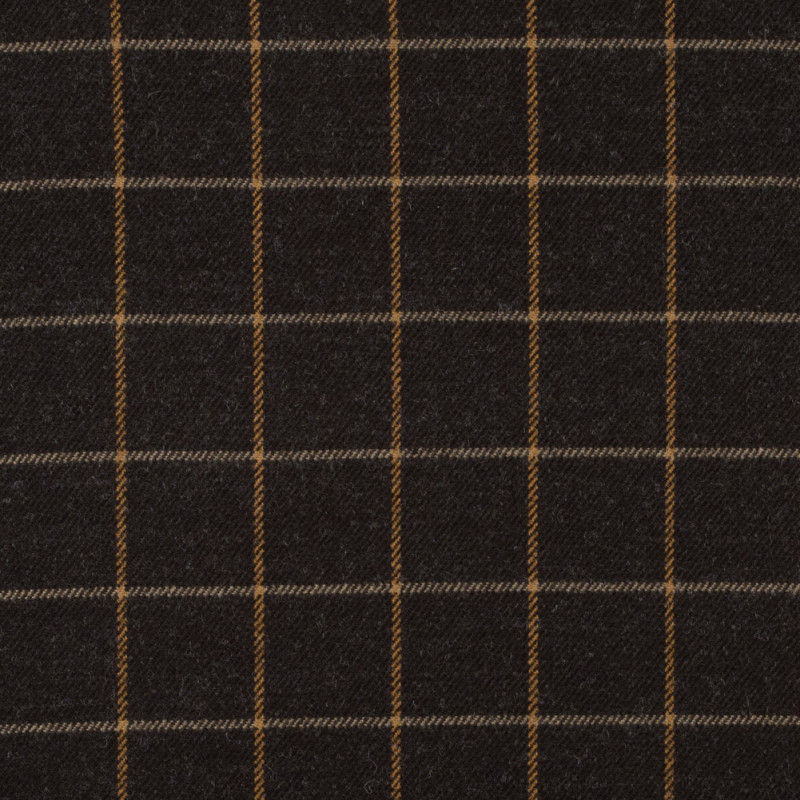
Then was the fabric issue: I had been eyeing this brown wool from Mood fabrics forever – and with that larger check, it was so close to the original fashion plate!

demitasse-windowpane-check-wool-twill-315303-11
Mood Fabrics: Demitasse Windowpane Check Wool Twill

I wasn’t sure how much I’d need so I ended up buyign 10 yards… just in case. 🙂

So when I got back from my trip to Venice, the first thing I did was dig into this. Honestly, working on a completely different time period after doing project after project in one – felt like a breath of fresh air.

First thing to do was adjust the pattern. Like all ageless patterns, this is drafted from Victorian fashion magazines from the period – so the pattern is one size fits none… I’m kidding – I’m sure someone out there has a perfect 36″ bust and a 23″ bust – but that certainly wasn’t me. So when I got the pattern, I realized I wanted to add about 3″ to the waist, and subtract 3″ from the bust. To do the subtraction at the bust, I chose not to do that right away, since I could do that during fitting. For the waist, I knew I would have to add some to the waist. Luckily the pattern comes with a nifty calculation sheet to figure out how much I’d have to add to each pattern piece – and I did so. I think it came to 3/8″ on each pattern piece on each side. Not much- but certainly enough.

Once I did that, I cut out my muslin and sewed up the jacket pieces.

Now to fit a Victorian muslin on you – you HAVE to put on your corset and undergarments first. It’s quite a pain in the butt to do this – you get undressed, put on the corset, put on the bum pad (I got mine here: ), put on your petticoat, then put on the muslin and fit it. So the proper undergarments are ideally: chemise, corset, bum pad, petticoat, corset cover, shirt… THEN the muslin, but… as you can see, I am not doing so. Also, you’ll notice my liberal use of a Wearing History Bust Improver. 😉

photo_2020-04-07_08-56-35

VERY important: when you’re fitting a muslin, put it on inside out WITHOUT ironing the seams flat! This way, you can easily pin the seams how you would like it to be.

One thing that was immediately clear when I put it on was that the back was loose. (Also, the front collra is AMAZING). So using pins, I pinned the line that I wanted to change the seam to.

photo_2020-04-07_09-32-35

Upon putting it back on, it became clear that this worked much better. I penciled the line in, and cut out my pattern. I then copied this new pencil lined pattern onto a new piece, and added my seam allowance. I figured this was good enough for me to start on my final.

photo_2020-04-07_09-32-37

Meanwhile, I also did the same with my waistcoat pieces. A waistcoat has to be more fitted so it was actually considerably more work. I had to pull the front of the waistcoat up at the top shoulder seams about an inch and a half (to account for the fact that I am not nearly as busty as the original pattern), so I wish I had more photos of the process. Sadly, I do not. To get the waistcoat to fit correctly, I actually went through THREE different muslins til it fit perfectly. So… please don’t kick yourself if your first muslin is not perfect. It took me THREE tries.

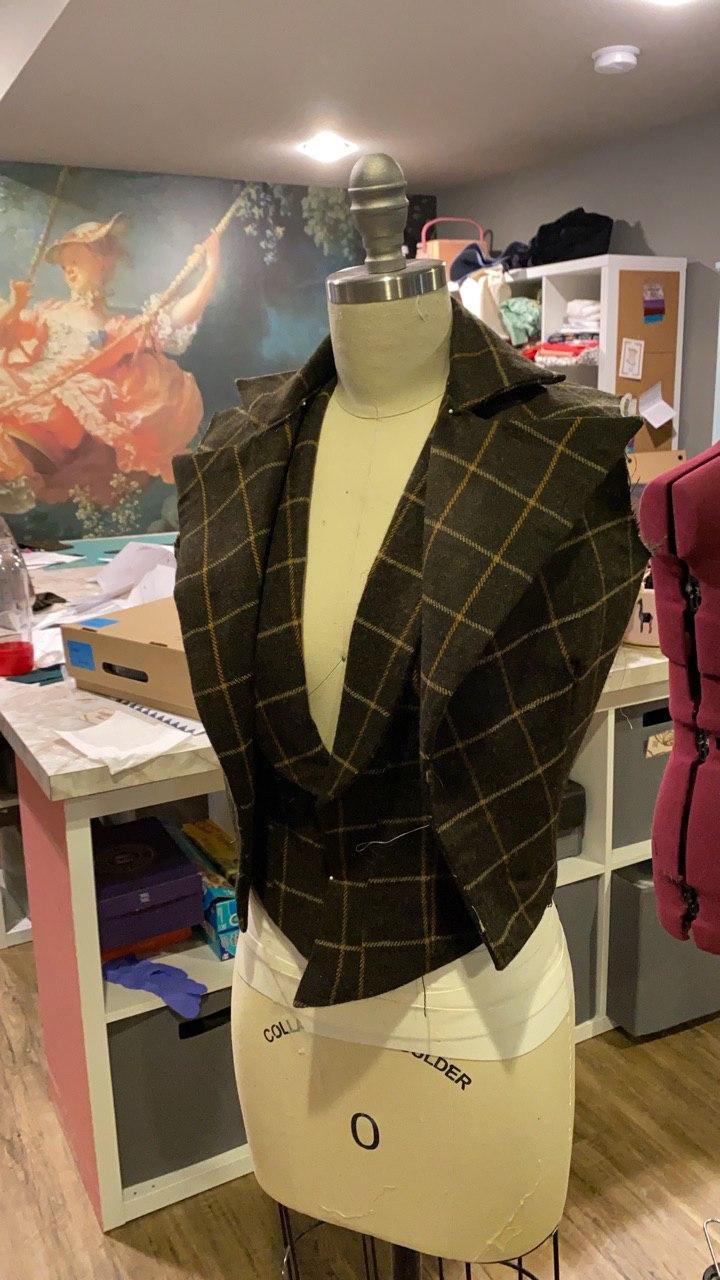
After all this, I started sewing my waistcoat together. I used horsehair interfacing and pad stitched the collar on my waistcoat, and stitched the whole thing together. It was surprisingly fast and I managed to do the pattern drafting, and waistcoat creation in two days.

The jacket padstichcing, which was on a much larger area (I mean, look at that enormous collar!) took considerably more time. The collar was also sewn and pad stitched. It was so cool to see how the padstitching actually worked to let the collar stand on it’s own, even sitting on my table.

Once the pieces were on my coat, I covered the pad stitching by stitching the wool collar top on – right side to right side, and then flipping it inside out.

photo_2020-04-07_08-56-20

After this… it was SLEEVE TIME. SLEEEEEEVESSS… PUFFED SLEEEEEVES….

No, I cannot have respectable day dreams Marilla.

THIS is the sleeve pattern.

I don’t even know if this video even does it justice. It’s HUGE.

I’m telling you, each sleeve takes 40″ of wool. Yes. This means that it takes about 2.5 YARDS of wool to make the two sleeves. I want to do some math – at 2.5 yards at 25 dollars a yard – puffed sleeves cost $62.50. EGADS. That’s todays money, moreover back in the 18th century when fabric was even more precious! Marilla wasn’t kidding about it being a frivolous expense!

So I initially cut it out of cotton muslin – AND I LOVED it. (no photo)

The wool I have here isn’t quite stiff enough on its own to handle the marvelous whimsy of puffed sleeves – it tends to slink a little. So I chose to flat line it with the cotton muslin I had cut out. After all, I didn’t have to alter the pattern at all. I sewed the sleeve up… and I gathered that HUGE voluminous sleeve. It was quite the thing to gather and sew it onto my bodice. Honestly – it couldn’t even get through my machine and I had to hand sew it on. Not a huge deal, and totally worth it… TO GET PUFFED SLEEVES.

photo_2020-04-07_09-39-18

Afterwards came the long and less fun process of lining everything.

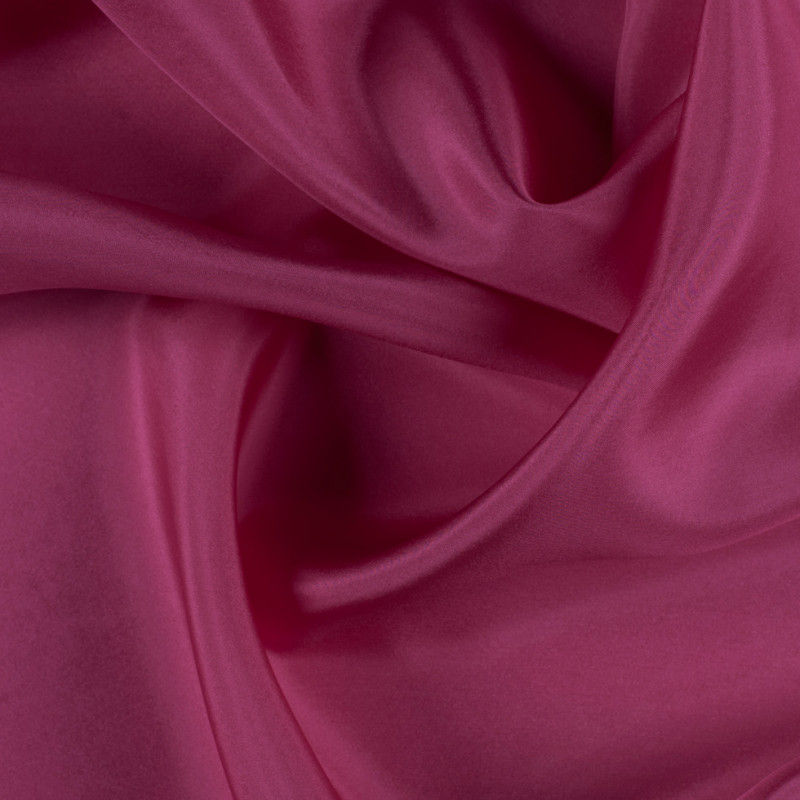
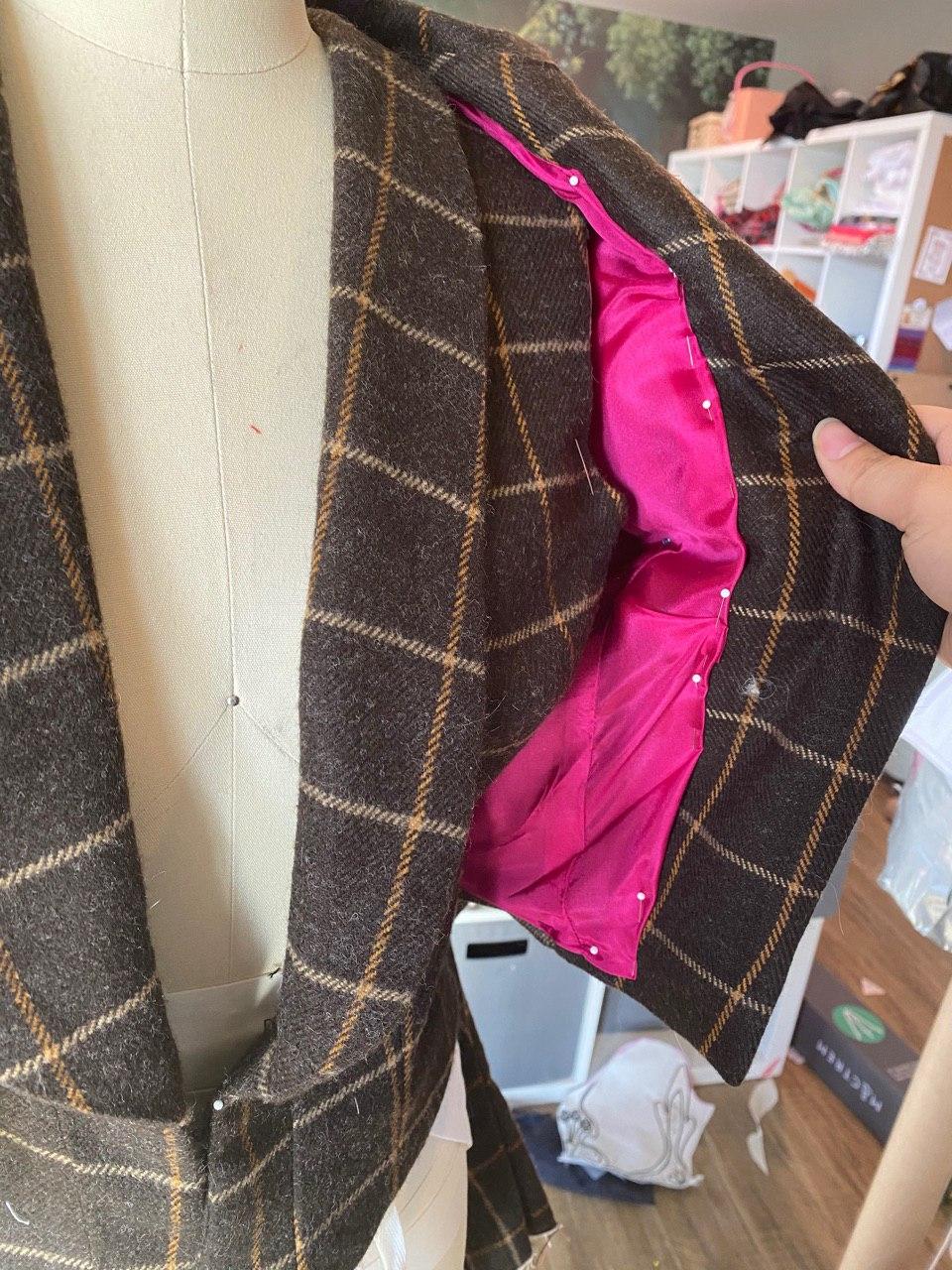
I used bright silk habotai though – which is wonderfully slinky and bright. I’m absolutely in love with Mood’s “beetroot” color– which is such a vibrant shade of pink. I love that you get glimpses of it as you walk around.

beetroot-china-silk-habotai-pv2000-152-11
Beetroot China Silk/Habotai

To line this, I first ironed the seam allowance down around the edges and sewed that flat using tiny stitches around the jacket. I suppose I could have just bag lined the jacket – but I find that results in lining that can pull and I wanted the jacket to hang just right.

Afterwards, I sewed the lining pieces together, ironed them flat, and then pinned the lining into the jacket, wrong side to wrong side. I did tiny hand stitches around the jacket to sew the lining to the jacket.

photo_2020-04-07_09-31-32

One thing that happened was that I realized the waistcoat shrunk in production. I had not realized this but I relied on the natural and wonderful stretch of the wool to have the waistcoat fit me so snugly. Once that stretch was eradicated by sewing it to the soft but not-stretchy silk habotai, it no longer could close in front. Granted I was close (maybe 1/2″), but honestly, this is as thin as I ever get and I didn’t want to rely on not eating a burger to fit into my waistcoat.

I have NO idea if this is historically accurate, but I know this is an old tailor’s trick from the 18th century, so I used it… I cut the back seam of the waistcoat up to 1″ from the top, sewed the two edges shut, and then put hand sewn eyelets up the back. This way, I would lace myself into the jacket. And completely honestly – I never plan on wearing the waistcoat without the jacket… so no one will know! Except for me. And you. And the whole internet.

And here is the completed waistcoat.

So… while I was doing the whole jacket process, I was also working on the skirt. The skirt is an interesting thing altogether, having a split on the left side, some wonderful draping in front, and an underskirt. The underskirt pattern was literally just a rectangle that I was expected to gather and wear. I suppose I could have… but it didn’t have the fun-ness I was looking for.

So I chose to take this opportunity to whip out the Truly Victorian walking skirt pattern – YES THAT ONE. The one that Bernadette Banner turned into a super cute History Bounding skirt (which I’m totally doing next).

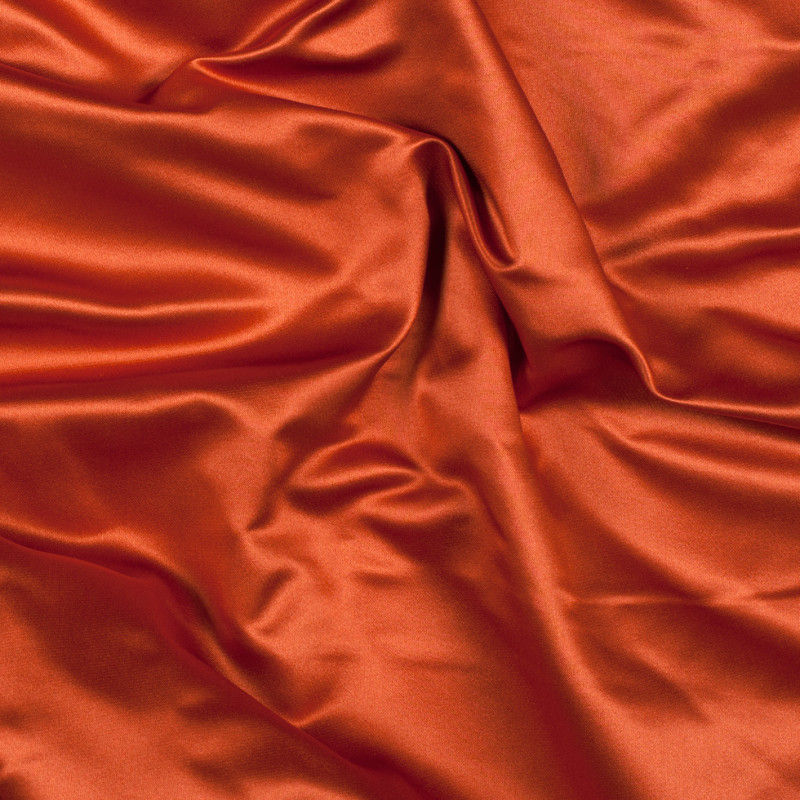
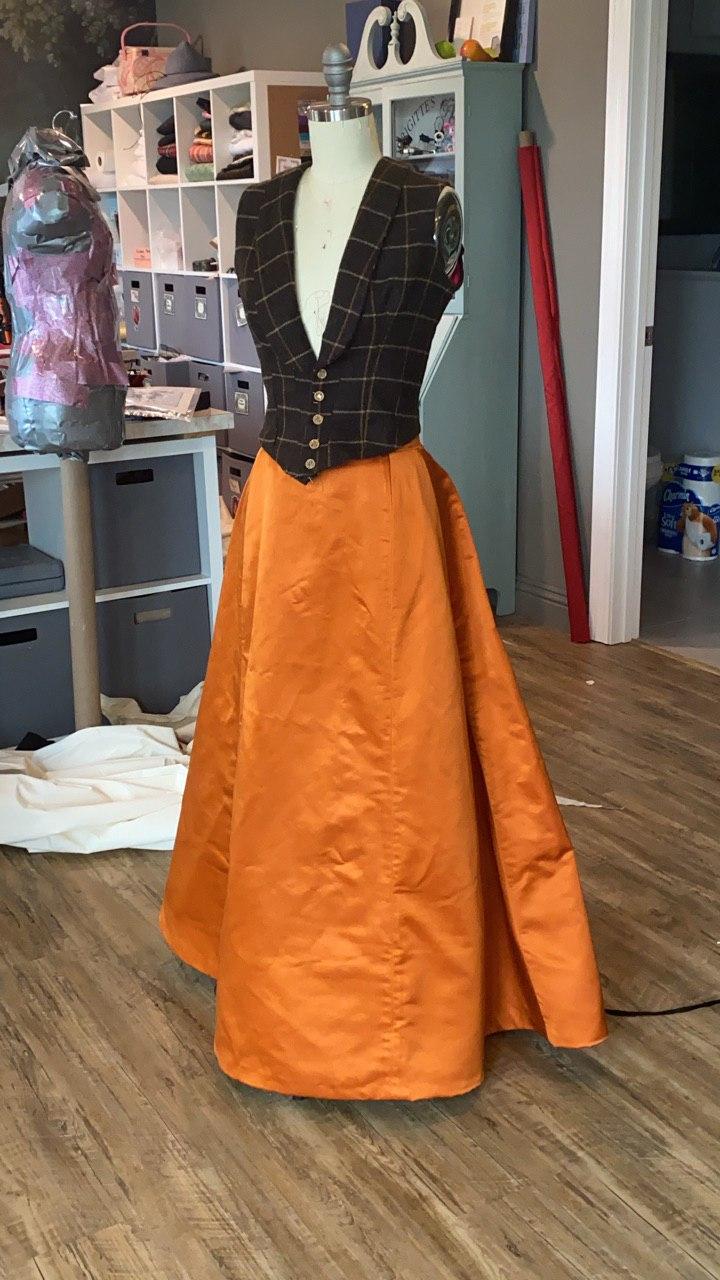
I decided to use Mood’s Burnt Orange silk duchessefor it. Yes. It’s 60 dollars a yard. Yes it’s super fabulous and worth it. Yes, I have a silk problem. THIS is why I’ll never do drugs. My fabric habit is just too overwhelmingly expensive. Just a heads up – for a size D- if your fabric doesn’t have a nap, you only need like 3 yards (I know this from experience). So I got the three yards of this fabulous orange fabric, and I cut out the pieces.

burnt-orange-silk-duchesse-satin-pv9500-15-11

If you’ve ever made a 1890s walking skirt – you know you have to flat line the crap out of it. That ethereal swinging motion of the skirt – the way that it magically floats outwards from your body… that’s all flat lining baby. Originally they had tarlatan. I chose to use cotton twill because I have bolts and bolts of it in the house already and because I blew my budget on silk. WORTH IT!

Afterwards, you need to line the bottom 10-18″ with interfacing. It’s a lot of owrk, but it is essential if you want that floating outwards feeling. The way that the ladies in the past would line it is that they would gentally prick stitch the interfacing onto the flat lined portion, carefully not sewing it to the exterior fabric…

I thought that was a lot of work, so I used iron on horsehair interfacing by pellon. … Yes. You can do that. So I just ironed it on, and I had that magical effect anyway. I’m convinced that if Victorian ladies had iron on interfacing and hem tape, they’d use it as much as I do.

photo_2020-04-07_09-54-07
You’ll notice if you look carefully that at points, I stitched it together, forgot that I forgot the iron on interfacing, and then sloppily ironed it on top… Or maybe you didn’t notice? Hopefully? 😉

Then I started sewing the skirt together.

The beauty of these skirts is how quickly these do come together – once you’ve spent the hours flat lining and interfacing the bottom. Note that the waistband of the skirt is neither flat lined or interfaced.

photo_2020-04-07_09-53-09
Even with just the waistcoat and the underskirt… I love it! I’d totally wear this with a lovely shirtwaist!

So… I forgot to mention, during the making of the waistcoat, I also started stitching together the overskirt.

The overskirt has some really wonderful draping on it. I did a mockup in cotton muslin, and then used the very same muslin as the interfacing for the wool. I wish I had some pictures of this, but I really don’t… But here are some of me wearing the skirt..

So after the skirt was flat lined to the muslin version, I hand hemmed all the edges of the skirt. This was finished long before I finished the underskirt, so you’ll notice that you can see my sweat pants under the skirt.

Once I added a wool waistband to the outfit, the skirt was done!

Now is the big question: How to keep your puffed sleeves puffed?

There isn’t one real answer to this – I’ve heard of people using stuffing, people using fabric bits and folds of tulle… The only thing that is consistent is that people definitely had sewn in sleeve supports. Unlike the 1830s, the sleeve supports were not moved around from garment to garment.

For mine, I chose to buy some lovely sleeve supports from The Boudoir Key on Etsy. On their own, they look like a little set of hoops for your sleeves, which they are! So you sew on the twill tape to the top of the shoulder, and the other (on the bottom) to the armpit. And once you do… that’s it!

Here is an image of the outfit with one sleeve support sewn in. Can you guess which side?

And then… I was done!

Boater hats were all the rage then, and though I don’t have an actual boater meant for this era, I do have a lovely little one from Miss Patina, so I posed with that.

I did order a blouse to wear underneathe – but it hasn’t come in yet… Once I have that, I’ll be putting up more photos. But for now, enjoy!

Thank you so much for reading!

An 1810 Spencer with Faux-Rouleaux

I confess, I don’t love regency. I’m 5’1″, and what they call a “stick” body shape. I found myself drawn to eras that have an exaggerated waist to hip ratio – I’m talking 1760s giant panniers, 1880’s giant bustles, 1890’s bump pads and tiny waists… and regency was just… also a stick. In fact, the first time I asked my husband what he thought of my regency dress, he said, “Is it supposed to just go… straight down?” I damn near threw something at him.

In any case, these outfits aren’t FOR him. They’re for us who want it! Regency does have something going that a lot of other eras do not. The accessories are PHENOMENAL. I love a wonderful regency bonnet, and due to the lack of giant side hoops, women gave up pockets and started carrying little hand bags called reticules. They wear little neck ruffles under their gowns for modesty called chemisettes. Gloves are a must. Chains, jewelry, decorate them everywhere. Tiny little lace up boots cover their adorable feet. They wear little jackets called spencers that are covered with the most wonderful details.

Spencers. That’s what finally talked me into regency.

These are a few of my favorite spencers from the Metropolitan Museum of Art.

You’ll notice they have decorations that look a lot like soutache. It’s actually called rouleaux, where you make tiny tubes out of bias tape of the same fabric, and then sew them on the fabric, into wonderful designs.

I seriously considered doing that myself to make my own spencer, but after seriously considering it, I realized I don’t have the patience. I do think it’s gorgeous and would direct anyone who wants to do it to this website:

Rambling Rouleaux

My friend Hannah, FabricnFiction does such a wonderful job explaining everything step by step. She even goes into tricks on how to make it look neater and prettier.

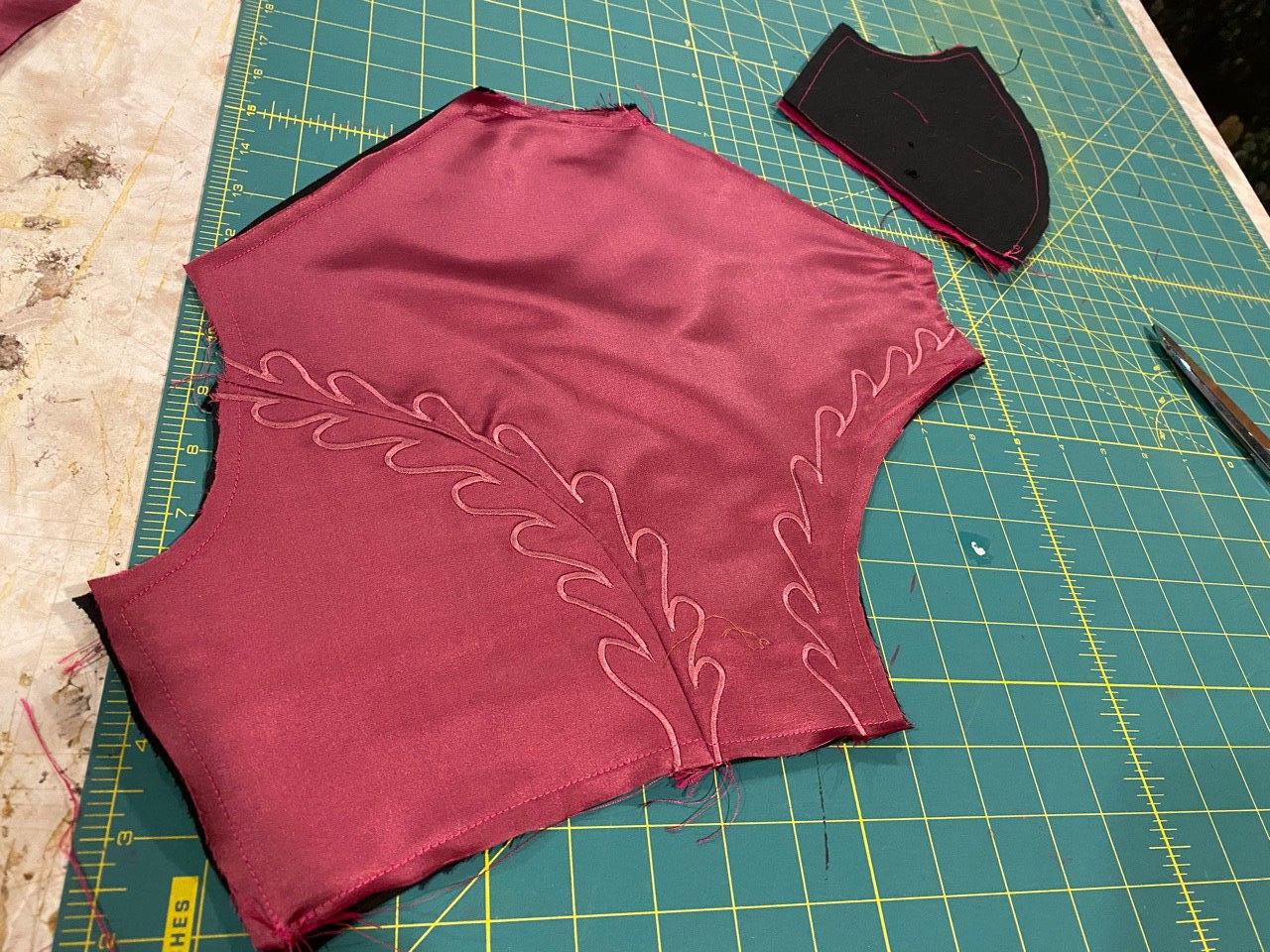
For me, instead of rouleaux, I decided to do a mock soutache out of machine embroidery. To be fair, I see soutache (using a non fabric trim to do the same thing as rouleaux) everywhere in the regency period, such as this lovely pink spencer that was sold by antique-gown.com.

antiquespinksencer

So to get started with machine embroidering a spencer, I had to make the mockup first out of cotton muslin. I used the pattern by black snails, which you can get off heretsy shop. I love that I can print it myself on my printer and just tape it up. I confess, I find it so satisfying when I see the pieces go together so well.

After I made my cotton muslin, I took it off, and used a pencil to draw the design in. After looking at different rouleaux and soutache designs from the period, I picked a design from Godey’s Lady’s Book and Magazine, a periodcal that ran from 1830-1896. Clearly, it’s 20 years too late for the time period I am aiming for (1810), but on the other hand, it’s period “looking” enough, and… I never claimed to be historically accurate anyway, so I ran with it.

5f80fe62efee345c5738ad53258bcb8c


After I drew the image onto the mockup in pencil, I made sure I liked the design. I then cut it up again, penciled in a ruler onto each piece so I knew the scale of the image, and scanned it into my computer.


Then came the digitizing portion. I opened it up in Palette 11, put in the image, and made sure the scale was correct. I used a large running stitch (0.15″ stitches) to pencil in the outline of the seam edge, and then a zig zag stitch using the open curve tool. My stitches were done at a density of 114 stitches/inch, with a zig zag stitch that was 0.12″ wide.

img_2301

I did a quick practice at this point with some pink remnant silks I had in the house. I stitched it out and realized I loved it. 🙂 Please note it’s important to test it at this point since I was wondering if the 0.12″ for the stitch width would be too wide, or perhaps even too narrow, and moreover, how the design would look in real life. Things always change from the screen to printing, so I thought this was a good time to check. Luckily I loved it so I didn’t have to alter anything.

eed77d81-ca05-4f06-ae73-940c2edeb76b

Now, the front isn’t the only portion of this spencer that will be embroidered – there will be embroidery all over the back, collar and sleeves too… I drew out and digitized all those at this point.

Now that I knew I would love it, I started with the final draft. I had this beautiful mauve silk satin that I got from renaissance fabrics a few months back, so I laid out the fabric and drew out the outline of all the pattern peices.

Now when I draw this out, I prefer to use frixion pen or marker, since the lines mostly vanish when you iron it. Please note “mostly vanish” – you can usually see a thin transparent trace of it, so do be careful. It vanishes mostly enough, but this may not be enough for you personally. Please test before you try it on your favorite fabric. You may have some trouble seeing my line – I ran out of black so I ended up using orange on mauve – enough for me to see it, but it didn’t photograph very well.

After drawing in the outline of the pattern pieces, I wanted to put in the line where I would actually be lining up the design to – since the pattern pieces include seam allowance and I want the design to be at the edge of the piece minus the seam allowances (since if the design went right to the edge, it would be destroyed by the seam allowance, if that makes sense). I drwe that secondary line in dotted line.

photo_2020-03-17_10-26-10

Now for silk historic embroidery on garments, to avoid puckering, I personally use tear away interfacing. Here I’m using Baby Lock brand tear away interfacing. I really recommend it since it is strong enough to handle the embroidery but still tears away without too much strain – (it really is a weird Goldilocks issue. Too weak and it doesn’t actually stabilize your stitches. Too strong and it distorts when you tear it away. Ick!)

So giant tip for ME when I’m embroidering these large scale designs – MAKE SURE YOUR HOOP IS TIGHT. Like taut like a drum. I use a cool nifty screwdriver tool to really tighten my hoop. I recommend this little tool as well. (Please note, I don’t get a commission from sharing these links – I don’t even have an amazon affiliate account because I’m too lazy (for now) – so… please know I don’t have a share in sharing these links or products and would honestly not recommend them if I thought they were bad.)

img_2338-1

After tightening the hoop as much as possible, I then actually pull the edges of the fabric around the edge of the hoop and pin them with little extra fine glass head pins to hold the design in place and minimize shrinkage. This may be overkill but I find it helps a lot with my designs.

photo_2020-03-17_10-25-51

I then put the hoop into my embroidery machine (I use a Baby Lock Valiant) and use the scan tool so I can place my design in visually.

For the thread, I use a silk thread by Tire Silk Threads, a Japanese company. I’m afraid there are no silk thread companies in the US. Japan still has it because they actually use silk threads for their kimonos, but the US really doesn’t. :/ It’s a pity but it’s understandable. In any case, their threads are gorgeous, and I try to find a thread that is as close as possible to the fabric color so it mimicks the soutache and rouleaux effect of using similar colors or the exact same fabric.
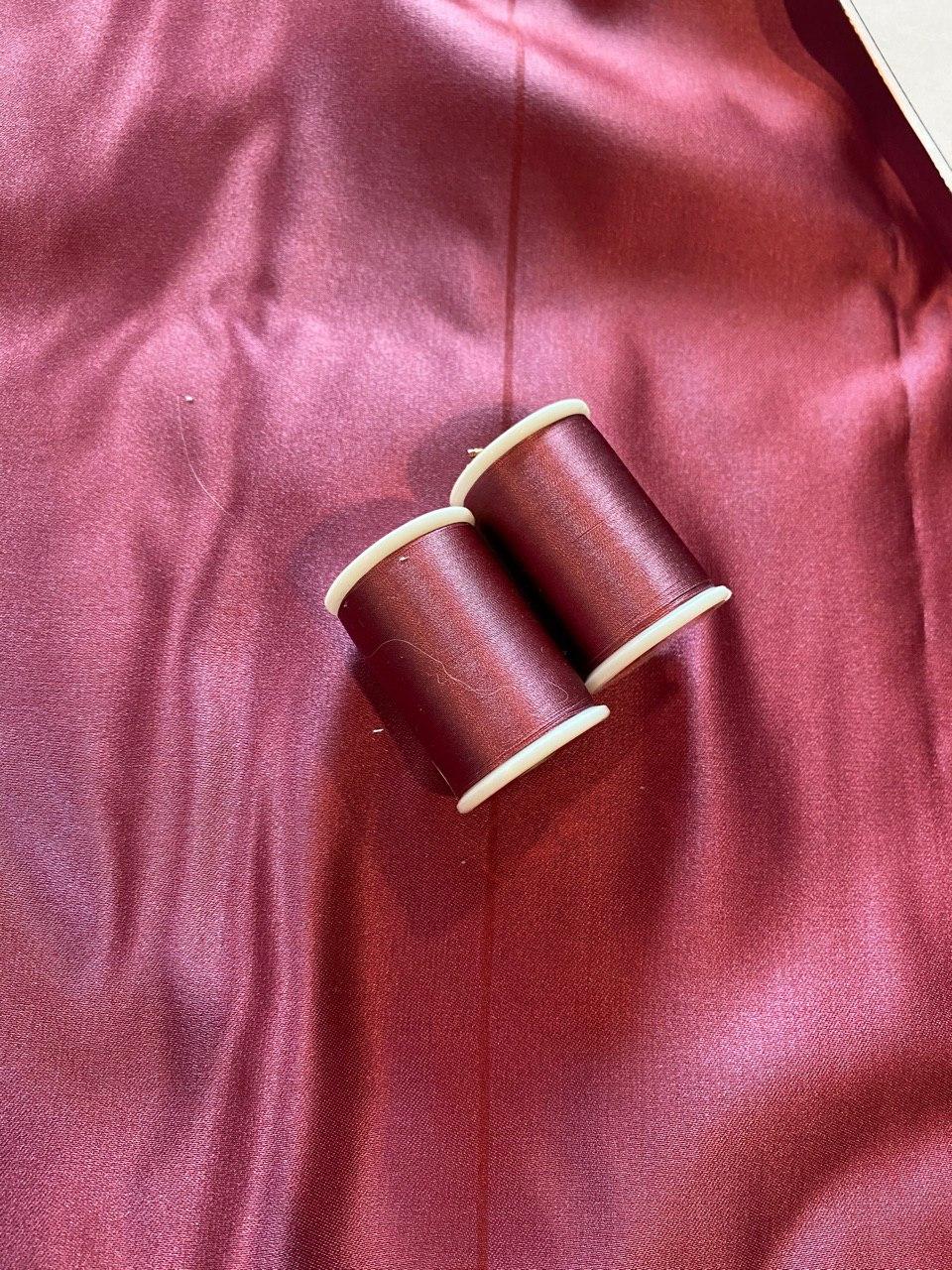
photo_2020-03-17_10-25-55

I stitch out the front.


Then I do the same for the back portions.

This design really doesn’t take too long to stitch out – I would say the front panels are about 40 minutes, and the back panels are about 10 minutes a pop. With the collar pieces, the side pieces and the sleeve pieces, we’re looking at approximately 3 hours total, including prep time for the embroidery – which is NOT bad at all.

After all is embroidered, I sit on the couch and tear away the interfacing- generally, the rule is take out as much as you can. I don’t fuss with every little bit but I do try to tear off as much I can comfortably.

After all that, it’s time to start putting it together. I cut the fabric out using the lines I had drawn out (the copied pattern pieces that included the seam allowances). Since the fabric is fairly flimsy and has a tendency to roll (like all silk satins), I flat lined them to some nice strong cotton twill. Note that I used black because that’s what I had in the house.


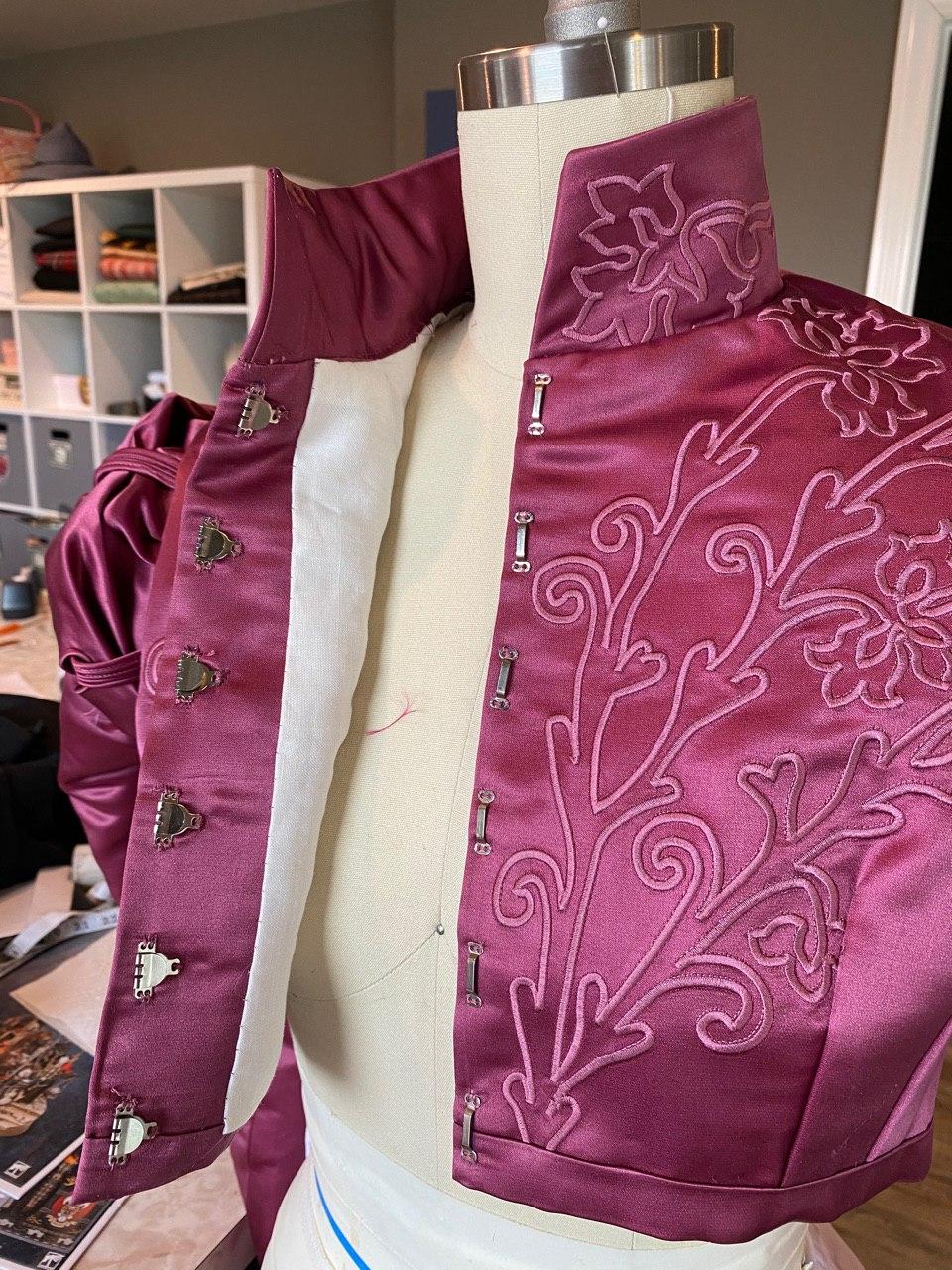
You’ll notice for the front panel, I only flat lined the front to where I would want the buttons to go. If I flat lined it all the way to the front edge, it would be four layers of fabric where the button holes would go and would just be too thick and annoying for me to sew through.

After flat lining, I used the instructions in the pattern to stitch together the bodice. It was so satisfying to see the design come together in the back!

spencer-3

I then sewed the bottom edge of the design to the bottom.

It was time to start the sleeves.
So… I wanted to add little puffed sleeves to mine. It’s hard to describe so I’ll show a spoiler of how it looked at the end here:

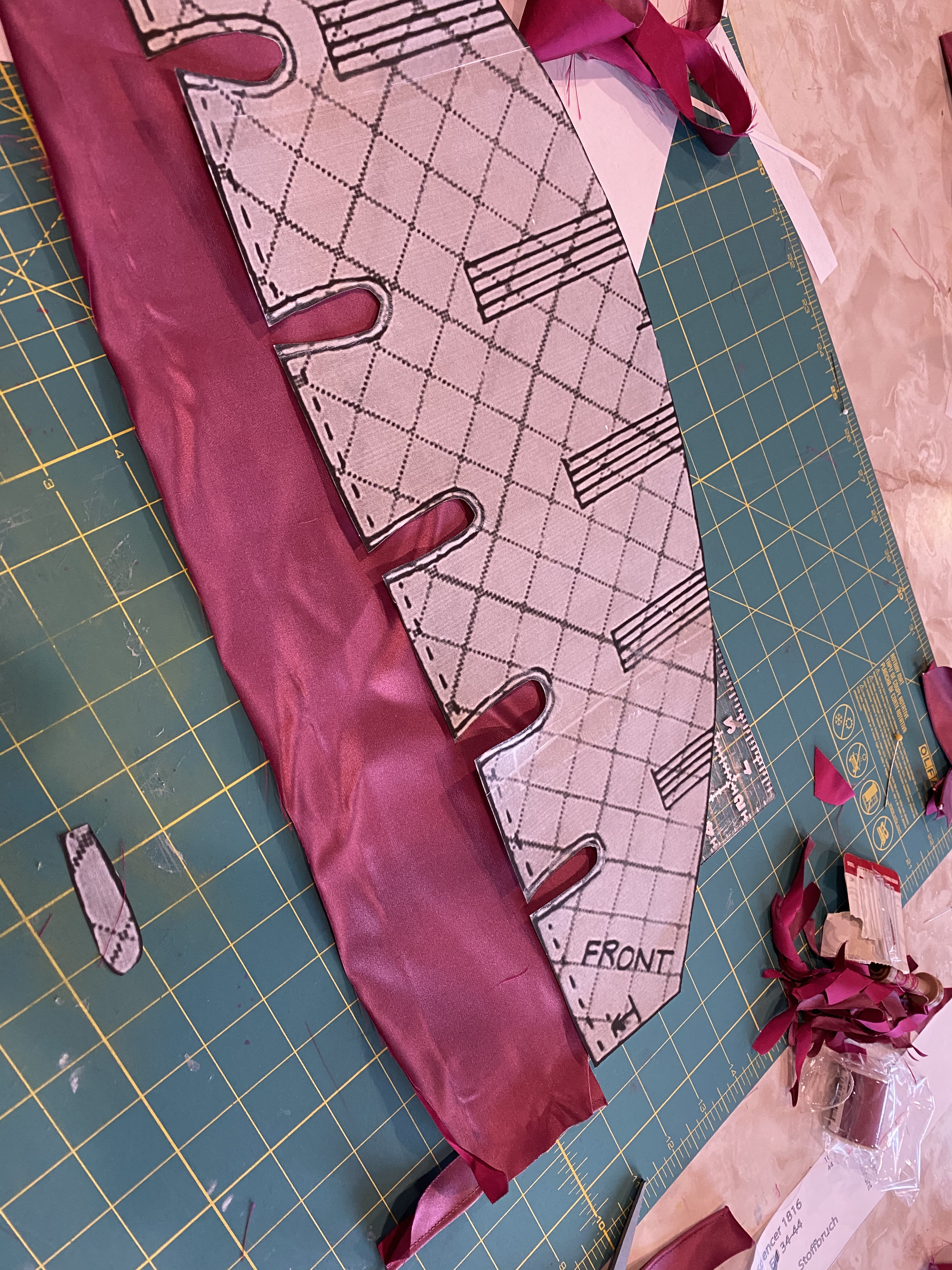
So to start, I made about 12 yards of bias tape 1.5″ wide. Then I used some 2mm gimp I had in the house (but any 2mm cord should do in all honesty), and just made a ton of cording. 12 yards of cording to be exact.

Meanwhile, I got the pattern piece from my book, Janet Arnold’s Patterns of Fashion 1 – and scanned it into my computer. I enlarged it digitally on my computer, and printed it out. I don’t feel comfortable sharing this pattern piece since it’s copyrighted to Janet Arnold but I’ll leave the book link up here. Seriously, if you love this time period and you only own one book, I recommend this one.

After printing out my pattern piece for the sleeve, taping it together (since it was on 3 sheets), and cutting it out, I cut it out of my fashion fabric. Please note that in mine, I forgot to add a seam allowance. To salvage this situation, I used a scant 1/4″ seam allowance on all sides. Don’t be me. Add a seam allowance.
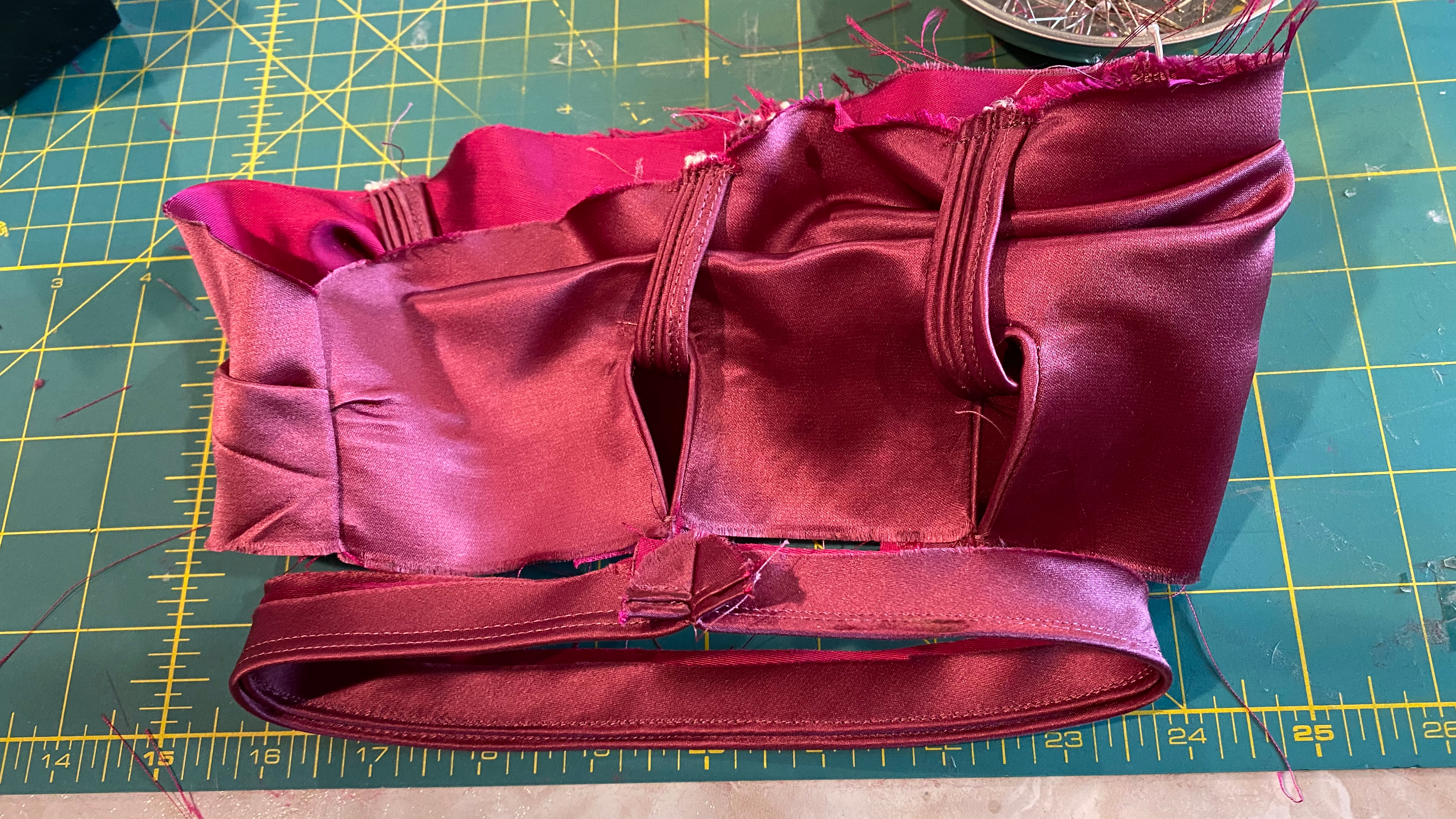
img_2407

I copied the looped areas, and then used my cording that I had already made to cord the areas as seen there. Then I cut the center, ironed it, and used hem tape (3/8″ by Heat and Bond) on the wrong side to sew that down. I’m sure this is historically inaccurate, but it was fast and it gave a nice appearance. Morever, this will NEVER be washed in a machine, so hem tape would be strong enough.

For the loops, I sewed together 4 pieces of cording together, cut the excess fabric off, and hem taped the edge clean. I made 10 pieces of cording – 4x 4″, 4x 5″, and 2x 6″ for the 10 different loops. Since there are 5 loops in each sleeve, the longest (6″) was for the middle, the 5″ for the two flanking the middle, and the shortest (4″) for the two at the ends. I looped everything at this point and machine sewed them together.

Afterwards, I pinched the two ends together and zig zag stitched them on my machine (I get asked this a lot so I’ll just let you know what I use now: Baby Lock Soprano).

Afterwards, I sewed the two ends of the sleeve together. You’ll notice that the two don’t fit together perfectly since the back is longer. This is normal. You’re supposed to put a pleat in somewhere to make the two about the same. For the band along the bottom, I used two cordings sewn together for a double cording. I gathered up the sleeve to fit the band, and then I sewed it with the two right sides together, then flipped it, ironed it, and used self bias tape to clean up the edges.

img_2447-2

img_2464

I then gathered the top, sewed it to the longer sleeve (already sewn together, seams ironed flat, turned inside out, lined, and ready to go), BEFORE i sewed it onto the bodice.

I know I’m showing the same images again but after reading (or scrolling through) all that, I hope you have more respect for how much time and effort this took. 😀

Then I sewed the lining together out of some linen remnants I had lying around the house, ironed it flat, and then pinned it to the inside. For the sleeves, the sleeves are already lined before I add them to the bodice, and I clip the sleeve edging, iron it flat to the bodice, then use the bodice lining to clean the edges.

Using tiny whip stitches, I sew everything together.

Then I used totally not historically accurate clips to the bodice so I could close it up properly.

photo_2020-03-18_13-11-28

And then I was done! It’s actually really hard to appreciate this outfit without the whole of the outfit, so here I am wearing it, complete with bonnet and parasol.

photo_2020-03-18_13-11-08

photo_2020-03-18_13-11-12

Thank you so much for getting all the way down here! As a thank you, The Spencer Embroidery Files are here if you want to make your very own! They’re designed for machines with larger hoops, so it may or may not work on yours. It’s in PES so you may have to convert them. My digital files were made for a pattern size 10, but I’m fairly sure it’ll fit with other sizes – though you may have to adjust the bck to fit the back curve for other sizes.

Please purchase the jacket pattern here from Black Snail Patterns if you want to use the same spencer pattern I used.

photo_2020-03-18_13-11-10


Leaving you with a picture of my dog photobombing my shoot. 🙂


FYI: For those of you interested in my accessories:

My reticule was made by my pattern. The fly fringe was made using instructions from Romantic Recollections.

The Corset I’m wearing is the Redthreaded corset.

I’m wearing American Duchess shoes(not shown).

The fabric for the spencer is from Renaissance fabrics.

The fabric for the gown is from Vaune.com.

The hair piece (bangs) is from Jenny La Fleur.


Pattern for a Reticule based on one at the Rijk Museum


Rijk Museum extant on left, my version on the right.

The pdf download file is here:

Sewstine-Rijk-Reticule-pattern

To print, please open in Adobe Acrobat, go to Print –> Poster (under paper size and handling)

Make sure that the file size is set to 100%

Please note that there is a 1/2″ seam allowance on the file. The lining should be sewn with a 5/8″ seam allowance.

The file does not come with the embroidery instructions or files. Embroidery file can be purchased through my Etsy shop.

For further instructions, please see my video on youtube.

The Sleepy Met Dress (AKA “Sleepy Hollow” dress meets Met Anglaise Dress)

cropped-millar0919024.jpgBelieve it or not, this is actually my fourth attempt to make this dress.

The very first 18th century dress I ever attempted to sew was in college, when I tried to make myself the Sleepy Hollow Dress. What I’m showing you now is truly embarrassing.


AHHHHH! I did absolutely no reading about 18th century clothing before I sewed this dress and it shows. No corset. The front is actually held together by Velcro. I used super heavy upholstery cloth. I didn’t even make a muslin and the waist was about an inch and a half too high.

I got so frustrated with the top that I ended up turning the gown portion into a bolero and an overskirt that I would wear to steampunk fairs. I confess, I did like how it looked for that use.

THAT was my very sad and pathetic first attempt.
But we all have to start somewhere right?

img_0471

The second attempt was four years ago. I used a really cool polyester fabric that had white satin stripes with black velvet ones. Cool fabric that I attempted to make movie accurate. It actually turned out pretty cute and was used in some awesome photoshoots by Carol Lara, who is an amazing photographer with a very modern goth, fantasy point of view. If you want super modern shots, she’s your gal and she made this gown shine to perfection.


The interesting thing is that while I was in love with the Sleepy Hollow black and white striped dress, I was also absolutely mad about the 1780’s gown in the Met, labeled as an “robe a la anglaise”. For the life of me, I have no idea how much I agree with that description because it’s so much more than that. The anglaise portion is a remnant of it’s previous life as a francaise, then remade in a time when Italian gowns (separate tops and skirts sewn together) were so much more popular. And that shows in the construction as well. (Again, not a historian. Let me know if I’m totally wrong here.)

img_2734

However, I hated zone fronts so I remade the dress as an Italian gown. This was done in my second year in residency, and I called it my “Bo Peep” dress. You can see me wearing it here.

img_0629

This year, I decided to combine both of these loves into one dress – the Met/Sleepy Hollow dress or my “HA” Sleepy Hollow dress. (Again, not truly HA since I use machines for linings and longer seams, and I’m at the point in my life where I will admit I will NEVER not do that. I work 80 hours a week and I refuse to spend time doing something by hand JUST so I can say I did it by hand. Especially when a machine will do it just as invisibly and better. That’s not to say I don’t respect all of you who do – I just don’t enjoy it so I don’t want to spend my time doing it.)

I think ALL of us are perpetually looking for that perfect black and white striped fabric. I had these goals in my head:

  1. JET black. Not a dark grey. Not a charcoal. Can’t look light or white in the light.
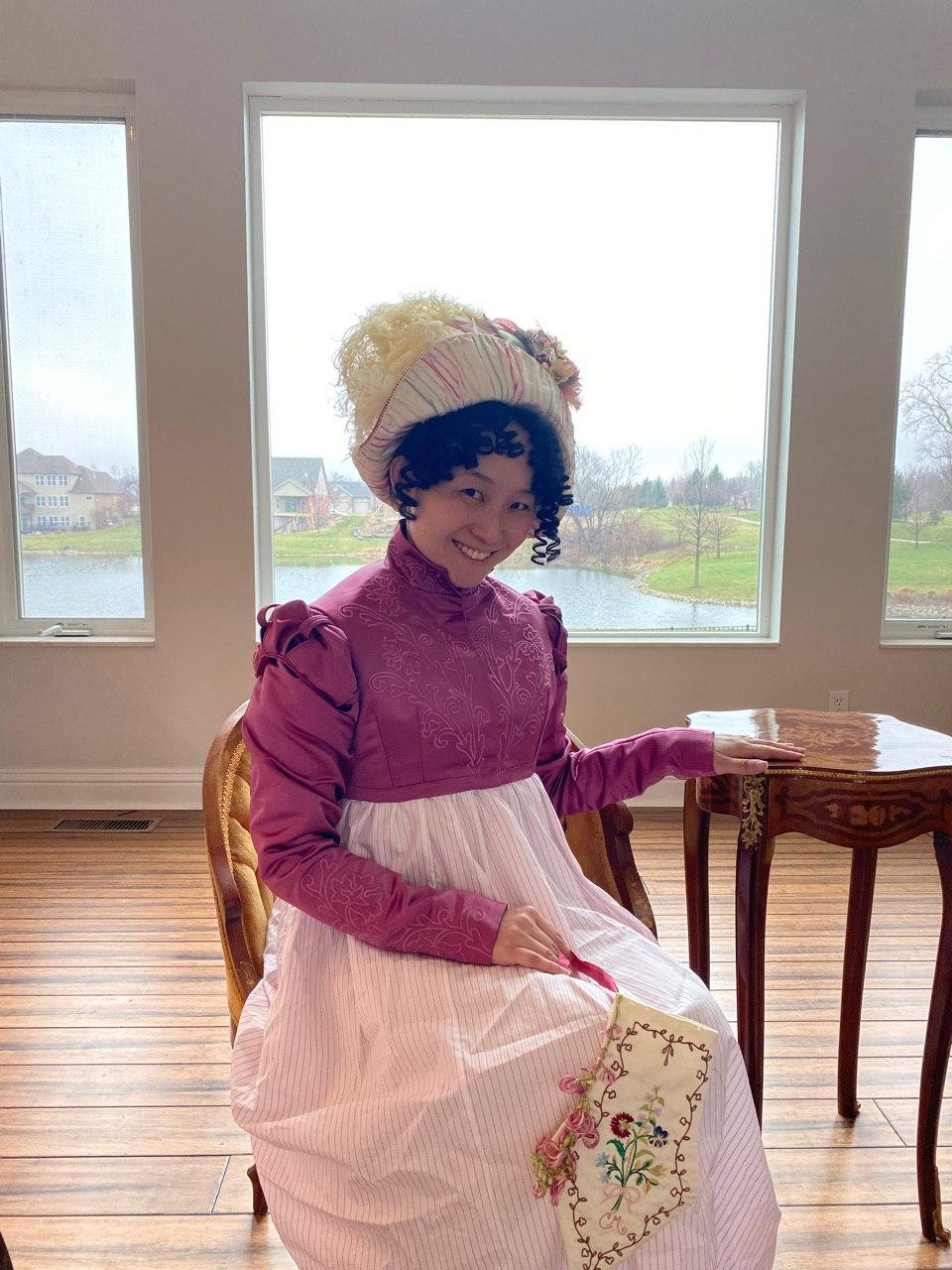
  2. Ivory, not white.
  3. ½” to 1” stripes
  4. 100% silk.
  5. Under $50/yard
  6. Must have 10 yards

The one that I found was a beautiful beige/gold silk taffeta, 44” wide, with ½” black stripes printed onto it. The stripes weren’t woven, but the print was pretty firmly on, so I didn’t mind too much. The price was quite reasonable (less than half of what I had expected to spend). They only had about 9 yards but I decided this was good enough and I got all I could.

Being 4 months pregnant at the time, I decided to postpone this dress til after the pregnancy so I could get it to fit a more normal Stine-figure.

The original goal was to just remake the Sleepy Hollow dress as in the show, complete with non HA trim and lots of shirred chiffon fabric trim. However, then the Met did their “Visitor to Versailles” exhibit while I was 5 months pregnant. I was in NYC for a wedding so I didn’t get to go- not really – but I did manage to pop in for ten minutes… and there it was! THE anglaise that I had so wanted to reproduce in my youth! I took a picture with it, but then had to run out.

img_9165

I didn’t have a chance to take the notes and closeups I wanted and reached out in the wide vastness of the web. I had some amazing people send me photos and notes! I want to give a GIANT shout out and thank you to Lauren of American Duchess who figured out that each stripe was 3/8″ of an inch and sat around COUNTING the stripes so that she could figure out how full the skirt was. I wish I could share her notes and photos but feel uncomfortable publishing someone else’s work. All I can say is… it was amazing. Meanwhile Paul Malcolm, a facebook friend sent me some amazing high resolution photos of the dress from an all angles. This ALSO helped immensely.

And so… the idea for the Sleepy Hollow meets Met Anglaise gown was born. Why NOT make the gown in black and white stripe? Why NOT make it utterly ridiculously Tim Burton? If I hated it, I could always remake it in pink and white stripe later. (Aaaand I love pink so I may still do this.)

I did have to wait a while after pregnancy. It took me about 6 months to go back down to my full pre-pregnancy weight, and on top of that… I had a lot of other stuff I wanted to get to first. What finally made me just sit down and start drafting the pattern was a post on my instagram, where I talked about the first 18th century dress I made.

Seeing that sad creature on my IG made me want to redo it. I spent the next 19 days frantically sewing, in hopes of getting it ready for my photoshoot.

I originally made my pattern via the draping method.


Now, I had no idea this project was a dream project for many. So if you guys want to sew along with me, and use my project as a guide for your own, please do! It would be an honor! To help all of you out, I’m sharing my PDF of my pattern free of charge. You can click below to download it.

Click here to Downloda Pattern Pieces as PDF

FYI: Please note to measure yourself ON TOP of your corset. I used my red threaded 1780’s front lacing synthetic whalebone corset, which has been custom adjusted to my body (somewhere between an XS to a S). With this corset, I have a 31″ bust and a 26″ waist. This pattern is sized to those measurements. I will not be releasing this pattern with any other sizes, and would highly recommend using the drafting method and my lines to make your own if you are different.

Also FYI: This is a PDF. To print, open in whatever pdf viewer, and then go to Print. Click “Poster”, and print at 100% (do not resize), and it should print on your home printer as multiple pages for you to scotch tape together.

Please note that this is a rough guide to sewing this dress. I cite my sources and tell you where to go for the instructions on how to sew this dress – anything further is all up to you.

Sources for instructions:

  • So the back of the original Met gown and the Sleepy Hollow gown is sewn “En fourreau”. I used my knowledge of en fourreau gowns from Larkin and Smith English gown pattern.
  • The rest of the gown is kind of sewn up like an Italian gown. I used the American Duchess instructions “English gown” for that.
  • The pattern does not include sleeve patterns. I used my favorite 18th century sleeve pattern (The JP Ryan Anglaise gown) pattern for the sleeves, but feel free to use your favorite.

In any case, this is how I made mine:

  1. I made a lining out of cotton coutil. I find twill works just as well for this. While the original was almost certainly lined in linen, I find that linen tends to stretch and distort, so I stopped using linen as a lining. I feel vindicated in this, when I found out that Academy Award winner Gwen Russell also uses cotton duck for lining since it olds up better for wearing and rewearing.
  2. Once the lining was on, I started cutting out the back pieces. I used the English Gown pattern instructions to sew the back “En fourreau” style.
  3. I used two different needles with two different threads at the same time to make sure I had the right color thread on the right colored stripe. This was not actually done on the original but I enjoyed doing it this way. 🙂
  4. Now, this may sound weird – but the gown foes from classic anglaise style in the back, to an more of an Italian style gown. (Look at the AD book for the definitions). While pleating up the skirt, I ran into an issue with this. To get around this, I cut a vertical slit, around 4″ long from the top, and folded the gown under the edge of the bodice, and then pleated the rest of the skirt a la the “Italian Gown” instructions in the American Duchess book. If this sounds confusing, don’t worry about it- pleat it however it looks pretty and makes you happy. I have no idea if what I did was HA.
  5. I did line the “flippy flappies” in the front of the gown in linen so that it would act a little more free and less thiff than it would have in the coutil.
  6. The front of the gown is sewn to the sides of the “zone front”.
  7. I used a pinking iron to make the pinks. I finaly found a use for my Monitor magazines! The original pinks were about 3/4″, mine was 1″. I then sewed it on.
  8. To close the gown in front, I just pin it closed using dress pins.


Okies, now that that’s all done, time for fun photos of me wearing the dress!


Photos by Lindsey Hinderer
Makeup by Savannah Summer

Some detail shots, also by Lindsey: